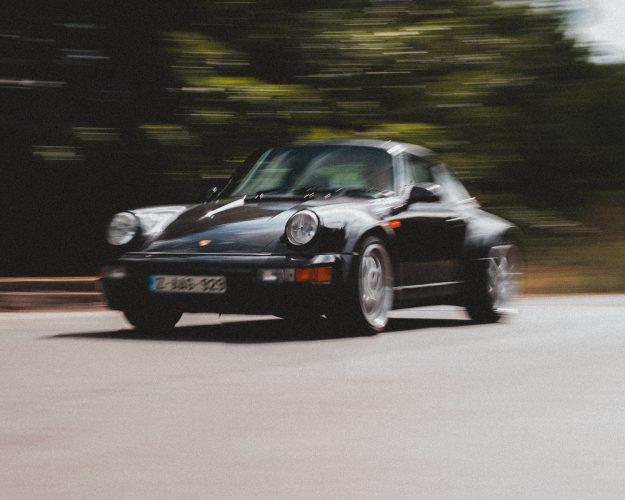
The world of Porsche anti-roll bars is wide and varied. So, before we get into those details, it is worth talking about what they are and what they do. So, without further ado, let’s get into the details.
Anti-roll bars are a key part of a vehicle’s suspension system, designed to reduce body roll during fast cornering or road irregularities. Essentially, they connect the left and right wheels through short, level arms connected by a torsion spring.
When the vehicle leans to one side, the anti-roll bar forces the opposite wheel to compress, reducing the tilt and improving stability.
Would you like to learn more about Porsche anti-roll bars with visuals? Check out this video, where we explain what the part is and does.
Porsche uses several types of anti-roll bars across its model range, each with specific dynamics and performance requirements tailored to the type of vehicle.
Let’s discuss some of them:
Passive Anti-Roll Bars
These are traditional anti-roll bars found in many vehicles. They are simple in design and rely on the torsional stiffness of the bar to resist body roll. The bar twists when the vehicle corners, transferring the load from one side of the vehicle to the other to reduce roll.
Active Anti-Roll Bars (Porsche Dynamic Chassis Control – PDCC)
Porsche’s PDCC system is a significant step up from the passive variant. The system is designed to actively adjust the stiffness of the anti-roll bars to counteract body roll in real time. The concept is similar to how noise cancellation works: it detects the waveform streaming in and lets out an inverse waveform to cancel it out.
There are three specific variants of PDCC found in different Porsche models, including:
Electromechanical PDCC (PDCC Sport)– This variant of anti-roll tech is found in models like the Panamera. It uses electromechanical actuators to adjust the anti-roll bars. The actuators use a direct current motor and a three-stage planetary gear set to twist the anti-roll bar halves in opposite directions to counteract body roll.
Hydraulic PDCC– Used in models like the Cayenne, this system leverages hydraulic actuators to adjust the anti-roll bars. The hydraulic pivot motors build up forces that fight the vehicle’s lateral movement. The system also features an offroad mode, which disengages the anti-roll bar halves to help with traction and axle articulation over irregular surfaces.
PDCC in the 911– This variant uses actively adjustable hydraulic cylinders positioned directly on the wheel suspensions. The design optimizes the sports car’s dynamics and space constraints and provides precision on the road without adding significant weight.
The primary function of an anti-roll bar is to reduce body roll by distributing weight more evenly across the vehicle’s wheels. Let’s break down how they work:
Cornering- When a vehicle corners, the body tends to roll to the outside of the turn due to centrifugal force. The suspension compresses on the outside wheels and extends on the outside wheels.
Torsion– The anti-roll bar, connected to both the left and right wheels, twists as one side of the suspension compresses and the other extends. The twisting action creates a torsional force that resists the roll.
Load transfer– The torsional force generated by the anti-roll bar transfers some of the load from the outside wheel to the inside wheels. This helps keep the vehicle more level and improves stability and traction.
Adjustability– In active systems like PDCC, the stiffness of the anti-roll bars can be adjusted in real-time based on driving conditions. This delivers optimal performance in diverse scenarios, from off-roading to high-speed cornering.
Ensuring that your anti-roll bars perform optimally is a great way to get the full benefits of driving a high-performance car. For Porsche drivers, the benefits include:
Improved handling– Anti-roll bars improve a vehicle’s handling characteristics, making it more responsive and stable when cornering.
Comfort– Active anti-roll bars enhance comfort over irregular surfaces while offering superb cornering ability.
Safety– Reducing body roll helps maintain better contact between the tires and the road, which improves traction and reduces the risk of losing control or skidding.
Versatility– Systems like PDCC offer different modes for driving conditions. An example is the Cayenne, which has an off-road mode for greater axle articulation and improved traction on uneven surfaces.
Over time, Porsche anti-roll bars can break or fail. Common issues include worn-outbushings, broken links, and even cracks in the bar itself.
Here are some of the ways you can tell your anti-roll bar has failed:
You may hear clunking or rattling noises, especially when turning corners or driving over bumps.
There may be excessive body roll and Increased swaying or leaning when cornering.
The steering and handling, especially at higher speeds, may feel loose or not responsive.
You may also notice cracks, corrosion, or worn-out bushings during an inspection.
The fixes for these issues include replacing the bushings, replacing links that are broken or bent, or replacing the entire bar. At Design911, we can help you understand you understand Porsche anti-roll bars and how to keep them performing at a high level.