





Enter your VAT number here and click Verify:
Your details have been verified. VAT number registered to:
,
.
Your order will now be zero rated for VAT purposes. We reserve the right to verify these details after your order request has been made and reinstate VAT if required.
Your VAT details were not recognised or were invalid. Your VAT number must be matched to your Billing Country as specified above. This is currently specified as . You do not need to enter the country code part of your VAT number as this has already been selected in your billing address details above.
The VAT number checking service is currently offline. Please supply your VAT details within the comments or special instructions field below and we will apply a VAT discount after placing your order request.
 Fabspeed
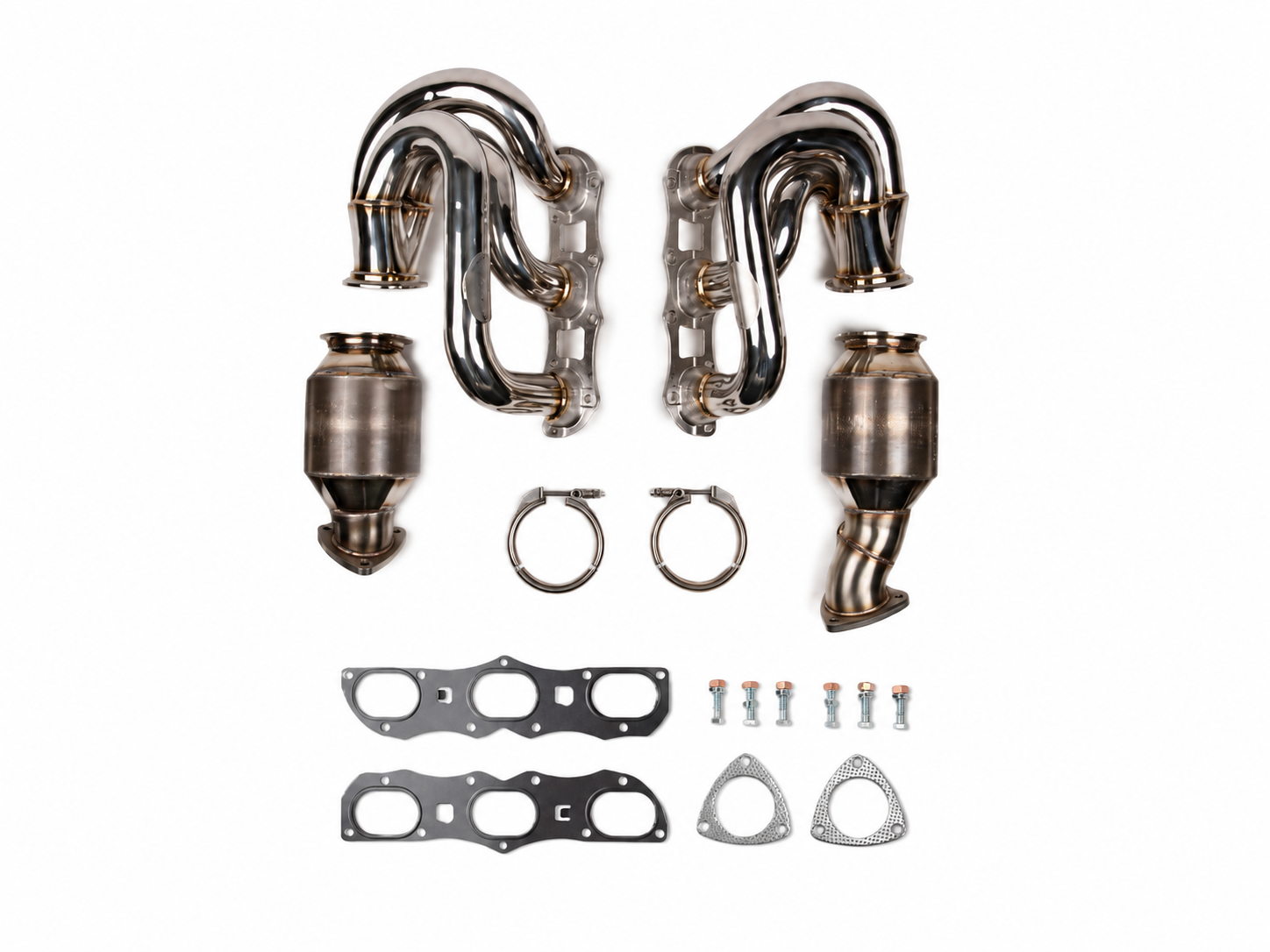
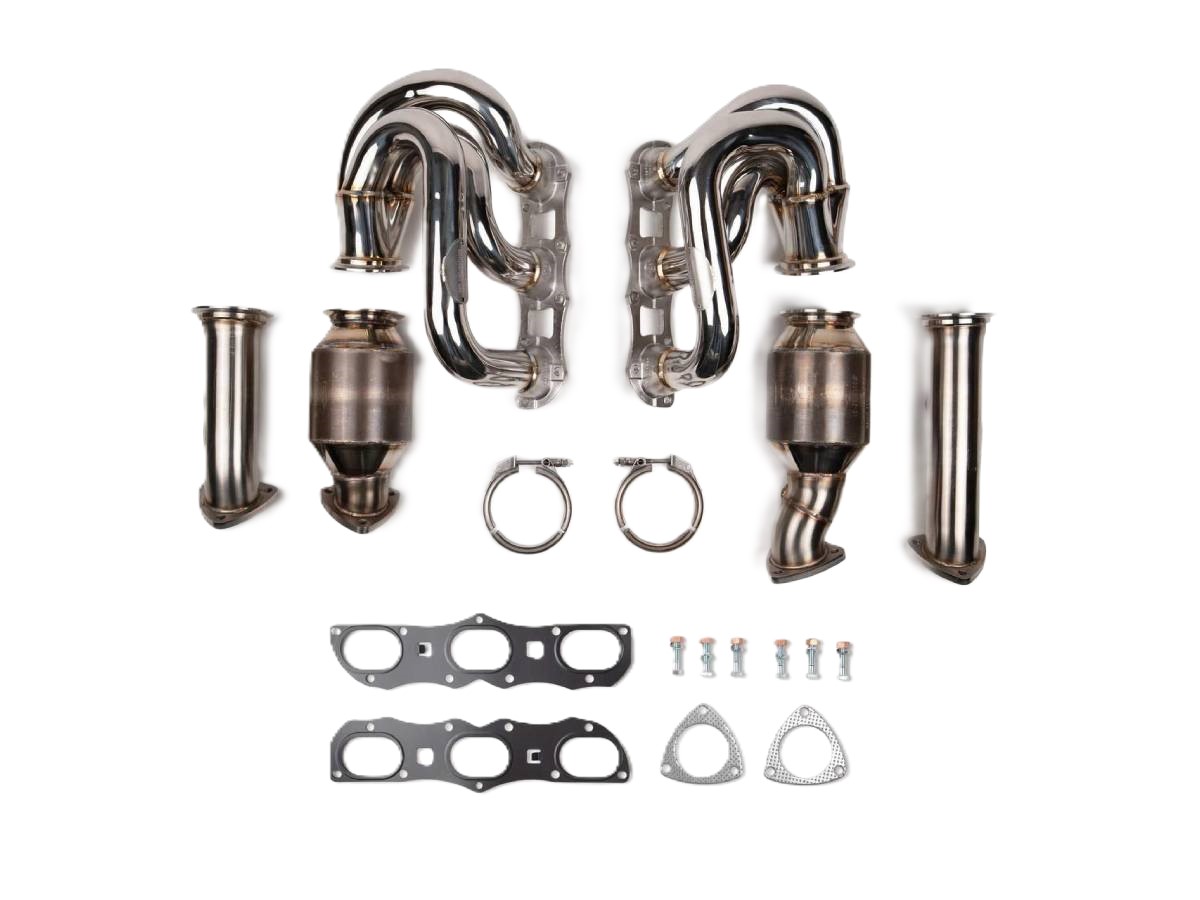
The Fabspeed RENNKRAFT Modular Headers with HJS Catalytic Converters are a high-performance exhaust manifold and catalyst upgrade developed for the Porsche 911 997.2 Carrera.
Fits:
- Porsche 997 MKII Carrera C2 3.6L 2009-12
- Porsche 997 MKII Carrera C4 3.6L 2009-12
Designed to replace the factory header and catalytic-converter assemblies, the system combines freer-flowing tubular headers with German-made HJS HD tri-metallic 200-cell high-flow catalytic converters. The objective is to improve exhaust scavenging, reduce restriction and enhance engine response while retaining catalytic exhaust-gas treatment.
Fabspeed's patented RENNKRAFT modular design uses quick-release V-band connections between the headers and catalyst sections. This allows the HJS sport catalysts to be removed independently if servicing is required and enables compatible QUICKTRACK cat-bypass sections to be installed for appropriate track-only competition use.
The headers are manufactured from CNC mandrel-bent T304L stainless steel and use high-velocity merge collectors designed to improve exhaust-gas scavenging. Fabspeed states performance gains of approximately 25 hp and 20 lb-ft of torque on its development application, although actual results will vary according to vehicle condition, specification, fuel, exhaust configuration and operating conditions.
What This Product Does:
- Replaces the original exhaust manifolds and catalytic-converter sections.
- Improves the path for exhaust gases leaving the cylinder heads.
- Uses performance-oriented merge collectors to improve exhaust scavenging.
- Reduces restriction compared with the standard exhaust arrangement.
- Uses HJS 200-cell high-flow catalysts for improved gas flow.
- Helps improve throttle response and engine breathing.
- Can support increased horsepower and torque.
- Produces a sportier and more defined exhaust note.
- Enhances off-throttle burbles and higher-frequency exhaust tones.
- Retains catalytic exhaust-gas treatment when the HJS sport cats are fitted.
- Provides individually replaceable catalyst sections.
- Uses V-band connections for easier servicing and configuration changes.
- Allows compatible track-only bypass sections to be fitted without replacing the complete header assembly.
- Works with exhaust systems designed to connect to the factory-style Porsche header location.
Fabspeed states that the HJS catalyst configuration flows approximately 90–93% of an equivalent straight pipe, providing high exhaust-flow capacity while retaining a catalytic substrate.
Symptoms Of Wear Or Failure:
The original exhaust system is exposed to continuous heat cycles, vibration, moisture and corrosive exhaust gases. Over time, the manifolds, joints and catalytic converters can deteriorate.
Possible symptoms include:
- Exhaust ticking or tapping noises, especially when cold.
- Exhaust leaks around header flanges or joints.
- Soot deposits around leaking connections.
- Increased exhaust noise.
- Exhaust fumes or unusual smells around the rear of the vehicle.
- Loss of engine performance.
- Poor throttle response.
- Engine feeling restricted at higher RPM.
- Increased fuel consumption.
- Check engine warning light.
- Catalyst-efficiency fault codes.
- Rattling from inside a catalytic converter.
- Metallic noises caused by a loose catalyst substrate.
- Excessive heat around one catalytic converter.
- Failed emissions testing.
- Cracked or damaged exhaust manifolds.
- Corroded exhaust hardware or flanges.
- Damaged catalyst substrate caused by overheating or misfires.
A partially restricted catalytic converter may cause relatively normal operation at low engine speeds but increasingly restrict the engine as airflow demand rises.
Why Replacement Matters:
The exhaust headers and catalytic converters are positioned directly in the path of exhaust gases leaving the engine.
If a manifold develops a leak, exhaust gases can escape before reaching the remainder of the exhaust system. This can affect noise, emissions and engine-management readings.
If a catalytic converter becomes internally damaged or restricted, exhaust backpressure can increase. The engine then has to work harder to push exhaust gases out of the cylinders, potentially reducing performance.
Replacing worn or restrictive components can help restore:
- Efficient exhaust flow.
- Strong throttle response.
- Consistent engine performance.
- Proper catalytic-converter operation.
- Reliable exhaust sealing.
- Correct exhaust sound.
- Reduced unwanted exhaust leakage.
- More effective engine breathing.
A performance header and sport-cat system can also reduce restriction beyond the level offered by the original components.
Related reference numbers
Related, superseded, cross reference or alternative numbers for comparison.
FSPOR9972MHSC
The product you are viewing cross references to these numbers
- Porsche 997 MKII Carrera C2 3.6L 2009-12
- Porsche 997 MKII Carrera C4 3.6L 2009-12
 Shop Securely
 12 Month Warranty
 Worldwide Delivery


Monday-Friday: 8.30am - 5.30pm (GMT)
Saturday: Closed
Sunday: Closed