





Enter your VAT number here and click Verify:
Your details have been verified. VAT number registered to:
,
.
Your order will now be zero rated for VAT purposes. We reserve the right to verify these details after your order request has been made and reinstate VAT if required.
Your VAT details were not recognised or were invalid. Your VAT number must be matched to your Billing Country as specified above. This is currently specified as . You do not need to enter the country code part of your VAT number as this has already been selected in your billing address details above.
The VAT number checking service is currently offline. Please supply your VAT details within the comments or special instructions field below and we will apply a VAT discount after placing your order request.

- Accessories
- Brakes
- Chassis / Bodywork
- Clothing & Gifts
- Electrical & Relays
- Engine Cooling
- Engine Electrical
- Engine Rebuild Parts
- Engine Tuning
- Exhausts
- Exterior Styling / Spoilers
- Gearbox / Transmission
- Heating / Air Conditioning
- Hydraulics
- Incar / Multimedia
- Interior & Accessories
- Lighting
- Mats & Carpets
- Motorsport and Off-Road
- Parts for Other Cars
- Pedal Cluster
- Rubber Seals
- Seats & Seat Belts
- Service Parts
- Special Offer Parts
- Steering Parts
- Suspension & Axle
- Suspension Upgrades
- Tyres
- Wheel Accessories
- Wheels
 Fabspeed
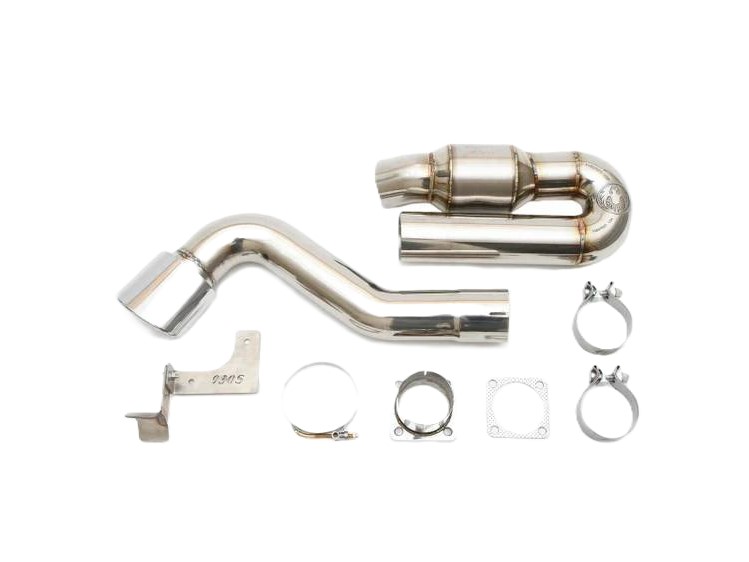
The Fabspeed Sport Muffler Bypass Exhaust System with Catalyst is a performance-focused exhaust upgrade designed for the 1976–1989 Porsche 911 Turbo / 930.
Fits:
- Porsche 911 1976-1977 3.0L Turbo (930)
- Porsche 911 1978-1989 3.3L Turbo (930)
The system replaces the heavier and more restrictive factory muffler arrangement with a freer-flowing single-outlet muffler bypass system incorporating a high-flow HJS Sport Catalytic Converter.
Constructed from 14–16 gauge T304 stainless steel, the system uses large 3.0-inch / 76.5mm CNC mandrel-bent tubing to provide a smoother, less restrictive route for exhaust gases leaving the turbocharger.
A Deluxe Oval Style Tip in polished chrome is included, providing a distinctive finished appearance at the rear of the vehicle.
Fabspeed states that the system is designed to improve horsepower and torque while reducing weight compared with the bulky factory muffler system. Specific horsepower, torque and weight figures are currently listed by Fabspeed as TBD.
What This Product Does:
The exhaust system carries combustion gases away from the engine and turbocharger while controlling exhaust noise, flow and emissions.
On the Porsche 930's turbocharged engine, exhaust gases leaving the turbine must pass through the catalytic converter, muffler and associated pipework before exiting the vehicle.
The Fabspeed system replaces the conventional rear muffler with a more direct bypass arrangement, helping reduce restriction downstream of the turbocharger.
Its main functions and benefits include:
- Improving exhaust gas flow
- Reducing post-turbo exhaust restriction
- Eliminating the bulky factory muffler
- Supporting improved throttle response
- Supporting increased horsepower and torque
- Reducing rear exhaust-system weight
- Producing a louder and more aggressive turbocharged exhaust note
- Providing a high-flow catalytic converter
- Replacing ageing factory exhaust components
- Improving corrosion resistance through stainless-steel construction
Because the muffler is bypassed, the system provides a considerably more direct and performance-focused exhaust character than the standard arrangement.
Symptoms Of Wear Or Failure:
The original exhaust components on a Porsche 930 may now be several decades old. Repeated heating and cooling cycles, condensation, vibration and corrosion can gradually deteriorate mufflers, catalytic converters and pipework.
Common symptoms include:
- Rust or corrosion on the exhaust system
- Cracks around pipes, seams or welds
- Exhaust blowing or hissing noises
- Black soot around leaking connections
- Loose or damaged exhaust clamps
- Rattling from the muffler
- Metallic rattling from the catalytic converter
- Excessively loud or irregular exhaust noise
- Exhaust fumes around the rear of the vehicle
- Damaged or weakened mounting points
- Reduced throttle response
- Reduced engine performance
- Increased turbo lag
- Excessive exhaust restriction
- Sulphur-like or unusual exhaust smells
- Visible damage or deformation of exhaust components
Internal muffler components can also deteriorate and become loose, producing rattling or obstructing exhaust flow.
Why Replacement Matters:
A damaged or restrictive exhaust system can affect both performance and reliability.
Leaks can allow hot exhaust gases to escape before reaching the intended outlet. This may expose surrounding engine or body components to unnecessary heat and create excessive noise.
Corrosion can also weaken pipework and mounting points until sections of the exhaust become loose or fail.
A damaged catalytic converter can be particularly restrictive if the internal substrate begins to break down or collapse.
On a turbocharged Porsche 930, excessive restriction downstream of the turbocharger can work against efficient exhaust evacuation. This may contribute to:
- Slower turbo response
- Reduced throttle response
- Loss of engine performance
- Increased exhaust temperatures
Replacing deteriorated exhaust components restores a secure and unobstructed exhaust path.
For vehicles with a serviceable standard exhaust, fitting the Fabspeed system provides the additional benefits of reduced restriction, lower weight and a considerably more aggressive exhaust sound.
NOTE: In the United Kingdom, sports catalytic converters and bypass pipes do not have type approval and are not legally permitted for use on vehicles manufactured after 1st March 2001. They are not MOT compliant and cannot be used on public roads. These components are intended solely for race and track use.
For vehicles manufactured before 1st March 2001, a non-type approved sports catalytic converter may be fitted, provided it offers comparable performance to the original and the vehicle continues to meet the applicable emissions standards for its age. The vehicle must still pass an MOT test.
If you are located outside the UK, please check your local laws and regulations to ensure compliance.
Related reference numbers
Related, superseded, cross reference or alternative numbers for comparison.
FSPOR911TSCMBE
The product you are viewing cross references to these numbers
- Porsche 911 1975-1977 3.0L Turbo (930)
- Porsche 911 1978-1989 3.3L Turbo (930)
 Shop Securely
 12 Month Warranty
 Worldwide Delivery


Monday-Friday: 8.30am - 5.30pm (GMT)
Saturday: Closed
Sunday: Closed