





Enter your VAT number here and click Verify:
Your details have been verified. VAT number registered to:
,
.
Your order will now be zero rated for VAT purposes. We reserve the right to verify these details after your order request has been made and reinstate VAT if required.
Your VAT details were not recognised or were invalid. Your VAT number must be matched to your Billing Country as specified above. This is currently specified as . You do not need to enter the country code part of your VAT number as this has already been selected in your billing address details above.
The VAT number checking service is currently offline. Please supply your VAT details within the comments or special instructions field below and we will apply a VAT discount after placing your order request.

Your Vehicle // Porsche // Cayenne 92A (958) 2010-2017 // Any

- Accessories
- Brakes
- Chassis / Bodywork
- Clothing & Gifts
- Electrical & Relays
- Engine Cooling
- Engine Electrical
- Engine Rebuild Parts
- Engine Tuning
- Exhausts
- Exterior Styling / Spoilers
- Gearbox / Transmission
- Heating / Air Conditioning
- Hydraulics
- Incar / Multimedia
- Interior & Accessories
- Lighting
- Mats & Carpets
- Motorsport and Off-Road
- Parts for Other Cars
- Pedal Cluster
- Rubber Seals
- Seats & Seat Belts
- Service Parts
- Special Offer Parts
- Steering Parts
- Suspension & Axle
- Suspension Upgrades
- Tyres
- Wheel Accessories
- Wheels
Fuel Injectors

Fuel Injector Engine Kit – Upper and Lower
Engine set of Fuel Injectors
The upper and lower fuel injectors are designed for the Porsche Cayenne
3.6ltr engine used in both the 957 and 958 generation models. This injector
plays a critical role in delivering the precise amount of fuel into the engine
for efficient combustion, smooth running and optimal performance.
Fits:
- Porsche 957 Cayenne 3.6L 2007-10
- Porsche 958 Cayenne V6 3.6L Petrol (300Hp) 2010-17
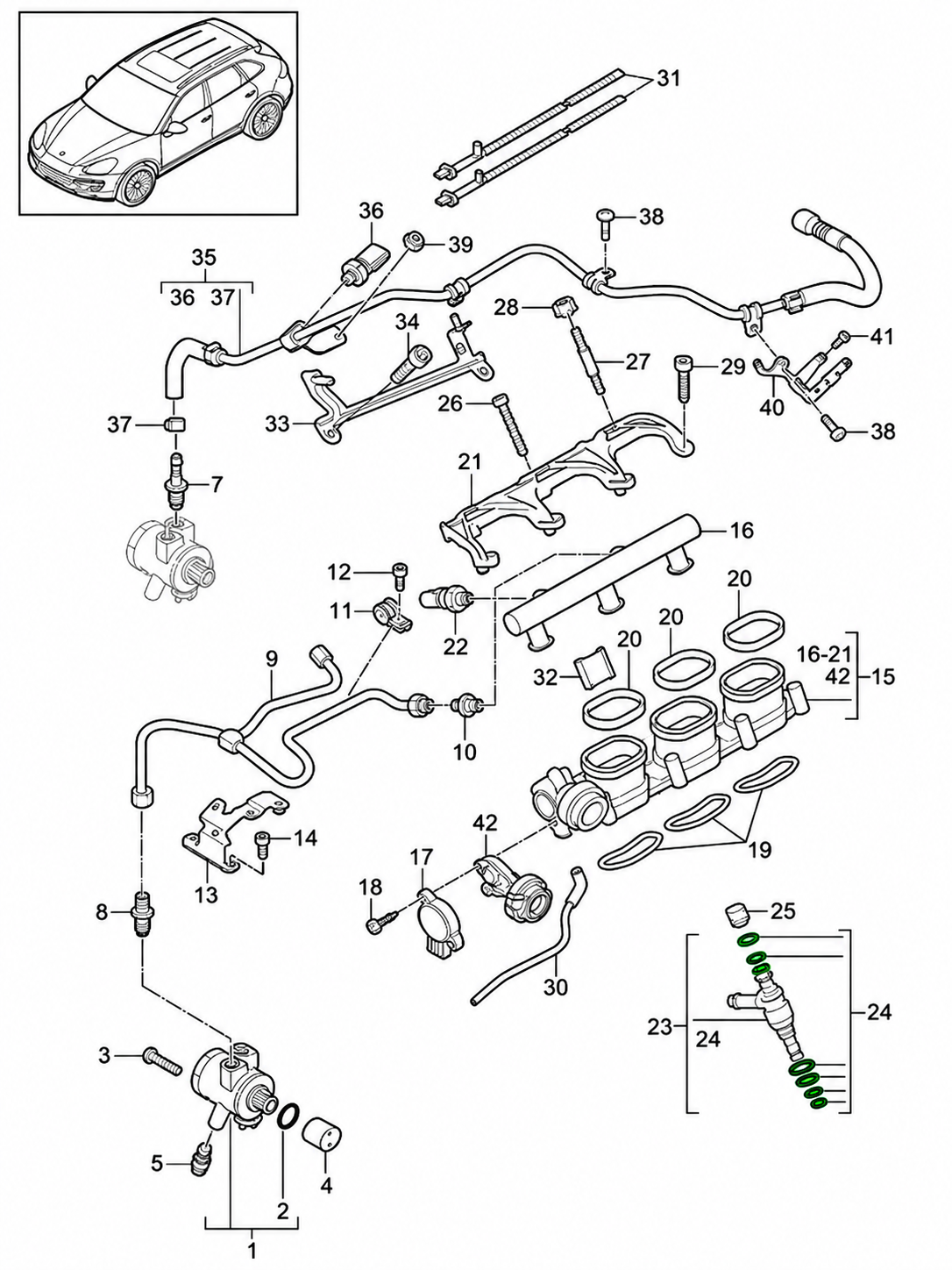
Diagram Ref No 6 and 7
In modern fuel injection systems, accurate fuel delivery is essential for maintaining power, fuel efficiency and emissions control. If an injector becomes clogged, worn or electrically faulty, it can significantly affect how the engine runs.
What This Fuel Injector Does
The fuel injector delivers a finely atomised spray of fuel into the engine’s intake system or combustion chamber. This precise fuel delivery allows the engine management system to maintain the correct air-fuel mixture.
Properly functioning injectors help ensure:
• Smooth engine operation
• Efficient fuel combustion
• Consistent power delivery
• Reduced emissions
• Reliable starting and idle performance
Because the injector must operate with precise timing and pressure, even small issues can quickly lead to noticeable engine problems.
Why Fuel Injectors Fail
Fuel injectors operate under demanding conditions and are exposed to heat, fuel pressure and contaminants over time. Common causes of injector failure include:
Carbon and deposit build-up
Fuel residues and carbon deposits can clog the injector nozzle, affecting spray
pattern and fuel flow.
Internal wear
Over time, the internal valve mechanism can wear, leading to inconsistent fuel
delivery.
Electrical faults
The injector solenoid may fail, preventing proper opening and closing during
operation.
Fuel contamination
Debris or poor fuel quality can damage injector components and restrict fuel
flow.
When these issues occur, the injector may deliver too much or too little fuel, resulting in poor engine performance.
Symptoms of a Faulty Cayenne Fuel Injector
• Engine misfires or rough idle
• Hesitation during acceleration
• Poor fuel economy
• Strong fuel smell from exhaust
• Check engine warning light
• Difficulty starting the engine
If left unresolved, faulty injectors can also damage catalytic converters and other emissions components.
Why You May Need to Replace the Lower Injector
Restoring proper fuel delivery is essential to keeping the Porsche Cayenne 3.6 running smoothly. Replacing worn or blocked injectors helps:
• Restore smooth engine performance
• Improve fuel efficiency
• Eliminate misfires and hesitation
• Protect engine components from incorrect fuelling
• Maintain correct emissions levels
Replacing a faulty injector early helps prevent more expensive engine or exhaust system repairs.
Related reference numbers
Related, superseded, cross reference or alternative numbers for comparison.
PAB906036
The product you are viewing cross references to these numbers

- Porsche 957 Cayenne 3.6L 2007-10
- Porsche 958 Cayenne S V6 3.6L (400Hp) Petrol 2010-17

Fuel Injector Kit – Lower
Engine set for Lower Injectors
The lower fuel injector is designed for the Porsche Cayenne
3.6ltr engine used in both the 957 and 958 generation models. This injector
plays a critical role in delivering the precise amount of fuel into the engine
for efficient combustion, smooth running and optimal performance.
Fits:
- Porsche 957 Cayenne 3.6L 2007-10
- Porsche 958 Cayenne V6 3.6L Petrol (300Hp) 2010-17
Diagram Ref No 6
In modern fuel injection systems, accurate fuel delivery is essential for maintaining power, fuel efficiency and emissions control. If an injector becomes clogged, worn or electrically faulty, it can significantly affect how the engine runs.
What This Fuel Injector Does
The fuel injector delivers a finely atomised spray of fuel into the engine’s intake system or combustion chamber. This precise fuel delivery allows the engine management system to maintain the correct air-fuel mixture.
Properly functioning injectors help ensure:
• Smooth engine operation
• Efficient fuel combustion
• Consistent power delivery
• Reduced emissions
• Reliable starting and idle performance
Because the injector must operate with precise timing and pressure, even small issues can quickly lead to noticeable engine problems.
Why Fuel Injectors Fail
Fuel injectors operate under demanding conditions and are exposed to heat, fuel pressure and contaminants over time. Common causes of injector failure include:
Carbon and deposit build-up
Fuel residues and carbon deposits can clog the injector nozzle, affecting spray
pattern and fuel flow.
Internal wear
Over time, the internal valve mechanism can wear, leading to inconsistent fuel
delivery.
Electrical faults
The injector solenoid may fail, preventing proper opening and closing during
operation.
Fuel contamination
Debris or poor fuel quality can damage injector components and restrict fuel
flow.
When these issues occur, the injector may deliver too much or too little fuel, resulting in poor engine performance.
Symptoms of a Faulty Cayenne Fuel Injector
• Engine misfires or rough idle
• Hesitation during acceleration
• Poor fuel economy
• Strong fuel smell from exhaust
• Check engine warning light
• Difficulty starting the engine
If left unresolved, faulty injectors can also damage catalytic converters and other emissions components.
Why You May Need to Replace the Lower Injector
Restoring proper fuel delivery is essential to keeping the Porsche Cayenne 3.6 running smoothly. Replacing worn or blocked injectors helps:
• Restore smooth engine performance
• Improve fuel efficiency
• Eliminate misfires and hesitation
• Protect engine components from incorrect fuelling
• Maintain correct emissions levels
Replacing a faulty injector early helps prevent more expensive engine or exhaust system repairs.
Related reference numbers
Related, superseded, cross reference or alternative numbers for comparison.
PAB906036H
The product you are viewing cross references to these numbers
- Porsche 957 Cayenne 3.6L 2007-10
- Porsche 958 Cayenne S V6 3.6L (400Hp) Petrol 2010-17

Fuel Injector Kit – Upper
Engine set for Upper Injectors
The upper fuel injector is designed for the Porsche Cayenne
3.6ltr engine used in both the 957 and 958 generation models. This injector
plays a critical role in delivering the precise amount of fuel into the engine
for efficient combustion, smooth running and optimal performance.
Fits:
- Porsche 957 Cayenne 3.6L 2007-10
- Porsche 958 Cayenne V6 3.6L Petrol (300Hp) 2010-17
Diagram Ref No 7
In modern fuel injection systems, accurate fuel delivery is essential for maintaining power, fuel efficiency and emissions control. If an injector becomes clogged, worn or electrically faulty, it can significantly affect how the engine runs.
What This Fuel Injector Does
The fuel injector delivers a finely atomised spray of fuel into the engine’s intake system or combustion chamber. This precise fuel delivery allows the engine management system to maintain the correct air-fuel mixture.
Properly functioning injectors help ensure:
• Smooth engine operation
• Efficient fuel combustion
• Consistent power delivery
• Reduced emissions
• Reliable starting and idle performance
Because the injector must operate with precise timing and pressure, even small issues can quickly lead to noticeable engine problems.
Why Fuel Injectors Fail
Fuel injectors operate under demanding conditions and are exposed to heat, fuel pressure and contaminants over time. Common causes of injector failure include:
Carbon and deposit build-up
Fuel residues and carbon deposits can clog the injector nozzle, affecting spray
pattern and fuel flow.
Internal wear
Over time, the internal valve mechanism can wear, leading to inconsistent fuel
delivery.
Electrical faults
The injector solenoid may fail, preventing proper opening and closing during
operation.
Fuel contamination
Debris or poor fuel quality can damage injector components and restrict fuel
flow.
When these issues occur, the injector may deliver too much or too little fuel, resulting in poor engine performance.
Symptoms of a Faulty Cayenne Fuel Injector
• Engine misfires or rough idle
• Hesitation during acceleration
• Poor fuel economy
• Strong fuel smell from exhaust
• Check engine warning light
• Difficulty starting the engine
If left unresolved, faulty injectors can also damage catalytic converters and other emissions components.
Why You May Need to Replace the Lower Injector
Restoring proper fuel delivery is essential to keeping the Porsche Cayenne 3.6 running smoothly. Replacing worn or blocked injectors helps:
• Restore smooth engine performance
• Improve fuel efficiency
• Eliminate misfires and hesitation
• Protect engine components from incorrect fuelling
• Maintain correct emissions levels
Replacing a faulty injector early helps prevent more expensive engine or exhaust system repairs.
Related reference numbers
Related, superseded, cross reference or alternative numbers for comparison.
PAB906036J
The product you are viewing cross references to these numbers
- Porsche 957 Cayenne 3.6L 2007-10
- Porsche 958 Cayenne S V6 3.6L (400Hp) Petrol 2010-17

Fits:
Porsche 958 Cayenne 3.0L V6 DIESEL 2012>>
(Engine type: CRCA / CRCB)
Click 'Zoom in' for large parts diagram.
Diagram ref no 6
Related reference numbers
Related, superseded, cross reference or alternative numbers for comparison.
95811012811
The product you are viewing cross references to these numbers

- Porsche 958 Cayenne V6 3.0L Diesel (245Hp) 2010-17


Fits:
Porsche 957 Cayenne 3.6L 2008-10
Porsche 958 Cayenne 3.6L 2011-17
Click 'Zoom in' for large parts diagram.
Diagram ref no 8
Related reference numbers
Related, superseded, cross reference or alternative numbers for comparison.
95511091000
The product you are viewing cross references to these numbers
- Porsche 957 Cayenne 3.6L 2007-10
- Porsche 958 Cayenne S V6 3.6L (400Hp) Petrol 2010-17
 Shop Securely
 12 Month Warranty
 Worldwide Delivery


The OE Match lower fuel injector gasket set is for resealing the lower high-pressure injector installation, it provides replacement sealing components for injector servicing and repairs where the existing seals require renewal.
Fits
- Porsche 957 Cayenne 3.6L VR6 2008–10
- Porsche 958 Cayenne 3.6L VR6 2011-2018
Check fitment for your specific vehicle (model, year, engine) before ordering.
Diagram ref no 8
Required Quantity
Three gasket sets are specified for the lower high-pressure injector positions in the applicable fuel-injection assembly.
What Is This Part?
This is a gasket set for the lower injector application within the engine's high-pressure fuel-injection assembly. That assembly includes the fuel collection pipes, high-pressure injectors and associated fuel lines. The gasket set services the sealing interfaces around the lower injector installation when worn or disturbed seals need replacing. Correct identification matters because the assembly also uses a separate gasket set for the upper injector application.
What Does This Part Do?
- Seals the injector installation: Provides replacement sealing components at the specified lower injector position.
- Supports resealing work: Allows deteriorated or damaged injector seals to be renewed during an appropriate repair.
- Services the correct application: Matches the lower injector sealing arrangement identified for the listed engines.
Why Replace This Part?
Injector seals may need replacement if inspection reveals deterioration, damage or leakage at the sealing interface. A seal that is cut, distorted or no longer seats correctly cannot be relied upon to seal simply by refitting it. The adjoining injector and sealing surfaces should also be checked, as replacing seals alone will not correct a damaged mating surface.
During injector removal or related engine work, assess the seals and follow the applicable workshop renewal instructions. Rough running, hard starting or fuel odours warrant diagnosis, but do not by themselves establish that this gasket set is the cause. Internal injector faults, electrical problems and leaks elsewhere in the fuel system require different repairs.
When to Replace This Part?
- Visible seal damage: Cuts, splitting, distortion or deterioration found during dismantling.
- Confirmed interface leakage: Inspection identifies leakage at a sealing point serviced by this set.
- Poor seating: An existing seal is displaced or cannot sit correctly in its intended position.
- Removal and refitting: The vehicle-specific workshop procedure requires seal renewal after the injector has been removed.
- Persistent running symptoms: Investigate rough idle, misfires or hard starting before deciding whether injector seals need replacement.
Where Is This Part Fitted?
Location: At the lower high-pressure injector installation in the engine's fuel-injection assembly, alongside the fuel collection pipe and injector connections. Match the lower injector application rather than selecting solely by engine capacity.
FAQs
- Will new seals fix a faulty injector? They can address a confirmed sealing fault, but will not repair an injector's internal electrical or fuel-metering fault.
- Should I order from a fault code alone? No. Fault codes guide diagnosis; confirm the affected component and the source of any leakage first.
- What should be checked during fitting? Check the injector, seal seating areas and associated connections for damage or contamination, and use the correct vehicle-specific installation procedure
Product Summary
- Product: Fuel injector gasket set for the lower injector application.
- Brand: OE Match.
- Reference: 95511091000.
- Purpose: Renewal of the specified injector sealing interfaces during servicing or repair.
Related reference numbers
Related, superseded, cross reference or alternative numbers for comparison.
95511091000
The product you are viewing cross references to these numbers
- Porsche 957 Cayenne 3.6L 2007-10
- Porsche 958 Cayenne S V6 3.6L (400Hp) Petrol 2010-17
Shop Securely
12 Month Warranty
Worldwide Delivery

OE Match upper fuel injector gasket set. It provides replacement sealing components for the upper high-pressure injector connection during injector resealing and repair.
Fits
- Porsche 957 Cayenne 3.6L 2008–10
- Porsche 958 Cayenne 3.6L 2011–17
Check fitment for your specific vehicle (model, year, engine) before ordering.
Diagram ref no 9
Required Quantity
Three upper gasket sets are specified for the fuel collection pipe and high-pressure injector assembly
What Is This Part?
This gasket set services the upper sealing position of the high-pressure fuel injector. It belongs to the fuel collection pipe and injector assembly, where the injector connects to its fuel supply. The sealing components form part of that connection rather than the injector's electrical control or fuel-metering mechanism. It is intended for sealing repairs and injector refitting work, with the exact replacement procedure determined by the engine application.
What Does This Part Do?
- Seals the upper connection: Provides the sealing components used at the upper injector position.
- Supports injector resealing: Allows the upper sealing components to be renewed when servicing the injector assembly.
- Works with the fuel collection pipe: Forms part of the sealing arrangement between the fuel supply assembly and injector.
Why Replace This Part?
Renew the upper sealing components if inspection confirms damage, deterioration or leakage at their connection. A seal that is cut, distorted or no longer seats correctly should not be relied upon during reassembly. Inspect the adjoining injector and connection as well, because damaged mating surfaces or an incorrectly seated injector may also need attention.
Injector removal is another important repair context. High-pressure injector servicing requires renewal of the sealing and service components specified by the applicable repair instructions, even when the injector itself is being reused. Follow the engine-specific procedure rather than assuming the removed seals can be refitted.
When to Replace This Part?
- Visible seal damage: Cuts, splits, distortion or deterioration found during dismantling.
- Confirmed connection leakage: Fuel dampness or a fuel smell traced to the upper injector sealing position.
- Poor seating: A displaced or damaged seal that prevents correct assembly.
- Injector servicing: When the applicable removal and refitting instructions specify new upper sealing components.
- Persistent running symptoms: Rough idle, misfires or hard starting warrant diagnosis; they do not by themselves confirm that this gasket set needs replacement.
Where Is This Part Fitted?
Location: At the upper high-pressure injector position within the engine's fuel collection pipe and injector assembly.
FAQs
- Will new seals repair a faulty injector? They address the sealing connection. Injector clogging, electrical faults or internal leakage require separate diagnosis.
- Can the old seals be reused after injector removal? Follow the engine-specific repair instructions. High-pressure injector service guidance calls for replacement of the specified sealing and service components when an injector is removed and reused.
- What should be checked before fitting? Check the injector seating area and mating connection, and keep dirt out of the assembly during installation.
- Are special fitting procedures important? Yes. Use the applicable repair instructions and appropriate tools; high-pressure injector seals can require different handling depending on their position and design.
Product Summary
- Product: Upper fuel injector gasket set.
- Brand: OE Match.
- Purpose: Renews the upper injector sealing components.
- Fitted position: Upper high-pressure injector connection in the fuel collection pipe assembly.
Related reference numbers
Related, superseded, cross reference or alternative numbers for comparison.
95511091100
The product you are viewing cross references to these numbers
- Porsche 957 Cayenne 3.6L 2007-10
- Porsche 958 Cayenne S V6 3.6L (400Hp) Petrol 2010-17
Shop Securely
12 Month Warranty
Worldwide Delivery

Fits:
Porsche 957 Cayenne 3.6L 2008-10
Porsche 958 Cayenne 3.6L 2011-17
Click 'Zoom in' for large parts diagram.
Diagram ref no 9
Related reference numbers
Related, superseded, cross reference or alternative numbers for comparison.
95511091100
The product you are viewing cross references to these numbers
- Porsche 957 Cayenne 3.6L 2007-10
- Porsche 958 Cayenne S V6 3.6L (400Hp) Petrol 2010-17
Shop Securely
12 Month Warranty
Worldwide Delivery

Fits:
Porsche 958 Cayenne 3.0L HYBRID 2011-18
Porsche 970 Panamera 3.0L HYBRID 2011-16
Click 'Zoom in' for large parts diagram.
Diagram ref no 24
Related reference numbers
Related, superseded, cross reference or alternative numbers for comparison.
95811090102
The product you are viewing cross references to these numbers
- Porsche 958 Cayenne S V6 3.0L Hybrid (380Hp) 2010-17
- Porsche 970.1 Panamera S Hybrid V6 3.0L 2011-13
- Porsche 970.2 Panamera S E-Hybrid V6 3.0L (416Hp) 2014-16
Shop Securely
12 Month Warranty
Worldwide Delivery

Fuel Injector – Lower
Sold each – 3 required per car
The lower fuel injector is designed for the Porsche Cayenne
3.6ltr engine used in both the 957 and 958 generation models. This injector
plays a critical role in delivering the precise amount of fuel into the engine
for efficient combustion, smooth running and optimal performance.
Fits:
- Porsche 957 Cayenne 3.6L 2007-10
- Porsche 958 Cayenne V6 3.6L Petrol (300Hp) 2010-17
Diagram Ref No 6
In modern fuel injection systems, accurate fuel delivery is essential for maintaining power, fuel efficiency and emissions control. If an injector becomes clogged, worn or electrically faulty, it can significantly affect how the engine runs.
What This Fuel Injector Does
The fuel injector delivers a finely atomised spray of fuel into the engine’s intake system or combustion chamber. This precise fuel delivery allows the engine management system to maintain the correct air-fuel mixture.
Properly functioning injectors help ensure:
• Smooth engine operation
• Efficient fuel combustion
• Consistent power delivery
• Reduced emissions
• Reliable starting and idle performance
Because the injector must operate with precise timing and pressure, even small issues can quickly lead to noticeable engine problems.
Why Fuel Injectors Fail
Fuel injectors operate under demanding conditions and are exposed to heat, fuel pressure and contaminants over time. Common causes of injector failure include:
Carbon and deposit build-up
Fuel residues and carbon deposits can clog the injector nozzle, affecting spray
pattern and fuel flow.
Internal wear
Over time, the internal valve mechanism can wear, leading to inconsistent fuel
delivery.
Electrical faults
The injector solenoid may fail, preventing proper opening and closing during
operation.
Fuel contamination
Debris or poor fuel quality can damage injector components and restrict fuel
flow.
When these issues occur, the injector may deliver too much or too little fuel, resulting in poor engine performance.
Symptoms of a Faulty Cayenne Fuel Injector
• Engine misfires or rough idle
• Hesitation during acceleration
• Poor fuel economy
• Strong fuel smell from exhaust
• Check engine warning light
• Difficulty starting the engine
If left unresolved, faulty injectors can also damage catalytic converters and other emissions components.
Why You May Need to Replace the Lower Injector
Restoring proper fuel delivery is essential to keeping the Porsche Cayenne 3.6 running smoothly. Replacing worn or blocked injectors helps:
• Restore smooth engine performance
• Improve fuel efficiency
• Eliminate misfires and hesitation
• Protect engine components from incorrect fuelling
• Maintain correct emissions levels
Replacing a faulty injector early helps prevent more expensive engine or exhaust system repairs.
Related reference numbers
Related, superseded, cross reference or alternative numbers for comparison.
PAB906036H
The product you are viewing cross references to these numbers
- Porsche 957 Cayenne 3.6L 2007-10
- Porsche 958 Cayenne S V6 3.6L (400Hp) Petrol 2010-17
Shop Securely
12 Month Warranty
Worldwide Delivery

The Porsche Fuel Injector O-Ring, 2.8 x 1.5 is a genuine replacement sealing component designed to provide a secure, leak-free seal between the fuel injector and the fuel rail or engine assembly on compatible Porsche models. Manufactured to OE specifications for fit, sealing performance and durability, this precision-engineered O-ring helps maintain correct fuel system pressure while preventing fuel leaks and the ingress of dirt or air into the fuel system.
Sold Each.
x6 Required Per Engine.
Fits:
- Porsche 957 Cayenne 3.0L Diesel 2007-10
- Porsche 958 Cayenne V6 3.0L Diesel (245Hp) 2010-17
- Porsche 970.1 Panamera Diesel V6 3.0L 2011-13
- Porsche 970.2 Panamera Diesel V6 3.0L (250Hp) 2014-16
- Porsche 971.1 Panamera 4S Diesel V8 4.0L 4WD (422 Hp) 2017-18
- Porsche 971.1 Panamera 4S Diesel 4.0L Twin-Turbo V8 Sport Turismo 2017-18
- Porsche 95B.1 Macan S Diesel 3.0L V6 (258Bhp) 2014-18
Diagram Ref No 9
Manufactured from high-quality fuel-resistant elastomer, the O-ring is engineered to withstand constant exposure to petrol, high fuel pressures, engine heat and repeated thermal cycling without hardening, cracking or losing elasticity. Precision-sized to the original Porsche dimensions, it provides direct OE-style fitment and reliable sealing performance during injector installation, servicing or engine repairs.
What This Product Does:
- Creates a leak-free seal around the fuel injector.
- Maintains correct fuel system pressure.
- Prevents fuel leaks between the injector and its mounting point.
- Helps prevent air entering the fuel system.
- Protects surrounding engine components from fuel contamination.
- Supports efficient fuel delivery and engine performance.
- Restores factory sealing performance.
- Forms an essential part of the fuel injection system.
Symptoms Of Wear Or Failure:
- Fuel smell from the engine bay.
- Visible fuel leaks around the injector.
- Difficult engine starting.
- Rough idle or engine misfires.
- Reduced engine performance.
- Increased fuel consumption.
- Loss of fuel pressure.
- Cracked, flattened or hardened O-ring.
- Fuel system fault codes.
- Increased fire risk due to fuel leakage.
Why Replacement Matters:
- The fuel injector O-ring is continually exposed to fuel, high operating temperatures and pressure fluctuations. Over time, the sealing material can harden, shrink, crack or become compressed, reducing its ability to maintain an effective seal around the injector.
- A worn or damaged O-ring can allow fuel to leak from the injector, reducing fuel system pressure and affecting engine performance. Fuel leaks within the engine bay also present a significant safety hazard and may damage surrounding components if left unresolved.
- Replacing the O-ring whenever a fuel injector is removed or serviced helps ensure a secure, leak-free fuel system. The genuine Fuel Injector O-Ring is manufactured to OE standards using premium fuel-resistant materials, providing factory-style fitment, dependable sealing performance and long-lasting durability, helping maintain the safety, efficiency and reliability expected from your Porsche.
Related reference numbers
Related, superseded, cross reference or alternative numbers for comparison.
95800748010
The product you are viewing cross references to these numbers
- Porsche 957 Cayenne 3.0L Diesel 2007-10
- Porsche 958 Cayenne V6 3.0L Diesel (245Hp) 2010-17
- Porsche 970.1 Panamera Diesel V6 3.0L 2011-13
- Porsche 970.2 Panamera Diesel V6 3.0L (250Hp) 2014-16
- Porsche 971.1 Panamera 4S Diesel V8 4.0L 4WD (422 Hp) 2017-18
- Porsche 971.1 Panamera 4S Diesel 4.0L Twin-Turbo V8 Sport Turismo 2017-18
- Porsche 95B.1 Macan S Diesel 3.0L V6 (258Bhp) 2014-18
Shop Securely
12 Month Warranty
Worldwide Delivery
The OE MATCH Fuel Injector O-Ring, 2.8 x 1.5 is a replacement sealing component designed to provide a secure, leak-free seal between the fuel injector and the fuel rail or engine assembly on compatible Porsche models. Manufactured to OE specifications for fit, sealing performance and durability, this precision-engineered O-ring helps maintain correct fuel system pressure while preventing fuel leaks and the ingress of dirt or air into the fuel system.
Sold Each.
x6 Required Per Engine.
Fits:
- Porsche 957 Cayenne 3.0L Diesel 2007-10
- Porsche 958 Cayenne V6 3.0L Diesel (245Hp) 2010-17
- Porsche 970.1 Panamera Diesel V6 3.0L 2011-13
- Porsche 970.2 Panamera Diesel V6 3.0L (250Hp) 2014-16
- Porsche 971.1 Panamera 4S Diesel V8 4.0L 4WD (422 Hp) 2017-18
- Porsche 971.1 Panamera 4S Diesel 4.0L Twin-Turbo V8 Sport Turismo 2017-18
- Porsche 95B.1 Macan S Diesel 3.0L V6 (258Bhp) 2014-18
Diagram Ref No 9
Manufactured from high-quality fuel-resistant elastomer, the O-ring is engineered to withstand constant exposure to petrol, high fuel pressures, engine heat and repeated thermal cycling without hardening, cracking or losing elasticity. Precision-sized to the original Porsche dimensions, it provides direct OE-style fitment and reliable sealing performance during injector installation, servicing or engine repairs.
What This Product Does:
- Creates a leak-free seal around the fuel injector.
- Maintains correct fuel system pressure.
- Prevents fuel leaks between the injector and its mounting point.
- Helps prevent air entering the fuel system.
- Protects surrounding engine components from fuel contamination.
- Supports efficient fuel delivery and engine performance.
- Restores factory sealing performance.
- Forms an essential part of the fuel injection system.
Symptoms Of Wear Or Failure:
- Fuel smell from the engine bay.
- Visible fuel leaks around the injector.
- Difficult engine starting.
- Rough idle or engine misfires.
- Reduced engine performance.
- Increased fuel consumption.
- Loss of fuel pressure.
- Cracked, flattened or hardened O-ring.
- Fuel system fault codes.
- Increased fire risk due to fuel leakage.
Why Replacement Matters:
- The fuel injector O-ring is continually exposed to fuel, high operating temperatures and pressure fluctuations. Over time, the sealing material can harden, shrink, crack or become compressed, reducing its ability to maintain an effective seal around the injector.
- A worn or damaged O-ring can allow fuel to leak from the injector, reducing fuel system pressure and affecting engine performance. Fuel leaks within the engine bay also present a significant safety hazard and may damage surrounding components if left unresolved.
- Replacing the O-ring whenever a fuel injector is removed or serviced helps ensure a secure, leak-free fuel system. The OE MATCH Fuel Injector O-Ring is manufactured to OE standards using premium fuel-resistant materials, providing factory-style fitment, dependable sealing performance and long-lasting durability, helping maintain the safety, efficiency and reliability expected from your Porsche.
Related reference numbers
Related, superseded, cross reference or alternative numbers for comparison.
95800748010
The product you are viewing cross references to these numbers
- Porsche 957 Cayenne 3.0L Diesel 2007-10
- Porsche 958 Cayenne V6 3.0L Diesel (245Hp) 2010-17
- Porsche 970.1 Panamera Diesel V6 3.0L 2011-13
- Porsche 970.2 Panamera Diesel V6 3.0L (250Hp) 2014-16
- Porsche 971.1 Panamera 4S Diesel V8 4.0L 4WD (422 Hp) 2017-18
- Porsche 971.1 Panamera 4S Diesel 4.0L Twin-Turbo V8 Sport Turismo 2017-18
- Porsche 95B.1 Macan S Diesel 3.0L V6 (258Bhp) 2014-18
Shop Securely
12 Month Warranty
Worldwide Delivery

The OE Match fuel injector seal ring set is for injector sealing repairs on Porsche 958 Cayenne and 970 Panamera 3.0L Hybrid applications. It contains three sealing rings for renewing the seals around an injector during appropriate repair or removal and refitting work.
Fits
- Porsche 958 Cayenne 3.0L HYBRID 2011–18
- Porsche 970 Panamera 3.0L HYBRID 2011–16
Check fitment for your specific vehicle (model, year, engine) before ordering.
Required Quantity
Six injector seal sets are required for the complete six-injector arrangement on the applicable 3.0L Hybrid engine.
What Is This Part?
This is a set of sealing rings used around a fuel injector in the petrol engine's high-pressure injection assembly. The injector sits between the fuel supply and the combustion chamber, with seals maintaining separation at its connections and seating points. These rings are service parts for the injector installation; they do not control fuel metering or correct an injector's electrical or internal mechanical faults. Renewing the appropriate seals is part of reassembling an injector correctly after a sealing repair or other work requiring its removal.
What Does This Part Do?
- Seals injector interfaces: The rings form seals at the injector's designated sealing points.
- Maintains separation: Correctly seated seals help prevent leakage across the interfaces they are intended to seal.
- Supports injector refitting: Replacement rings allow damaged or disturbed seals to be renewed during reassembly.
Why Replace This Part?
Injector seals may need replacing when inspection finds cuts, flattening, distortion or other deterioration that prevents correct seating. Heat exposure and removal or installation can affect sealing condition, so the rings and their mating surfaces should be checked whenever the injector is disturbed. Follow the engine-specific repair procedure for seals that must be renewed after removal.
A sealing repair should follow diagnosis of the actual leak. Fuel odour, rough running or starting difficulties can have several causes, including injector faults, fuel connections and ignition problems. New seals will not repair a damaged injector body, worn sealing seat or defective fuel line.
When to Replace This Part?
- Visible seal damage: A ring is split, nicked, distorted or no longer seats correctly.
- Confirmed leakage: Inspection identifies leakage at an injector sealing interface.
- Removal damage: A seal is damaged while extracting or refitting an injector.
- Specified renewal: The relevant workshop procedure requires new seals after injector removal.
- Repeat sealing trouble: Inspect the injector, sealing grooves and mating surfaces before fitting another set.
Where Is This Part Fitted?
Location: Around the petrol engine's high-pressure fuel injectors, at their sealing interfaces within the fuel rail and cylinder-head installation.
Technical Details
- Number of sealing rings: 3.
Product Summary
- Product: Fuel injector seal ring set.
- Brand: OE Match.
- Purpose: Renewal of injector sealing rings during diagnosed sealing repairs or specified refitting work.
Related reference numbers
Related, superseded, cross reference or alternative numbers for comparison.
95811090102
The product you are viewing cross references to these numbers
- Porsche 958 Cayenne S V6 3.0L Hybrid (380Hp) 2010-17
- Porsche 970.1 Panamera S Hybrid V6 3.0L 2011-13
- Porsche 970.2 Panamera S E-Hybrid V6 3.0L (416Hp) 2014-16
Shop Securely
12 Month Warranty
Worldwide Delivery

Fuel Injector – Upper
Sold each – 3 required per car
The upper fuel injector is designed for the Porsche Cayenne
3.6ltr engine used in both the 957 and 958 generation models. This injector
plays a critical role in delivering the precise amount of fuel into the engine
for efficient combustion, smooth running and optimal performance.
Fits:
- Porsche 957 Cayenne 3.6L 2007-10
- Porsche 958 Cayenne V6 3.6L Petrol (300Hp) 2010-17
Diagram Ref No 7
In modern fuel injection systems, accurate fuel delivery is essential for maintaining power, fuel efficiency and emissions control. If an injector becomes clogged, worn or electrically faulty, it can significantly affect how the engine runs.
What This Fuel Injector Does
The fuel injector delivers a finely atomised spray of fuel into the engine’s intake system or combustion chamber. This precise fuel delivery allows the engine management system to maintain the correct air-fuel mixture.
Properly functioning injectors help ensure:
• Smooth engine operation
• Efficient fuel combustion
• Consistent power delivery
• Reduced emissions
• Reliable starting and idle performance
Because the injector must operate with precise timing and pressure, even small issues can quickly lead to noticeable engine problems.
Why Fuel Injectors Fail
Fuel injectors operate under demanding conditions and are exposed to heat, fuel pressure and contaminants over time. Common causes of injector failure include:
Carbon and deposit build-up
Fuel residues and carbon deposits can clog the injector nozzle, affecting spray
pattern and fuel flow.
Internal wear
Over time, the internal valve mechanism can wear, leading to inconsistent fuel
delivery.
Electrical faults
The injector solenoid may fail, preventing proper opening and closing during
operation.
Fuel contamination
Debris or poor fuel quality can damage injector components and restrict fuel
flow.
When these issues occur, the injector may deliver too much or too little fuel, resulting in poor engine performance.
Symptoms of a Faulty Cayenne Fuel Injector
• Engine misfires or rough idle
• Hesitation during acceleration
• Poor fuel economy
• Strong fuel smell from exhaust
• Check engine warning light
• Difficulty starting the engine
If left unresolved, faulty injectors can also damage catalytic converters and other emissions components.
Why You May Need to Replace the Lower Injector
Restoring proper fuel delivery is essential to keeping the Porsche Cayenne 3.6 running smoothly. Replacing worn or blocked injectors helps:
• Restore smooth engine performance
• Improve fuel efficiency
• Eliminate misfires and hesitation
• Protect engine components from incorrect fuelling
• Maintain correct emissions levels
Replacing a faulty injector early helps prevent more expensive engine or exhaust system repairs.
Related reference numbers
Related, superseded, cross reference or alternative numbers for comparison.
PAB906036J
The product you are viewing cross references to these numbers
- Porsche 957 Cayenne 3.6L 2007-10
- Porsche 958 Cayenne S V6 3.6L (400Hp) Petrol 2010-17
Shop Securely
12 Month Warranty
Worldwide Delivery
-

Fuel collection pipe / high-pressure injector / high pressure pump (Model: 5502,CEYA) Cayenne 92A (958) 3.6L 2011-18 107-030
-
Fuel collection pipe / Fuel line / high-pressure injector (Model: 059E) Cayenne 92A (958) 3.0L DIESEL >>05/2011 107-035
-
Fuel collection pipe / high-pressure injector / high pressure pump / Fuel line (Model: CRCA,CRCB, CNRB,CVVA, CVVB,CVVC) Cayenne 92A (958) 3.0L DIESEL 05/2011-18 107-037
-
Fuel collection pipe / high-pressure injector / high pressure pump (Model: 06EC,CGEA, CGE,CGFA,CJT) Cayenne 92A (958) 3.0L HYBRID 2011-18 107-040
-
Fuel collection pipe / Fuel line / high-pressure injector (Model: CUDB,CUDC) Cayenne 92A (958) 4.2L DIESEL 2011-18 107-042


Fuel Injectors – Precision Fuel Delivery for Porsche Performance and Efficiency
Fuel injectors are a crucial component in your Porsche’s engine management system, ensuring the precise amount of fuel is delivered to each cylinder for clean, efficient combustion. A properly functioning injector optimises power output, throttle response, and fuel economy — maintaining the performance standards Porsche is known for.
At Design911, we offer a comprehensive range of fuel injectors designed for Porsche models old and new — from air-cooled classics to the latest turbocharged engines. Built to manufacturer-quality standards using advanced materials and precision nozzles, our injectors ensure accurate fuel atomisation, consistent spray patterns, and long-term durability under extreme temperatures and pressures.
Whether you’re restoring a 911, maintaining a Cayman, or upgrading for performance driving, our injectors are engineered to deliver clean, efficient combustion and consistent engine response.
What Do Fuel Injectors Do?
Fuel injectors are electronically controlled valves that deliver precise amounts of pressurised fuel into the combustion chamber or intake manifold.
Core Functions:
- Atomise
and inject fuel for efficient combustion.
- Ensure
consistent air-fuel ratio across all cylinders.
- Improve engine responsiveness, power, and economy.
- Support emissions control by maintaining clean, complete fuel burn.
Every Porsche engine relies on its injectors for accurate fuel delivery — a vital factor in maintaining both performance and efficiency.
Why Do Fuel Injectors Fail?
Fuel injectors are exposed to heat, pressure, and fuel impurities, making them prone to gradual wear or clogging over time.
Common Causes of Failure Include:
- Fuel
contamination, leading to clogging or restricted flow.
- Carbon
build-up on the nozzle tips, disrupting spray pattern.
- Electrical
or coil failure, affecting signal timing.
- Internal
leaks due to seal deterioration or corrosion.
- Ethanol degradation, which can damage internal components.
Symptoms of injector failure include rough idling, poor acceleration, increased fuel consumption, misfires, or difficulty starting — all signs of inconsistent fuel delivery.
Why Replace with
Precision-Engineered Fuel Injectors?
Replacing worn or clogged injectors restores proper fuel
delivery, maximising power, smoothness, and efficiency. Our performance-grade,
direct-fit injectors are designed to provide consistent fuel flow,
superior atomisation, and long service life.
Key Benefits:
- Restores power and throttle response.
- Improves fuel economy and engine smoothness.
- Prevents misfires, stalling, and hard starts.
- Reduces emissions through cleaner combustion.
- Crafted from high-quality, corrosion-resistant materials.
- Direct-fit design for easy installation and long-term reliability.
Perfect for preventative maintenance or performance upgrades, these injectors deliver manufacturer-level precision and durability for every Porsche engine.
Highlights:
- High-quality
replacement fuel injectors for Porsche models.
- Precision-engineered
nozzles for accurate atomisation.
- Tested for pressure stability and spray accuracy.
- Improves power, efficiency, and emissions performance.
- Compatible with classic and modern Porsche engines.
- Essential for restorations, rebuilds, and tuning projects.




Monday-Friday: 8.30am - 5.30pm (GMT)
Saturday: Closed
Sunday: Closed