





Enter your VAT number here and click Verify:
Your details have been verified. VAT number registered to:
,
.
Your order will now be zero rated for VAT purposes. We reserve the right to verify these details after your order request has been made and reinstate VAT if required.
Your VAT details were not recognised or were invalid. Your VAT number must be matched to your Billing Country as specified above. This is currently specified as . You do not need to enter the country code part of your VAT number as this has already been selected in your billing address details above.
The VAT number checking service is currently offline. Please supply your VAT details within the comments or special instructions field below and we will apply a VAT discount after placing your order request.

Your Porsche
Porsche

Porsche for Porsche
Porsche genuine parts and lifestyle products for Porsche models from Design911
A Quick Look at Porsche
Porsche information on this page is based on details supplied by the manufacturer or distributor, plus any OE references provided with the parts.
Choosing the Right Fit for Your Porsche
Where Porsche is listed for Porsche, use the supplied model coverage and OE references to confirm suitability. Check details that commonly affect fitment such as model year, side/position, and connector type where relevant.
- Typical reasons people replace these parts include maintaining originality, keeping factory specification, and choosing the latest genuine revisions for peace of mind.
- Common real-world issues behind many Porsche repairs are age and mileage: oil leaks, cooling system fatigue, brake and suspension wear, corrosion and electrical faults from moisture or heat cycling.
- Before ordering, confirm part numbers against VIN or option/PR codes, especially for safety‑critical or complex components.
- When upgrading, decide whether you want pure originality or performance changes, as some aftermarket options may suit specific goals better than genuine.
- For bigger jobs, replace related seals, hardware and consumables at the same time to avoid repeat labour and compatibility issues.
- Where available, follow the manufacturer’s fitting and bedding‑in guidance to get the best performance and longevity.
Browse by Category
If you already know the area you are working on, start with the category and then filter by Porsche model. Where real-world symptoms and typical reasons to replace are provided, use them to keep the wording grounded.
Brakes — Brake components are renewed to restore stopping performance, address wear or upgrade a Porsche for fast road or track use. Common symptoms include: Common symptoms include vibration under braking, increased stopping distances, squealing, pulling to one side, warning lights and visible wear to discs and pads.
- Check whether the parts are OE-equivalent replacements or performance upgrades and match this to how the Porsche is used.
- Follow any recommended bedding-in procedure and consider replacing discs, pads, sensors and fitting hardware together where advised.
Clothing & Gifts — Porsche-themed clothing and gifts let owners and enthusiasts show their passion off the road, or make ideal presents for fans of the marque. Common symptoms include: Items may become worn, faded, damaged or go out of style, prompting replacement with newer designs.
- Review available size, colour and material details to help choose the right item and ensure it matches how it will be used.
- Check any care or washing guidance so garments and accessories keep their appearance for longer.
Lifestyle — To explore different Porsche-inspired lifestyle products or gift ideas. Common symptoms include: General wear from handling or display.
- Confirm whether items are official Porsche lifestyle products or from trusted partner brands where stated.
- Consider who the item is for and how it will be used day to day to select the most suitable style or product type.
Keyring — To choose a different design, material or model theme. Common symptoms include: Scratches, worn finishes or loose fittings.
- Keyrings make simple, practical Porsche-themed gifts and can be matched to specific models or heritage designs where available.
- If a keyring shows damage or looseness, replace it to avoid losing keys or further wear to finishes.
Size chart — The size chart acts as a practical reference tool for all apparel purchases. Common symptoms include:
Explore Porsche at Design911
View the current Porsche range for Porsche at Design911, then filter by model and category to narrow down to the right parts.


Side inscription e-Hybrid in High Gloss Black with Acid green. Provides decorative exterior lettering for the Panamera 971 MK2.
Fits
- Panamera 971 MK2 (2021–2023)
Check fitment for your specific vehicle (model, year, engine) before ordering.
What This Product Does
The inscription forms part of the vehicle’s exterior identification and styling. Replacing deteriorated lettering helps restore a consistent appearance, including after bodywork or repainting.
Functions
- Provides decorative lettering on the vehicle’s side.
- Replaces an existing exterior inscription.
- Completes the lettering detail after exterior refurbishment.
Symptoms of Fault
- Fading or discolouration.
- Cracked, damaged or missing lettering.
- Lifting edges or loss of adhesion.
- Uneven positioning following previous repairs.
Why Replacement Matters
Renewing damaged lettering restores the exterior detail without changing the wider styling of the car. Before fitting, compare parts with the required inscription and confirm suitability using the vehicle identification number. Check the intended position and alignment before installation.
Related reference numbers
Related, superseded, cross reference or alternative numbers for comparison.
971854
The product you are viewing cross references to these numbers
- Porsche 971.2 Panamera 4 E-Hybrid 2.9L V6 2021-23
- Porsche 971.2 Panamera 4 E-Hybrid Sport Turismo 2.9L V6 2021-23
- Porsche 971.2 Panamera 4S E-Hybrid 2.9L V6 2021-23
- Porsche 971.2 Panamera 4S E-Hybrid Sport Turismo 2.9L V6 2021-23
- Porsche 971.2 Panamera Turbo S E-Hybrid 4.0L V8 2021-23
- Porsche 971.2 Panamera Turbo S E-Hybrid Sport Turismo 4.0L V8 2021-23
 Shop Securely
 12 Month Warranty
 Worldwide Delivery

The Porsche Engine Specification Sticker is a replacement engine information and emissions specification decal for selected 1990 model-year Porsche 911 (964) vehicles.
Fits:
- Porsche 964 (911) C2 1990 (USA, Canada, Australia Market Only)
- Porsche 964 (911) C4 1990 (USA, Canada, Australia Market Only)
Cars With Option Codes:
553 - Version For USA, Canada
479 - Version For Australia
Diagram Ref No 12
Designed to replicate the original engine compartment labelling, this sticker is positioned on the inner surface of the rear engine lid, where it provides factory specification information relevant to the vehicle's engine and exhaust system.
The Porsche 911 (964) was supplied in several market-specific configurations, with differences in emissions equipment, exhaust settings and engine specification information.
To identify these configurations, Porsche fitted designated information labels to the vehicle during manufacture.
The 96400610902 sticker is associated with 1990 model-year vehicles built for the Australian, United States and Canadian markets, subject to the applicable factory specification.
These labels are particularly important during the restoration of classic Porsche vehicles, as they help preserve the original engine compartment appearance and the information associated with the correct production specification.
Over many years, the original engine specification sticker may deteriorate because of heat exposure, moisture, cleaning products, abrasion or previous repair work.
The printed information may become faded or unreadable, while the adhesive may lose its effectiveness and allow the sticker to lift or peel away.
Engine lid replacement, repainting and body restoration can also result in the original sticker being removed.
Replacing a missing or damaged label helps restore the factory-style appearance of the engine compartment and preserves the intended identification information.
This component is especially relevant to Porsche 964 restorations, concours preparation, engine lid refurbishment and repairs where original decals have been lost or damaged.
What This Product Does:
The engine specification sticker displays factory engine and exhaust-related information for the applicable Porsche 964 model and market specification.
It is a passive identification label rather than a mechanical or electrical component.
Its main functions include:
- Displaying engine information: Presents the relevant original engine specification details.
- Identifying exhaust-related specifications: Provides information associated with the original exhaust and emissions configuration.
- Supporting vehicle identification: Helps distinguish the correct factory specification for the applicable model year and market.
- Preserving factory information: Maintains an information label originally specified by Porsche.
- Supporting restoration accuracy: Helps return the engine compartment to an original-style appearance.
- Assisting inspection: Makes the displayed engine information available for visual reference.
- Completing engine compartment presentation: Replaces an absent or deteriorated factory-style decal.
- Supporting documentation: Provides a reference label alongside the vehicle's original service and technical information.
Symptoms Of Wear Or Failure:
Engine specification stickers are exposed to environmental conditions within the engine compartment.
Although they have no moving parts, they may deteriorate through age, heat and repeated cleaning.
Common signs that the sticker needs replacement include:
- Faded printing: Text and markings become difficult to read.
- Peeling edges: The adhesive begins to separate from the engine lid surface.
- Cracked label material: Age and heat exposure may cause surface cracking.
- Missing sections: Parts of the sticker may tear or break away.
- Discolouration: Heat, cleaning chemicals or contamination may alter the original appearance.
- Adhesive failure: The sticker no longer remains securely attached.
- Wrinkled surface: Material deterioration or poor previous installation may cause distortion.
- Scratches and abrasion: Contact during cleaning or maintenance may damage the printed information.
- Oil or grease contamination: Deposits may stain the sticker or obscure the text.
- Water damage: Moisture exposure may affect printing or adhesive performance.
- Incomplete information: Printed details may have become partially illegible.
- Missing original sticker: A previous engine lid repair or repaint may have removed it.
- Incorrect replacement decal: The vehicle may have been fitted with a label intended for another year or market.
- Poor engine compartment presentation: A deteriorated sticker may detract from an otherwise restored vehicle.
Why Replacement Matters:
Restore Original Engine Compartment Appearance
The original Porsche engine compartment contains several factory information and identification labels.
Replacing a damaged sticker helps recreate the appearance of the vehicle as originally supplied.
Preserve Engine Specification Information
A legible engine sticker provides a convenient visual reference to factory specification information.
Replacing an unreadable label restores the ability to see that information in its intended location.
Support Accurate Classic Porsche Restoration
Correct decals can be an important detail during restoration work.
The proper model-year and market-specific sticker helps preserve the authenticity of the finished engine compartment.
Replace Labels Removed During Repairs
Engine lid repainting, accident repairs and panel replacement frequently result in original decals being lost.
A replacement sticker allows the engine lid to be completed after refinishing.
Improve Presentation
Faded, peeling or damaged decals may detract from the appearance of an otherwise well-maintained Porsche 964.
A clean, correctly applied replacement helps provide a tidier finish.
Support Concours Preparation
For owners preparing a vehicle for a classic Porsche display or concours event, details such as correctly positioned information stickers may contribute to a more factory-accurate presentation.
Address Age-Related Deterioration
Original 1990 labels have been exposed to decades of use and environmental conditions.
Replacement may be appropriate where the printed information is no longer legible or the label has suffered adhesive failure.
Maintain the Correct Market Specification
Selecting the correct label helps avoid fitting a later-year or different-market sticker that does not correspond to the original vehicle configuration.
Related reference numbers
Related, superseded, cross reference or alternative numbers for comparison.
96400610902
The product you are viewing cross references to these numbers
- Porsche 964 (911) C2 1989-93
- Porsche 964 (911) C4 1989-93
Shop Securely
12 Month Warranty
Worldwide Delivery

The Genuine Porsche Power Steering Pump Cover (Part Number: 96435510150) is an original equipment protective trim component designed for Porsche 911 (964) models manufactured between 1989 and 1994.
Fits:
- Porsche 964 (911) C2 1989-93
- Porsche 964 (911) C4 1989-93
- Porsche 964 (911) RS 3.6L 1991-93
- Porsche 964 (911) RS 3.8L 1991-93
- Porsche 964 (911) TURBO 3.3L 1991-93
- Porsche 964 (911) TURBO 3.6L 1991-93
Diagram Ref No 29
Manufactured to Porsche's original specifications, this cover is fitted within the front luggage compartment, forming part of the vehicle's original equipment protective panel arrangement.
Also identified in some Porsche parts catalogues as an ABS Pump Cover, the component helps shield the relevant hydraulic equipment area from dust, dirt, loose objects and accidental contact during routine luggage compartment use or maintenance.
Designed to fit the original mounting arrangement, the cover helps maintain a tidy, factory-correct appearance within the front luggage compartment while providing protection for the components and connections positioned beneath it.
Over time, the original cover may become cracked, scratched, distorted or damaged due to ageing, repeated removal, vibration or accidental impact. Damaged mounting points may also prevent the cover from remaining securely positioned.
Replacing a worn, damaged or missing cover with a Genuine Porsche component helps restore the original protective arrangement and preserve the vehicle's factory appearance.
Ideal for front luggage compartment refurbishment, hydraulic system servicing and classic Porsche restoration projects, this Genuine Porsche cover provides a replacement for compatible 964 models.
What This Product Does:
The Power Steering Pump Cover is a protective panel fitted within the Porsche 964's front luggage compartment.
Its primary function is to cover the designated hydraulic equipment area, protecting the surrounding components from incidental contact, dust and loose items while maintaining the original interior panel arrangement.
Although the component is described by Porsche as a power steering pump cover, aftermarket parts suppliers also identify it as an ABS pump cover. It is a protective trim component rather than an operating part of the hydraulic steering or braking system.
Its main functions include:
- Protecting hydraulic equipment: Helps shield the covered component area from loose objects, dust and accidental contact.
- Maintaining a tidy luggage compartment: Conceals exposed equipment and provides a cleaner, factory-style appearance.
- Supporting component protection: Helps reduce incidental interference with the components and connections beneath the panel.
- Maintaining original fitment: Uses the intended Porsche mounting arrangement for compatible vehicles.
- Reducing unwanted panel movement: A correctly secured cover helps prevent rattling or vibration caused by loose trim.
- Supporting vehicle restoration: Reinstates missing or damaged protective trim during refurbishment.
- Preserving vehicle originality: Maintains the front luggage compartment configuration intended by Porsche.
Symptoms Of Wear Or Failure:
The power steering pump cover is a non-mechanical protective component and does not experience the same internal wear as a hydraulic pump.
However, ageing, repeated removal, temperature changes, vibration and accidental damage may cause deterioration.
Common signs that the cover requires replacement include:
- Cracked or split material: Visible cracks may compromise the cover's structural integrity or mounting security.
- Broken mounting points: Damaged retaining sections may prevent the cover from fitting securely.
- Loose or displaced cover: A cover that no longer remains correctly positioned may leave the equipment area exposed.
- Rattling or vibration: Worn or damaged retaining points may allow unwanted movement during driving.
- Warped or distorted shape: Ageing, heat exposure or incorrect storage may prevent the cover from fitting properly.
- Scratched or damaged surfaces: Repeated handling or contact with luggage may affect the original appearance.
- Missing cover: Previous repairs or restoration work may leave the hydraulic equipment area without its intended protective panel.
- Incorrect panel alignment: Deformed material or broken fasteners may cause uneven fitting.
- Damaged retaining hardware: Missing or deteriorated fittings may prevent the panel from being installed correctly.
- General cosmetic deterioration: Discolouration, surface damage or ageing may reduce the appearance of the front luggage compartment.
Why Replacement Matters:
Replacing a damaged or missing power steering pump cover helps preserve the original protective arrangement and appearance of the Porsche 964's front luggage compartment.
A cracked or incorrectly secured cover may no longer provide the intended protection for the surrounding equipment. Loose or damaged mounting points may also result in rattling, poor alignment or further deterioration of the panel.
Installing a Genuine Porsche replacement cover helps to:
- Restore original equipment protection: Reinstate the protective panel fitted over the designated hydraulic equipment area.
- Maintain factory appearance: Preserve the clean and organised presentation of the front luggage compartment.
- Replace cracked or damaged trim: Restore a properly fitting cover where the original has deteriorated.
- Improve mounting security: Eliminate unwanted movement caused by a damaged cover, provided the associated retainers are serviceable.
- Help protect surrounding components: Reduce accidental contact with the equipment beneath the panel.
- Prevent further trim deterioration: Replace weakened or damaged material before additional sections break.
- Support classic Porsche restoration: Maintain factory-correct components during refurbishment.
- Preserve vehicle originality: Use the original Porsche part rather than an improvised replacement.
- Maintain Genuine Porsche specifications: Restore the intended shape and fitment for compatible vehicles.
Replacement is particularly recommended during front luggage compartment restoration, after accident repairs or when the original cover has been removed, broken or lost.
Related reference numbers
Related, superseded, cross reference or alternative numbers for comparison.
96435510150
The product you are viewing cross references to these numbers
- Porsche 964 (911) C2 1989-93
- Porsche 964 (911) C4 1989-93
- Porsche 964 (911) RS 3.6L 1991-93
- Porsche 964 (911) RS 3.8L 1991-93
- Porsche 964 (911) TURBO 3.3L 1991-93
- Porsche 964 (911) TURBO 3.6L 1991-93
Shop Securely
12 Month Warranty
Worldwide Delivery

The Genuine Porsche Lower Heat Deflector (Part Numbers: 9A110431300 and 9A110431400) is an original equipment engine heat protection component designed for selected Porsche 911 (991.1) Carrera models manufactured between 2012 and 2016.
Fits:
- Porsche 991.1 Carrera C2 3.4L (350 Bhp) 2012-16
- Porsche 991.1 Carrera C2S / GTS 3.8L (400/430 Bhp) 2012-16
- Porsche 991.1 Carrera C4 3.4L (350 Bhp) 2012-16
- Porsche 991.1 Carrera C4S / GTS 3.8L (400/430 Bhp) 2012-16
Manufactured to Porsche's original equipment specifications, these heat deflectors are fitted to the lower section of the cylinder head and valve cover area, helping protect surrounding engine components from excessive heat exposure.
Available in separate configurations for cylinders 1–3 and cylinders 4–6, the lower heat deflectors form part of the engine's original thermal protection arrangement, working alongside the corresponding upper heat insulation components.
During operation, Porsche's naturally aspirated flat-six engine generates substantial heat. The lower heat deflectors help shield nearby components from radiant heat, supporting the protection of sensitive engine parts, wiring, seals and surrounding materials.
Over time, original heat deflectors can become corroded, distorted, cracked or damaged due to repeated heating and cooling cycles, engine vibration and physical impact during maintenance.
A damaged or missing heat deflector may reduce the intended thermal protection of surrounding components, potentially increasing their exposure to excessive temperatures.
Replacing a deteriorated lower heat deflector with a Genuine Porsche component helps restore the original engine heat protection arrangement, maintain correct component shielding and preserve the manufacturer's intended engine configuration.
Ideal for engine servicing, cylinder head repairs, valve cover maintenance and Porsche restoration projects, these Genuine Porsche heat deflectors provide correctly shaped replacements for compatible vehicles.
What This Product Does:
The lower heat deflector is a protective component fitted around the lower section of the engine cylinder head and valve cover assembly.
Its primary purpose is to help shield surrounding engine components from radiant heat generated during normal engine operation.
As the engine reaches operating temperature, heat is transferred through the cylinder heads, exhaust components and surrounding structures.
The lower heat deflector helps reduce direct radiant heat exposure in the protected area, supporting the long-term condition of nearby engine components.
Its main functions include:
- Providing thermal protection: Helps shield surrounding engine components from excessive radiant heat.
- Protecting sensitive components: Reduces heat exposure around nearby wiring, hoses, seals and other heat-sensitive materials.
- Supporting engine compartment heat management: Helps maintain the intended distribution of heat around the cylinder head assembly.
- Reducing localised heat exposure: Provides a protective barrier between heated engine areas and adjacent components.
- Maintaining original engine protection: Works with the upper heat insulation components to preserve Porsche's intended thermal shielding arrangement.
- Supporting component durability: Helps reduce prolonged heat exposure that may contribute to premature deterioration of nearby materials.
- Maintaining correct factory fitment: Provides the original shape and positioning required for the applicable cylinder bank.
- Supporting reliable engine operation: Helps preserve the protection of components surrounding the cylinder heads.
Symptoms Of Wear Or Failure:
Engine heat deflectors are continually exposed to elevated temperatures, repeated thermal expansion, vibration and environmental contamination.
Although these components do not contain moving parts, they may deteriorate through corrosion, fatigue or mechanical damage.
Common signs that a lower heat deflector requires replacement include:
- Visible corrosion: Moisture, road contamination and repeated heat exposure may cause corrosion or deterioration of the deflector surface.
- Cracked or fractured material: Repeated heating and cooling cycles may contribute to fatigue or cracking.
- Warped or distorted shape: Excessive heat or physical damage can cause the deflector to lose its original profile.
- Loose mounting points: Damaged retaining holes or fasteners may prevent the deflector from remaining securely attached.
- Metallic rattling noises: A loose or damaged deflector may vibrate against surrounding engine components.
- Missing or broken sections: Physical damage may reduce the effectiveness of the thermal barrier.
- Heat-related deterioration nearby: Discolouration, brittle insulation or damaged adjacent components may indicate excessive localised heat exposure.
- Incorrect positioning: A displaced deflector may no longer provide the intended coverage.
- Damage during maintenance: Heat shields can become bent or damaged during cylinder head, valve cover or surrounding engine repairs.
- Contact with surrounding components: A distorted or incorrectly installed heat deflector may create unwanted contact or vibration.
Why Replacement Matters:
Replacing a damaged lower heat deflector is important for maintaining the original heat protection arrangement of the Porsche 911's engine.
A cracked, distorted or missing deflector may leave nearby engine components exposed to additional radiant heat, potentially contributing to the deterioration of wiring insulation, seals and other heat-sensitive materials.
Loose or damaged heat deflectors can also generate unwanted vibration and rattling noises during engine operation.
Installing a Genuine Porsche replacement Lower Heat Deflector helps to:
- Restore factory thermal protection: Reinstate the intended heat shielding around the lower cylinder head area.
- Protect surrounding components: Reduce direct radiant heat exposure to nearby engine parts and materials.
- Maintain engine compartment heat management: Preserve the thermal protection arrangement designed by Porsche.
- Prevent unwanted rattling: Replace loose, cracked or damaged deflectors that cause vibration-related noises.
- Restore secure mounting: Ensure the heat protection component is correctly positioned and retained.
- Reduce heat-related deterioration: Help protect sensitive materials from prolonged exposure to elevated temperatures.
- Maintain original engine configuration: Replace damaged components with the correct factory-specified part.
- Support long-term engine reliability: Preserve the protection of components operating within demanding temperature conditions.
- Assist with engine repairs: Provide replacement heat shielding during cylinder head or valve cover servicing.
- Support Porsche restoration: Restore missing or deteriorated original equipment components.
- Maintain Genuine Porsche quality: Ensure the intended fitment and component design for compatible vehicles.
Replacement is particularly recommended when the original heat deflector shows visible damage, corrosion, deformation or insecure mounting.
When carrying out engine repairs, inspecting both the upper and lower heat protection components is advisable to ensure the original shielding arrangement remains complete.
Related reference numbers
Related, superseded, cross reference or alternative numbers for comparison.
9A110431
The product you are viewing cross references to these numbers
- Porsche 991.1 Carrera C2 3.4L (350 Bhp) 2012-16
- Porsche 991.1 Carrera C2S / GTS 3.8L (400/430 Bhp) 2012-16
- Porsche 991.1 Carrera C4 3.4L (350 Bhp) 2012-16
- Porsche 991.1 Carrera C4S / GTS 3.8L (400/430 Bhp) 2012-16
Shop Securely
12 Month Warranty
Worldwide Delivery

Genuine Porsche gearshift knob in black Alcantara for selected manual-transmission 997, 987 Boxster and 987C Cayman applications.
Fits
- Porsche 997 MK1 TURBO 2007–09
- Porsche 997 MK1 GT2 2007–09
- Porsche 997 MK1 GT3 / GT3 RS 2007–09
- Porsche 997 MKII GT3 / GT3 RS 2010–11
- Porsche Boxster 987 2.7L 2005–08/08
- Porsche Boxster 987 S 3.2/3.4L 2005–08/08
- Porsche 997 MKII Turbo 2010–13
- Porsche 997 MKII GT2 RS 2011–13
- Porsche Cayman 2.7L 987C 2006–08
- Porsche Cayman S 3.4L 987C 2005–08
What This Product Does
The knob provides the hand-contact surface used to move the manual gear lever. It is an interior control component, distinct from the selector cables, lever bracket and internal gearbox mechanism.
Functions
- Provides a grip for operating the gear lever.
- Replaces the existing knob when renewing the interior control trim.
Technical Details
- Porsche part number: 99742407593A15.
- Operator-specified trim: black Alcantara.
Why Replacement Matters
Renewing a worn or damaged knob addresses the condition of the surface handled during gear changes and helps retain the original interior specification. Replacement should follow confirmation that the knob itself, rather than another part of the shift mechanism, needs attention.
FAQs
Will a replacement knob cure difficult gear selection?
Not necessarily. Clutch, linkage or cable faults need separate diagnosis; replacing the handgrip does not repair those components.
What should I check for compatibility?
Compare the vehicle's transmission, equipment codes and existing part identification. The assembly titles include multiple versions, while individual
diagram rows carry narrower application notes.
Check fitment for your specific vehicle (model, year, engine) before ordering.
Related reference numbers
Related, superseded, cross reference or alternative numbers for comparison.
99742407593A15
The product you are viewing cross references to these numbers
- Porsche Boxster 987 2.7L 2005-08/08
- Porsche Boxster 987 S 3.2/3.4L 2005-08/08
- Porsche 997 MK1 TURBO 2007-09
- Porsche 997 MK1 GT3 / GT3 RS 2007-09
- Porsche 997 MK1 GT2 2007-09
- Porsche 997 MKII GT3 / GT3 RS 2010-11
- Porsche 997 MKII Turbo 2010-13
- Porsche 997 MKII GT2 RS 2011-13
- Porsche Cayman 2.7L 987C 2006-08
- Porsche Cayman S 3.4L 987C 2005-08
Shop Securely
12 Month Warranty
Worldwide Delivery

The Genuine Porsche Air Conditioning Compressor (Part Number: 97012601106) is a precision-engineered replacement component designed to restore efficient air conditioning performance on selected Porsche Panamera (970) models manufactured between 2014 and 2016.
Fits:
- Porsche 970.2 Panamera S V6 Turbo 3.0L 2WD (420Hp) 2014-16
- Porsche 970.2 Panamera S V6 Turbo 3.0L 2WD Executive 2014-16
- Porsche 970.2 Panamera 4S V6 Turbo 3.0L 4WD (420Hp) 2014-16
- Porsche 970.2 Panamera 4S V6 Turbo 3.0L 4WD Executive 2014-16
573 - Air Conditioner
576 - 4-Zone Air Conditioning System
Manufactured to Porsche's original equipment specifications, this air conditioning compressor is responsible for pressurising and circulating refrigerant throughout the vehicle's air conditioning system, ensuring effective cabin cooling and passenger comfort.
Driven by the engine's auxiliary belt, the compressor draws in low-pressure refrigerant vapour and compresses it into high-pressure, high-temperature gas. This enables the refrigerant to circulate through the condenser, expansion device and evaporator, allowing heat to be removed from the passenger compartment.
The compressor is supplied with an integrated electromagnetic clutch assembly, which allows the air conditioning system to engage or disengage the compressor according to cooling requirements.
Over time, air conditioning compressors can deteriorate due to internal mechanical wear, insufficient lubrication, refrigerant leakage, contamination or electrical faults. A malfunctioning compressor may result in poor cabin cooling, unusual operating noises or complete air conditioning failure.
Replacing a worn or defective compressor with a Genuine Porsche component helps restore the original cooling performance, maintain reliable refrigerant circulation and preserve the comfort expected from the Porsche Panamera.
Ideal for air conditioning system repairs, compressor failure diagnosis and climate control maintenance, this Genuine Porsche replacement provides the correct fitment and functionality for compatible vehicles.
What This Product Does:
The air conditioning compressor is one of the main components of the vehicle's climate control system.
Its primary function is to compress and circulate refrigerant through the closed air conditioning circuit, enabling heat to be removed from the cabin and released outside the vehicle.
When the air conditioning system is activated, the compressor draws low-pressure refrigerant vapour from the evaporator and compresses it into a high-pressure gas.
This gas passes through the condenser, where heat is released into the surrounding air. The refrigerant then passes through the expansion device and evaporator, absorbing heat from the passenger compartment before returning to the compressor.
Its main functions include:
- Pressurising refrigerant: Compresses low-pressure refrigerant vapour into high-pressure gas to support the cooling process.
- Circulating refrigerant: Maintains refrigerant movement through the air conditioning system.
- Supporting cabin cooling: Enables the air conditioning system to remove heat from the passenger compartment.
- Maintaining climate control performance: Supports consistent cooling according to the temperature selected by the driver and passengers.
- Supporting humidity reduction: Allows the evaporator to remove moisture from incoming air, helping reduce cabin humidity.
- Assisting windscreen demisting: Supports dehumidification when the air conditioning system is operating during demisting.
- Controlling compressor operation: The integrated clutch allows compressor engagement and disengagement according to system requirements.
- Maintaining passenger comfort: Helps provide reliable cooling during warm weather and extended journeys.
Symptoms Of Wear Or Failure:
Air conditioning compressors operate under demanding conditions, experiencing repeated operating cycles, mechanical loading, temperature changes and high refrigerant pressures.
Over time, internal components, seals, bearings and electrical connections may deteriorate, resulting in reduced cooling efficiency or complete compressor failure.
Common symptoms of a worn or failing air conditioning compressor include:
- Weak or insufficient cabin cooling: A worn compressor may struggle to maintain the refrigerant pressure required for effective cooling.
- Warm air from the vents: A compressor that fails to operate correctly may prevent the air conditioning system from producing cold air.
- Intermittent air conditioning performance: Cooling may work occasionally before becoming ineffective due to compressor control or electrical faults.
- Unusual compressor noises: Worn internal components or bearings may produce grinding, rattling, whining or squealing sounds.
- Compressor clutch failure: A faulty electromagnetic clutch may prevent the compressor from engaging correctly.
- Refrigerant leakage: Damaged compressor seals, connections or housing components may allow refrigerant and compressor oil to escape.
- Oil residue around the compressor: Oily deposits around the compressor body or connections may indicate refrigerant-related oil leakage.
- Excessive vibration: Internal mechanical damage or bearing deterioration may cause abnormal vibration during compressor operation.
- Auxiliary belt noise: A worn compressor pulley bearing or seized compressor may cause squealing or excessive belt loading.
- Reduced cooling at idle: A compressor with reduced pumping efficiency may provide inconsistent cooling, although other system faults can cause similar symptoms.
- Air conditioning warning or fault codes: Electrical control faults or abnormal refrigerant pressure readings may be recorded by the vehicle's climate control system.
- Complete air conditioning failure: Severe internal damage, compressor seizure or electrical failure may prevent the system from operating.
Why Replacement Matters:
Replacing a defective air conditioning compressor is essential for restoring reliable cabin cooling and maintaining the correct operation of the Porsche Panamera's climate control system.
A malfunctioning compressor may be unable to generate the pressure difference required for the refrigeration cycle, resulting in reduced cooling performance or complete air conditioning failure.
Mechanical damage within the compressor can also release metallic particles and other contaminants into the refrigerant circuit, potentially damaging additional air conditioning components.
If the compressor seizes, it may place excessive load on the auxiliary drive belt and related components.
Installing a Genuine Porsche replacement Air Conditioning Compressor helps to:
- Restore effective cabin cooling: Reinstate the refrigerant compression required for reliable air conditioning performance.
- Maintain refrigerant circulation: Support correct operation of the complete air conditioning system.
- Improve passenger comfort: Restore consistent cooling during warm weather and long journeys.
- Resolve compressor-related noises: Eliminate abnormal sounds caused by a confirmed defective compressor.
- Restore reliable clutch operation: Replace a faulty compressor and integrated clutch assembly where applicable.
- Reduce the risk of further system damage: Address mechanical compressor failure before additional components are affected.
- Support climate control functionality: Maintain the cooling and dehumidification performance required by the vehicle's climate control system.
- Restore original Porsche specifications: Provide the intended fitment and operational characteristics for compatible vehicles.
- Improve long-term reliability: Replace worn or damaged components to support dependable cooling performance.
- Maintain vehicle originality: Use a Genuine Porsche replacement component rather than modifying the existing air conditioning arrangement.
Replacing the compressor is particularly recommended when diagnostic testing confirms internal mechanical damage, inadequate refrigerant compression, clutch failure or refrigerant leakage originating from the compressor itself.
For vehicles that have experienced internal compressor failure, the complete refrigerant circuit should be inspected for contamination before installing the replacement component.
Related reference numbers
Related, superseded, cross reference or alternative numbers for comparison.
97012601106
The product you are viewing cross references to these numbers
- Porsche 970.2 Panamera S V6 Turbo 3.0L 2WD (420Hp) 2014-16
- Porsche 970.2 Panamera S V6 Turbo 3.0L 2WD Executive 2014-16
- Porsche 970.2 Panamera 4S V6 Turbo 3.0L 4WD (420Hp) 2014-16
- Porsche 970.2 Panamera 4S V6 Turbo 3.0L 4WD Executive 2014-16
Shop Securely
12 Month Warranty
Worldwide Delivery
.jpg?width=200&height=150&format=webp&quality=65&iv=rendition-2 "NOx Sensor. Porsche 958 Cayenne 3.0L Diesel 2010-17 - PAB907807D, 95860680700, 95860680701, 95860680740, 95860680741, 95860680742")
The Genuine Porsche NOx Sensor (Part Number: PAB907807D) is a precision-engineered exhaust emissions monitoring component designed to measure nitrogen oxide (NOx) levels in the exhaust system of selected Porsche Cayenne 3.0L V6 diesel models.
Fits:
- Porsche 958 Cayenne V6 3.0L Diesel (245Hp) 2010-17
Diagram Ref No 28
Manufactured to Porsche's original equipment specifications, this sensor provides accurate exhaust gas measurements to the engine control unit (ECU), allowing the vehicle's emissions management system to monitor and control harmful nitrogen oxide emissions.
Positioned within the exhaust system, the NOx sensor continuously analyses exhaust gas composition and provides essential feedback for the operation of the vehicle's emissions control and exhaust after-treatment systems.
Over time, NOx sensors can become contaminated, electrically damaged or affected by prolonged exposure to extreme exhaust temperatures. A failing sensor can trigger emissions-related warning lights, reduce engine performance and interfere with the correct operation of the exhaust treatment system.
Replacing a faulty sensor with a Genuine Porsche component helps restore accurate emissions monitoring, reliable engine management and correct operation of the vehicle's emissions control systems.
Ideal for emissions system repairs, engine management fault diagnosis and routine exhaust system maintenance, this Genuine Porsche NOx sensor offers the correct fitment and compatibility for applicable vehicles.
What This Product Does:
The NOx sensor is an essential component of the vehicle's exhaust emissions control system. Its primary function is to monitor the concentration of nitrogen oxides, including nitric oxide (NO) and nitrogen dioxide (NO₂), within the exhaust gases.
These gases are produced during combustion, particularly when high temperatures and pressures occur inside the engine.
The sensor measures NOx concentration and communicates this information to the vehicle's engine management or emissions control system, helping ensure that exhaust after-treatment components operate correctly.
Its main functions include:
- Monitoring nitrogen oxide emissions: Measures NOx levels within the exhaust system to provide accurate emissions data.
- Supporting emissions control: Supplies information used to monitor the effectiveness of exhaust after-treatment and emissions reduction systems.
- Assisting SCR system operation: On vehicles equipped with Selective Catalytic Reduction (SCR), NOx feedback helps the control system manage AdBlue dosing and monitor emissions reduction performance.
- Supporting engine management: Provides emissions-related feedback used by the vehicle's electronic control systems.
- Reducing harmful exhaust emissions: Helps the vehicle's emissions control system minimise nitrogen oxide output.
- Maintaining emissions compliance: Supports correct operation of the systems designed to meet applicable exhaust emissions standards.
- Protecting exhaust treatment components: Helps identify abnormal emissions conditions that could indicate issues within the exhaust after-treatment system.
Symptoms Of Wear Or Failure:
NOx sensors operate in extremely demanding conditions, exposed to high exhaust temperatures, soot, moisture, vibration and chemical contamination. Over time, these conditions can cause sensor deterioration, electrical faults or inaccurate measurements.
Common symptoms of a failing NOx sensor include:
- Illuminated engine warning light: A defective NOx sensor may trigger the check engine light or an emissions-related warning on the dashboard.
- Emissions system warning messages: The vehicle may display warnings relating to the exhaust treatment system or emissions control.
- AdBlue or SCR system faults: Incorrect NOx readings can interfere with SCR monitoring and trigger AdBlue-related warnings on equipped vehicles.
- Reduced engine performance: Certain sensor or emissions system faults may cause the ECU to restrict engine power or activate a reduced-performance mode.
- Increased fuel consumption: Incorrect emissions feedback may contribute to inefficient operation of associated engine management systems.
- Failed emissions test: Faulty NOx measurement or emissions system operation may result in excessive exhaust emissions or an emissions-related inspection failure.
- Stored diagnostic fault codes: The ECU may record NOx sensor communication errors, signal faults, heater circuit faults or emissions efficiency-related codes.
- Intermittent emissions warnings: A deteriorating sensor or damaged electrical connection may cause warning messages to appear and disappear.
- Damaged wiring or connectors: Heat, vibration and moisture can cause deterioration of the sensor wiring harness or electrical connections.
Why Replacement Matters:
Replacing a defective NOx sensor is important for maintaining reliable emissions monitoring, correct engine management and the continued operation of the vehicle's exhaust after-treatment system.
A malfunctioning NOx sensor may provide inaccurate or missing exhaust gas data, preventing the emissions control system from correctly evaluating nitrogen oxide levels.
This can trigger warning lights, diagnostic fault codes and, in certain situations, reduced engine performance or restrictions associated with the emissions control system.
Installing a Genuine Porsche replacement NOx sensor helps to:
- Restore accurate NOx monitoring: Provide reliable exhaust emissions measurements to the vehicle's control systems.
- Support correct SCR operation: Enable accurate emissions feedback for SCR and AdBlue systems where fitted.
- Help resolve emissions warnings: Address dashboard warnings and diagnostic fault codes caused by a confirmed defective sensor.
- Maintain engine performance: Help prevent performance restrictions associated with NOx sensor or emissions monitoring faults.
- Support emissions compliance: Maintain the correct operation of the systems responsible for controlling nitrogen oxide emissions.
- Protect exhaust after-treatment systems: Provide reliable monitoring data to help identify abnormal emissions conditions.
- Restore system reliability: Replace ageing or damaged sensor electronics with a new component.
- Maintain original Porsche specifications: Ensure the replacement meets the intended fitment and operational requirements.
- Reduce the risk of further emissions-related issues: Help prevent continued operation with unreliable emissions monitoring.
Replacing a failed NOx sensor is particularly important when investigating persistent emissions warning messages, SCR system faults or diagnostic codes relating to nitrogen oxide measurement.
Related reference numbers
Related, superseded, cross reference or alternative numbers for comparison.
PAB907807D
The product you are viewing cross references to these numbers
- Porsche 958 Cayenne V6 3.0L Diesel (245Hp) 2010-17
Shop Securely
12 Month Warranty
Worldwide Delivery

The Genuine Porsche High Pressure Fuel Injector (part number 94611012832) is a precision-engineered component designed to deliver the correct quantity of fuel directly into the engine's combustion chamber at high pressure. Essential for maintaining optimal engine performance, fuel efficiency and smooth operation, this injector ensures accurate fuel atomisation and consistent combustion under varying driving conditions.
Sold Each.
x6 Required Per Car.
Fits:
- Porsche 958 Cayenne V6 3.6L Petrol (300Hp) 2017
- Porsche 95B.1 Macan GTS Petrol 3.0L V6 (360Bhp) 2014-18
- Porsche 95B.1 Macan Turbo 3.6L V6 (400Bhp) 2014-18
Diagram Ref No 5
Manufactured to Porsche's original equipment specifications, this high-pressure fuel injector is designed for selected Porsche Macan and Cayenne petrol engines, providing reliable fuel delivery and precise engine management.
What This Product Does:
- The high-pressure fuel injector plays a critical role in the engine's direct fuel injection system. It receives pressurised fuel from the fuel rail and delivers a finely atomised spray into the combustion chamber at precisely controlled intervals.
- The engine control unit (ECU) regulates the injector's operation to ensure the correct air-fuel mixture for efficient combustion. Proper injector performance helps maintain smooth acceleration, responsive throttle operation, consistent power output, reduced emissions and efficient fuel consumption.
Symptoms Of Wear Or Failure:
Over time, fuel injectors can become clogged, contaminated, worn or develop internal electrical or mechanical faults. Common symptoms of a failing high-pressure fuel injector include:
- Rough idling: Uneven fuel delivery can cause engine vibration or unstable idle speed.
- Engine misfires: An injector that fails to deliver the correct amount of fuel may cause incomplete combustion and intermittent misfires.
- Reduced engine performance: Poor fuel atomisation can result in sluggish acceleration, hesitation and loss of power.
- Increased fuel consumption: A leaking or poorly functioning injector may cause excessive fuel delivery and reduced efficiency.
- Difficulty starting: Faulty injectors can disrupt fuel delivery during engine start-up, causing prolonged cranking or unreliable starting.
- Engine warning light: Injector-related faults or combustion irregularities may trigger the check engine light.
- Fuel smell or excessive exhaust emissions: A leaking injector may cause an overly rich fuel mixture, potentially producing noticeable fuel odours or increased emissions.
Why Replacement Matters:
- Replacing a worn or defective high-pressure fuel injector is essential for maintaining engine reliability, performance and fuel efficiency.
- A malfunctioning injector can cause an incorrect air-fuel mixture, leading to poor combustion, engine misfires and increased fuel consumption. If left unresolved, these issues may contribute to carbon deposits, catalytic converter damage and, in severe cases, internal engine damage caused by excessive fuel entering the combustion chamber.
- Installing a Genuine Porsche replacement injector helps restore accurate fuel delivery, smooth engine operation and consistent performance while reducing the risk of further fuel system or engine-related problems.
Related reference numbers
Related, superseded, cross reference or alternative numbers for comparison.
94611012832
The product you are viewing cross references to these numbers
- Porsche 958 Cayenne S V6 3.6L (400Hp) Petrol 2010-17
- Porsche 95B.1 Macan GTS Petrol 3.0L V6 (360Bhp) 2014-18
- Porsche 95B.1 Macan Turbo 3.6L V6 (400Bhp) 2014-18
Shop Securely
12 Month Warranty
Worldwide Delivery

High Pressure Fuel Injector
Sold each - 6 required per car
The injector delivers precisely measured fuel directly into
the combustion chamber under high pressure, ensuring efficient combustion, smooth
engine operation and consistent performance.
Fits:
- Porsche 991.2 Turbo Coupe 3.8L (540 Bhp) 2016-19
- Porsche 991.2 Turbo S Coupe 3.8L (580 Bhp) 2016-19
- Porsche 991.2 Turbo Cabriolet 3.8L (540 Bhp) 2016-19
- Porsche 991.2 Turbo S Cabriolet 3.8L (580 Bhp) 2016-19
- Porsche 991.2 GT2 RS 3.8L PDK (700 bhp) 2018-19
Diagram Ref No 5
Manufactured to Porsche's original specifications, it provides the correct fuel delivery characteristics for these high-performance engines.
What Does the High Pressure Fuel Injector Do?
The injector sprays a precisely controlled quantity of petrol directly into the engine's combustion chamber.
Working with the engine management system and high-pressure fuel pump, it ensures accurate fuel delivery during idling, acceleration and high engine loads.
Correct injector operation is essential for maintaining engine power, fuel efficiency, smooth running and reliable combustion.
Why Do High Pressure Fuel Injectors Fail?
Fuel injectors operate under extreme pressure and
temperature conditions. Over time, they can develop problems caused by:
- Carbon deposits restricting the injector spray nozzle.
- Contaminated fuel or fine particles damaging internal components.
- Wear of internal injector valves and seals.
- Electrical faults affecting injector operation.
- Heat
cycling and prolonged high-performance engine use
A faulty injector can cause uneven fuel delivery, misfires, poor acceleration and increased fuel consumption.
When Should the Injector Be Replaced?
Replacement should be considered when an injector is confirmed faulty, leaking or unable to deliver the correct quantity of fuel.
Common symptoms include:
- Rough idling or engine misfires.
- Hesitation during acceleration.
- Reduced engine performance.
- Increased fuel consumption.
- Engine warning light illumination.
- Fuel mixture or cylinder misfire fault codes.
- Difficult starting or excessive exhaust emissions.
A malfunctioning injector can cause incorrect air-fuel mixtures and potentially damage the engine or catalytic converter if left unresolved.
Checks and Diagnosis
Before replacing an injector, check the engine fault codes, fuel rail pressure and individual cylinder misfire data.
Inspect the fuel supply system and injector electrical connections. Where necessary, carry out injector performance and leakage testing to confirm the fault.
High-pressure fuel systems require specialist depressurisation and installation procedures. Replace associated seals and mounting components as specified by Porsche.
Key Features
- Provides precise high-pressure fuel delivery.
- Supports accurate combustion and engine performance.
- Helps restore smooth idling and acceleration.
- Manufactured to original Porsche specifications.
- Six injectors required for a complete engine set.
Product Category Description – Porsche 991.2 Turbo & GT2 RS Fuel Injectors
High-pressure fuel injectors are essential components of the Porsche 991.2 Turbo, Turbo S and GT2 RS direct fuel injection systems. They deliver precisely controlled fuel quantities into each cylinder, ensuring efficient combustion and consistent engine performance.
Faulty or contaminated injectors can cause misfires, poor throttle response, increased fuel consumption and reduced engine power.
Replacing a defective injector helps restore accurate fuel delivery, reliable combustion and the performance expected from Porsche's turbocharged engines.
Related reference numbers
Related, superseded, cross reference or alternative numbers for comparison.
9A111022231
The product you are viewing cross references to these numbers
- Porsche 991.2 Turbo Coupe 3.8L (540 Bhp) 2016-19
- Porsche 991.2 Turbo S Coupe 3.8L (580 Bhp) 2016-19
- Porsche 991.2 Turbo Cabriolet 3.8L (540 Bhp) 2016-19
- Porsche 991.2 Turbo S Cabriolet 3.8L (580 Bhp) 2016-19
- Porsche 991.2 GT2 RS 3.8L PDK (700 bhp) 2018-19
Shop Securely
12 Month Warranty
Worldwide Delivery

Helper Spring, Front.
The Genuine Porsche Front Helper Spring (Part Number: 92834352702) is an original equipment suspension component designed for selected Porsche 928 and Porsche 959 models. Installed within the front suspension strut assembly, this auxiliary spring provides additional cushioning and helps control suspension movement during compression.
Sold Each.
x2 Required Per Car.
Fits:
Diagram Ref No 5
Manufactured to Porsche's original equipment specifications, the front helper spring works alongside the main suspension spring and shock absorber to help protect the suspension assembly from excessive compression forces.
During driving, the front suspension is continuously subjected to road impacts, changing loads and movement caused by braking, cornering and uneven surfaces. The helper spring provides progressive resistance as the suspension approaches the end of its compression travel, reducing harsh impacts and helping protect associated components.
Over time, the original helper spring can deteriorate due to age, repeated compression, temperature changes and exposure to road contaminants. A worn or damaged component may no longer provide effective cushioning, resulting in harsher suspension impacts, unwanted noises and additional stress on surrounding suspension parts.
Replacing a deteriorated helper spring with a Genuine Porsche component helps restore the original suspension cushioning characteristics and maintain the handling, ride comfort and mechanical protection intended by Porsche.
Ideal for front suspension maintenance, shock absorber replacement and classic Porsche restoration projects, this Genuine Porsche helper spring provides the correct replacement specification for compatible vehicles.
What This Product Does:
The front helper spring, also referred to as an additional spring or suspension bump stop, is a protective cushioning component within the front suspension strut assembly.
Unlike the main suspension coil spring, which supports the vehicle's weight and helps maintain ride height, the helper spring provides additional resistance during suspension compression.
When the front suspension encounters a large bump or significant load, the helper spring helps absorb the final stages of suspension travel, preventing excessive impact forces from being transmitted directly into the shock absorber and surrounding suspension components.
Its main functions include:
- Providing additional suspension cushioning: Helps absorb compression forces when the front suspension approaches the limit of its travel.
- Protecting shock absorbers: Reduces harsh impacts that could damage the shock absorber assembly during excessive compression.
- Controlling suspension movement: Provides progressive resistance during significant suspension compression.
- Improving ride comfort: Helps reduce harsh impacts transmitted through the suspension when driving over uneven surfaces.
- Supporting vehicle stability: Contributes to controlled suspension behaviour during heavy compression, braking and cornering.
- Reducing mechanical stress: Helps protect surrounding suspension components from excessive impact loads.
- Maintaining suspension functionality: Supports the original suspension travel and cushioning characteristics.
- Preserving original Porsche ride quality: Helps maintain the front suspension behaviour intended by Porsche's engineering specifications.
Symptoms Of Wear Or Failure:
The front helper spring is exposed to repeated compression, suspension movement, vibration, temperature changes and environmental contamination.
Over time, its material can deteriorate, lose resilience or become physically damaged, reducing its ability to provide effective cushioning.
Common symptoms of a worn or failing front helper spring include:
- Harsh suspension impacts: A deteriorated helper spring may no longer cushion the suspension effectively during heavy compression, resulting in noticeable impacts over large bumps.
- Knocking or clunking noises: Damaged cushioning components may allow increased mechanical contact within the suspension assembly.
- Reduced ride comfort: Suspension impacts may feel more severe, particularly when driving over potholes or uneven road surfaces.
- Excessive suspension bottoming: A worn or compressed helper spring may provide insufficient resistance as the suspension reaches the end of its travel.
- Visible cracking or splitting: Age-related deterioration may cause cracks, tears or separation in the spring material.
- Compressed or deformed material: Repeated suspension movement may permanently deform the helper spring, reducing its effectiveness.
- Crumbling or missing sections: Severely deteriorated material may break apart, leaving the suspension with reduced end-of-travel cushioning.
- Increased suspension vibration: Reduced cushioning can allow more impact forces to reach the vehicle's body and suspension mounting components.
- Premature shock absorber wear: Repeated harsh compression impacts may place additional stress on the shock absorber assembly.
- Damaged surrounding components: A severely deteriorated helper spring may contribute to excessive loading of suspension mounts and associated parts.
Why Replacement Matters:
Replacing a deteriorated front helper spring is important for maintaining the correct operation and long-term reliability of the Porsche's front suspension system.
Although relatively small, this component helps prevent excessive impact forces from reaching the shock absorber and associated suspension components.
When the helper spring becomes hardened, compressed, cracked or damaged, it may no longer provide the progressive cushioning required during heavy suspension compression.
Continued operation with a defective helper spring can result in harsh suspension impacts, increased noise and unnecessary stress on expensive suspension components.
Installing a Genuine Porsche replacement front helper spring helps to:
- Restore suspension cushioning: Reinstate the intended resistance and cushioning during significant suspension compression.
- Protect shock absorbers: Reduce the risk of damage caused by excessive suspension bottoming.
- Improve ride comfort: Help minimise harsh impacts when driving over potholes and uneven road surfaces.
- Reduce unwanted suspension noises: Address knocking or impact sounds caused by a deteriorated helper spring.
- Maintain suspension travel control: Support progressive resistance as the suspension approaches its compression limit.
- Protect surrounding suspension components: Reduce excessive impact loads on mounts and other suspension parts.
- Preserve original handling characteristics: Maintain the suspension behaviour and mechanical protection intended by Porsche.
- Improve long-term reliability: Replace ageing components before further deterioration creates additional maintenance requirements.
- Support classic Porsche restoration: Restore the original suspension arrangement using the correct Genuine Porsche component.
- Maintain original equipment quality: Ensure correct fitment and material specification for the applicable suspension system.
Replacing the helper spring is particularly recommended during front shock absorber servicing or suspension refurbishment, as access to the component may require partial disassembly of the suspension strut.
For older Porsche 928 and 959 vehicles, inspecting both front helper springs is advisable to identify age-related deterioration and maintain consistent suspension cushioning.
Related reference numbers
Related, superseded, cross reference or alternative numbers for comparison.
92834352702
The product you are viewing cross references to these numbers

- Porsche 928 4.5L 1978-82
- Porsche 928S 4.7L 1981-83
- Porsche 928S2 4.7L 1984-86
- Porsche 928S4 5.0L 1987-92
- Porsche 928GT 5.0L 1989-91
- Porsche 928GTS 5.4L 1992-95
Shop Securely
12 Month Warranty
Worldwide Delivery

Complete centre radiator and coolant pipe replacement kit for Porsche 981 Boxster Spyder and 981 Cayman GT4 models. This kit combines an OE Match centre coolant radiator with Genuine Porsche coolant pipes, providing the key components required to renew the centre section of the engine cooling system.
Complete 7-piece kit – sold as one set.
Fits:
Porsche 981 Boxster Spyder 2016
Porsche 981 Cayman GT4 2016
Diagram ref no 1, 4, 5, 6 and 7
This kit includes the centre-mounted engine coolant radiator together with the associated Genuine Porsche coolant pipes used within the 981 Spyder and GT4 cooling system.
The centre radiator helps remove heat from the engine coolant, while the connecting pipes carry coolant through the cooling circuit between the radiator and the rest of the cooling system.
Ideal for cooling system repair, front-end restoration or replacement of leaking, damaged or corroded cooling components.
What this kit does
- Replaces the centre engine coolant radiator
- Includes associated Genuine Porsche coolant pipes
- Helps restore correct coolant circulation
- Supports stable engine operating temperatures
- Helps maintain efficient cooling system heat transfer
- Suitable for cooling system repair or overhaul
- Ideal for replacing leaking, damaged or corroded components
- Combines an OE Match radiator with Genuine Porsche pipework
Why Replace the Radiator and Pipes?
Radiators and coolant pipes are exposed to repeated heat cycles, system pressure, road debris and corrosion. Over time, the radiator core or pipework can become damaged or begin to leak.
Common reasons for replacement include:
- Coolant leakage
- Damaged or corroded coolant pipes
- Radiator core damage
- Reduced cooling efficiency
- Higher than normal coolant temperatures
- Front-end accident damage
- Cooling system refurbishment
Replacing the centre radiator and associated pipework together helps restore the integrity of the cooling circuit and reliable coolant flow.
Where it fits on the car
Fits within the centre front engine cooling system, connecting the centre radiator to the vehicle coolant circuit.
Related reference numbers
Related, superseded, cross reference or alternative numbers for comparison.
RADANDPIPEKIT981SP-GT4.OEM
The product you are viewing cross references to these numbers

- Porsche Boxster 981 Spyder 3.8L 2016
- Porsche Cayman GT4 3.8L 2015-16

The Genuine Porsche Radiators and Pipes Replacement Kit is a complete selection of essential cooling system components designed for the Porsche 981 Boxster Spyder and 981 Cayman GT4 (2016). This kit includes a genuine Porsche centre radiator, two coolant hoses and four rubber radiator mountings, providing the key components needed to replace a damaged, leaking or deteriorated centre radiator assembly.
Complete 7-piece kit – sold as one set.
Fits:
Porsche 981 Boxster Spyder 2016
Porsche 981 Cayman GT4 2016
Diagram ref no 1, 4, 5, 6 and 7
Manufactured to Porsche's original specifications, these components help restore efficient engine cooling, maintain correct coolant circulation and ensure secure radiator installation.
Ideal for cooling system repairs, accident damage restoration or preventative maintenance, this kit provides genuine Porsche quality and precise vehicle compatibility.
Functions
- Efficient Cooling: Helps maintain optimal engine temperatures by dissipating excess heat.
- Coolant Circulation: Ensures proper coolant flow through the centre radiator.
- Overheating Protection: Reduces the risk of engine overheating.
- Secure Mounting: Rubber bushes support the radiator and absorb vibrations.
- Reliable Performance: Maintains cooling efficiency and engine reliability.
Why Replace This Part?
Over time, radiators can deteriorate due to corrosion, road debris, stone impacts and repeated temperature changes. Coolant hoses may become brittle, cracked or weakened, while rubber mounting bushes can wear or lose their ability to support the radiator securely.
A damaged radiator or leaking coolant hose can cause coolant loss, reduced cooling efficiency and potentially serious engine overheating.Replacing worn components with this genuine Porsche kit helps restore cooling system reliability, minimise the risk of unexpected failures and maintain the vehicle's original performance and dependability.
When to Replace This Part?
- Coolant Leaks: Visible leaks around the radiator or hoses.
- Overheating: Engine temperatures rising above nzormal.
- Radiator Damage: Cracks, corrosion or impact damage.
- Worn Hoses: Cracked, brittle or leaking coolant pipes.
- Damaged Mountings: Worn or deteriorated radiator rubber bushes.
- Accident Repairs: Following front-end damage affecting the cooling system.
Where Does It Fit on the Car?
Location: Front centre cooling system, behind the front bumper.
The centre radiator is positioned at the front of the vehicle, between the main side radiator assemblies, where it receives airflow through the front bumper's central air intake.
The two coolant hoses connect to the centre radiator and form part of the vehicle's coolant circulation circuit. The upper and lower rubber mounting bushes fit around the radiator's mounting points, providing secure support and vibration isolation.
Related reference numbers
Related, superseded, cross reference or alternative numbers for comparison.
RADANDPIPEKIT981SP-GT4.OE
The product you are viewing cross references to these numbers
- Porsche Boxster 981 Spyder 3.8L 2016
- Porsche Cayman GT4 3.8L 2015-16
Complete Genuine Porsche centre radiator and coolant hose replacement kit for the Porsche 991.2 GT3, 982 Boxster Spyder and 982 Cayman GT4. This comprehensive cooling system kit includes the original Porsche centre water radiator, left and right coolant hoses, and upper and lower rubber radiator mountings.
Complete 7-piece kit – sold as one set.
Fits:
Porsche 991.2 GT3 4.0L / GT3 RS 4.0L 2017 - 2019
Porsche 982 Boxster Spyder 2019>>
Porsche 982 Cayman GT4 2019>>
Diagram ref no 1, 4, 5, 6 and 7
What This Kit Does
The front centre radiator helps dissipate heat from the engine coolant, supporting stable operating temperatures during high-performance road and track driving.
The supplied coolant hoses connect the radiator to the cooling circuit, while the rubber mountings secure the radiator and help isolate vibration.
Key Features
- Complete Genuine Porsche centre radiator replacement kit.
- Includes one original Porsche centre coolant radiator.
- Supplied with left and right coolant connecting hoses.
- Includes two upper and two lower rubber radiator mountings.
- Supports efficient coolant circulation and engine temperature control.
- Restores the original radiator mounting arrangement.
- Ideal for cooling system repairs, radiator replacement and track car maintenance.
Why Replace This Kit?
The centre radiator is exposed to road debris, vibration, moisture and repeated temperature changes. Over time, radiator cores may become damaged or corroded, hoses can deteriorate and rubber mountings may harden or split. These issues can cause coolant loss, reduced cooling efficiency or insecure radiator mounting.
Replacing the radiator, hoses and mounting components together helps restore the factory cooling arrangement and reduces the risk of retaining worn components during a major repair.
Common Reasons for Replacement
- Coolant leaking from the centre radiator.
- Cracked or damaged radiator core.
- Deteriorated or leaking coolant hoses.
- Low coolant warning.
- Cooling system pressure loss.
- Damaged or compressed radiator rubber mountings.
- Front-end impact or road debris damage.
- Reduced cooling performance during demanding driving.
- Complete centre radiator refurbishment.
Where It Fits on the Car
The kit fits within the front centre radiator assembly, located behind the front bumper of the Porsche 991.2 GT3, Boxster Spyder and Cayman GT4.
The radiator connects to the engine cooling circuit through the supplied hoses and is supported by four rubber mountings.
Related reference numbers
Related, superseded, cross reference or alternative numbers for comparison.
RADANDPIPEKIT991GT3.2.OE
The product you are viewing cross references to these numbers
- Porsche Boxster Spyder / Spyder RS 718 4.0L 01/2019>>
- Porsche 991.2 GT3 4.0L (500 Bhp) / GT3 RS 4.0L (520 Bhp) 2017-19
- Porsche Cayman GT4 718 4.0L / GT4 RS 718 4.0L

Complete Genuine Porsche centre radiator and coolant hose replacement kit for Porsche 991.1 GT3 3.8L (2014–2016) and 991.1 GT3 RS 4.0L (2015–2016). This comprehensive cooling system kit includes the original Porsche centre water radiator, left and right coolant hoses, and upper and lower rubber radiator mountings. Ideal for cooling system repair, radiator replacement or preventative maintenance.
Complete 7-piece kit – sold as one set.
Fits:
Porsche 991.1 GT3 3.8L 2014 - 2016
Porsche 991.1 GT3 RS 4.0L 2015 - 2016
Diagram ref no 1, 4, 5, 6 and 7
What This Kit Does
The Porsche 991.1 GT3 and GT3 RS use a high-performance engine cooling system designed to maintain stable operating temperatures during demanding road and track driving.
The centre radiator helps dissipate heat from the circulating engine coolant, while the connecting hoses allow coolant to flow through the radiator assembly.
The upper and lower rubber mountings hold the radiator securely in position and help isolate vibration from the surrounding structure.
Replacing these components together helps restore the original cooling system arrangement.
Key Features
- Complete Genuine Porsche centre radiator replacement kit.
- Includes one centre water/coolant radiator.
- Supplied with left and right radiator coolant hoses.
- Includes two upper and two lower rubber mountings.
- Designed for first-generation Porsche 991 GT3 and GT3 RS models.
- Supports efficient coolant circulation and engine temperature control.
- Ideal for radiator repairs, cooling system refurbishment and track car maintenance.
- Original Porsche components for factory-specification fitment.
Why Replace This Kit?
Radiators and coolant hoses are exposed to repeated temperature changes, cooling system pressure, road debris and vibration.
Over time, the radiator core can become damaged or corroded, coolant hoses may deteriorate and rubber mountings can harden or split.
A damaged centre radiator or leaking hose can lead to coolant loss, reduced cooling efficiency and increased risk of engine overheating.
Replacing the radiator, hoses and mounting supports together helps avoid retaining worn components during a major cooling system repair.
Common Reasons for Replacement
- Coolant leaking from the centre radiator.
- Damaged or corroded radiator core.
- Cracked or deteriorated coolant hoses.
- Low coolant warning.
- Cooling system pressure loss.
- Damaged or compressed radiator rubber mountings.
- Front bumper or radiator impact damage.
- Reduced cooling efficiency during demanding driving.
- Complete centre radiator refurbishment.
Where It Fits on the Car
The kit fits within the front centre radiator assembly, located behind the front bumper. The radiator connects to the engine cooling system through the supplied left and right coolant hoses and is supported by the upper and lower rubber mountings.
Related reference numbers
Related, superseded, cross reference or alternative numbers for comparison.
RADANDPIPEKIT991GT3.1.OE
The product you are viewing cross references to these numbers
- Porsche 991.1 GT3 3.8L (475 Bhp) 2014-16
- Porsche 991.1 GT3 RS 4.0L (500 Bhp) 2015-16

The Porsche 991 Turbo / Turbo S centre radiator, coolant hoses and mounting kit provides the key components for replacing the front centre radiator assembly on selected 991.1 and 991.2 Turbo 3.8L models from 2014–2020. Including one centre radiator, two coolant hoses and four rubber mountings, this seven-piece kit helps restore cooling performance, reliable coolant circulation and secure radiator installation. Ideal for cooling system repair, radiator replacement or preventative maintenance.
Complete 7-piece kit – sold as one set.
Fits:
Porsche 991.1 Turbo / Turbo S 3.8L 2014 - 2016
Porsche 991.2 Turbo / Turbo S 3.8L 2016 - 2019
Diagram ref no 1, 4, 5, 6 and 7
What This Kit Does
The Porsche 991 Turbo cooling system uses multiple front-mounted radiators to help regulate engine operating temperature. The centre radiator provides additional cooling capacity by transferring heat from the circulating coolant to the surrounding airflow. The connecting coolant hoses maintain coolant flow through the radiator, while the upper and lower rubber mountings secure the radiator in position and help isolate vibration. Replacing these components together helps restore the original cooling system arrangement.
Key Features
- Complete centre radiator replacement package.
- Suitable for selected Porsche 991 Turbo and Turbo S models.
- Includes one centre coolant radiator.
- Includes both centre radiator connecting hoses.
- Supplied with two upper and two lower rubber mountings.
- Helps restore coolant circulation and cooling efficiency.
- Replaces worn, leaking or damaged original cooling components.
- Ideal for radiator repairs, front-end restoration and cooling system maintenance.
Why Replace This Kit?
Radiators and coolant hoses are exposed to repeated heat cycles, cooling system pressure, vibration and road debris. Over time, radiator cores may become corroded or damaged, coolant hoses can deteriorate and rubber mountings may harden or split.
Replacing the centre radiator, hoses and mountings together reduces the risk of retaining worn components during a major cooling system repair.
Common Reasons for Replacement
- Coolant leaking from the centre radiator.
- Cracked or damaged radiator core.
- Deteriorated coolant hoses.
- Low coolant warning.
- Cooling system pressure loss.
- Damaged or compressed rubber mountings.
- Front bumper or radiator impact damage.
- Reduced cooling performance.
- Complete centre radiator refurbishment.
Where It Fits on the Car
This kit fits within the front centre radiator assembly, behind the front bumper. The radiator connects to the engine cooling circuit through the supplied coolant hoses and is supported by the upper and lower rubber mounting bushes.
Related reference numbers
Related, superseded, cross reference or alternative numbers for comparison.
RADANDPIPEKIT991T.OE
The product you are viewing cross references to these numbers
- Porsche 991.1 Turbo 3.8L (520 Bhp) 2014-16
- Porsche 991.1 Turbo S 3.8L (560 Bhp) 2014-16
- Porsche 991.2 Turbo Coupe 3.8L (540 Bhp) 2016-19
- Porsche 991.2 Turbo S Coupe 3.8L (580 Bhp) 2016-19
- Porsche 991.2 Turbo Cabriolet 3.8L (540 Bhp) 2016-19
- Porsche 991.2 Turbo S Cabriolet 3.8L (580 Bhp) 2016-19

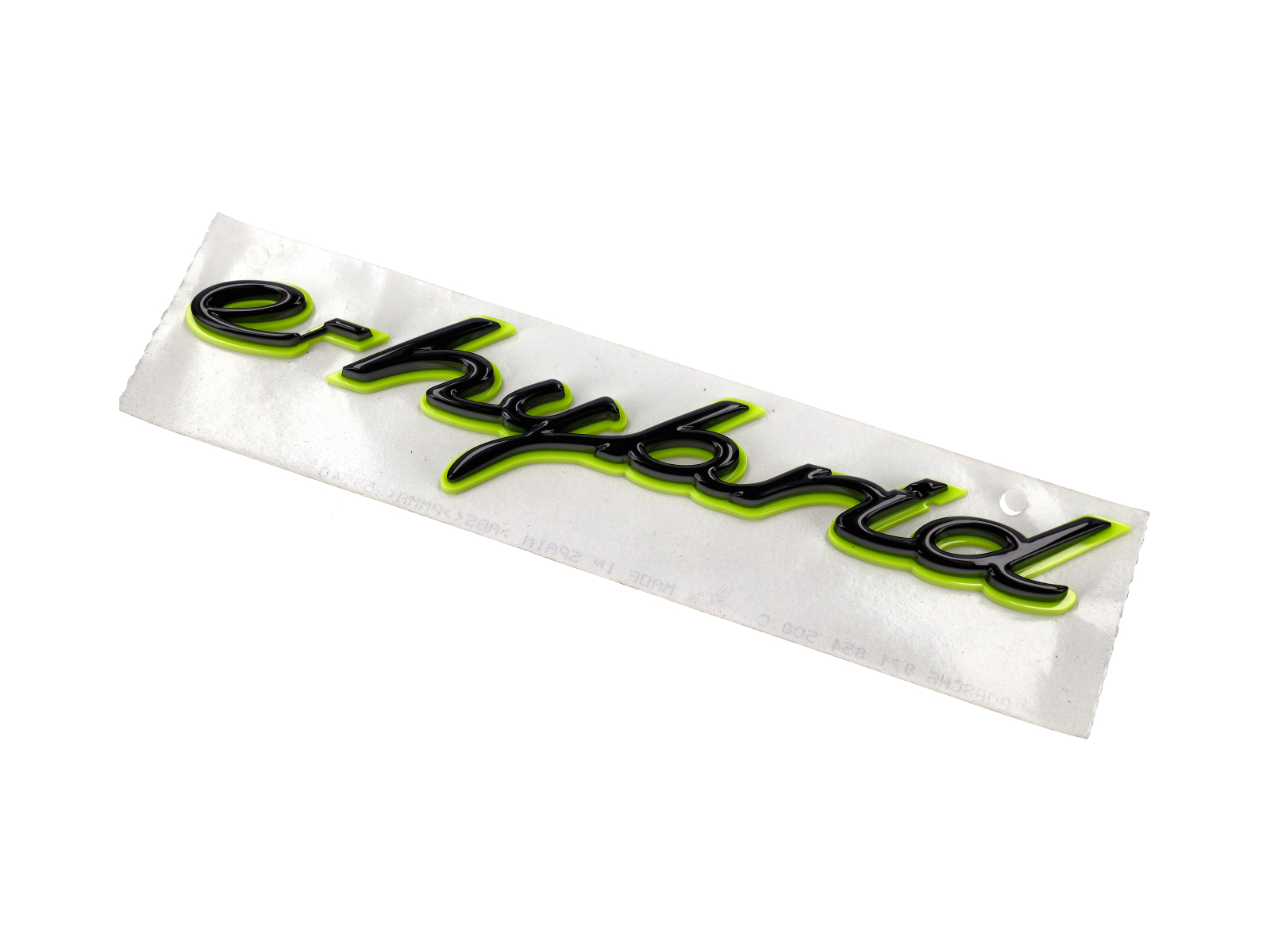
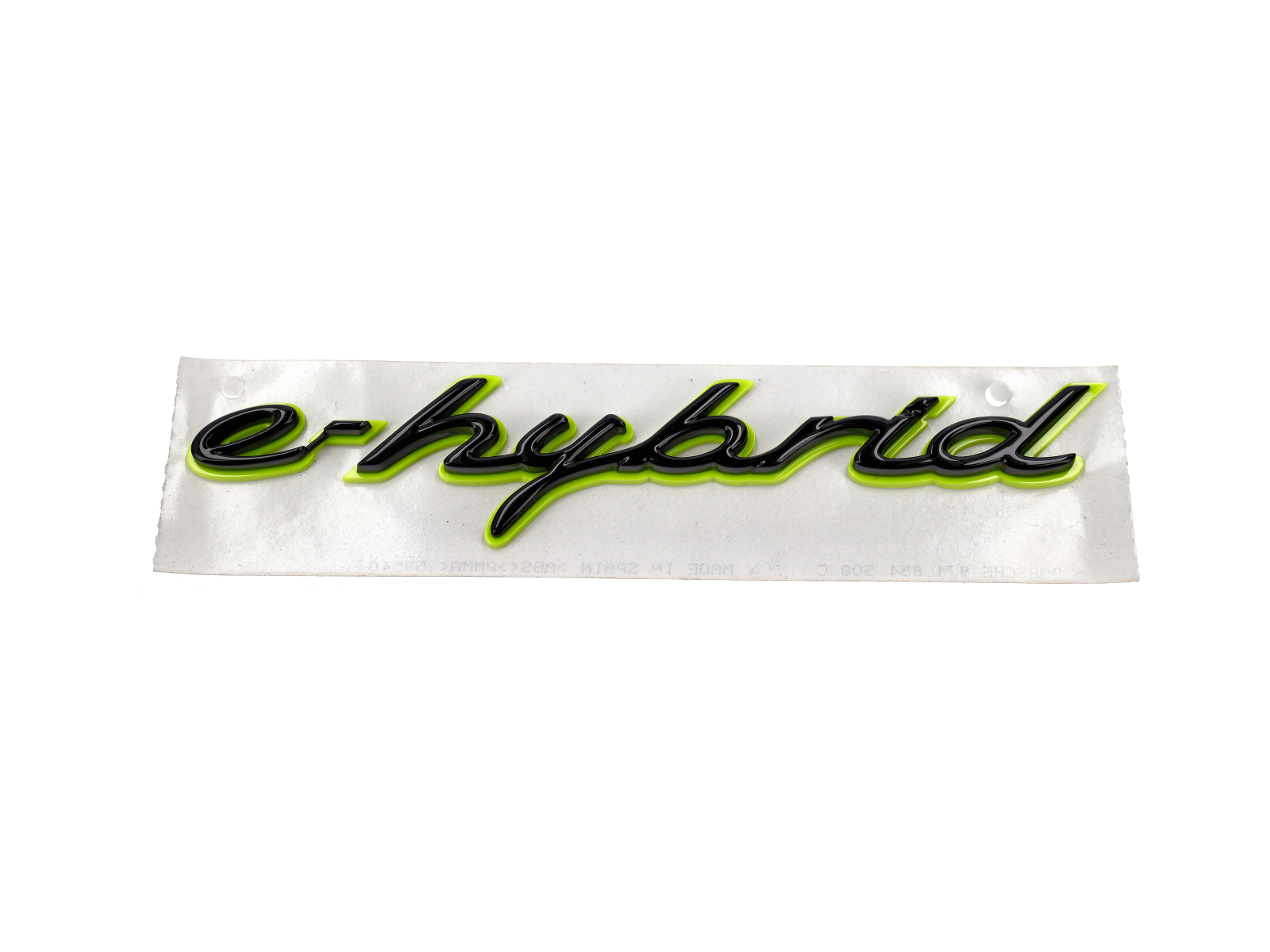
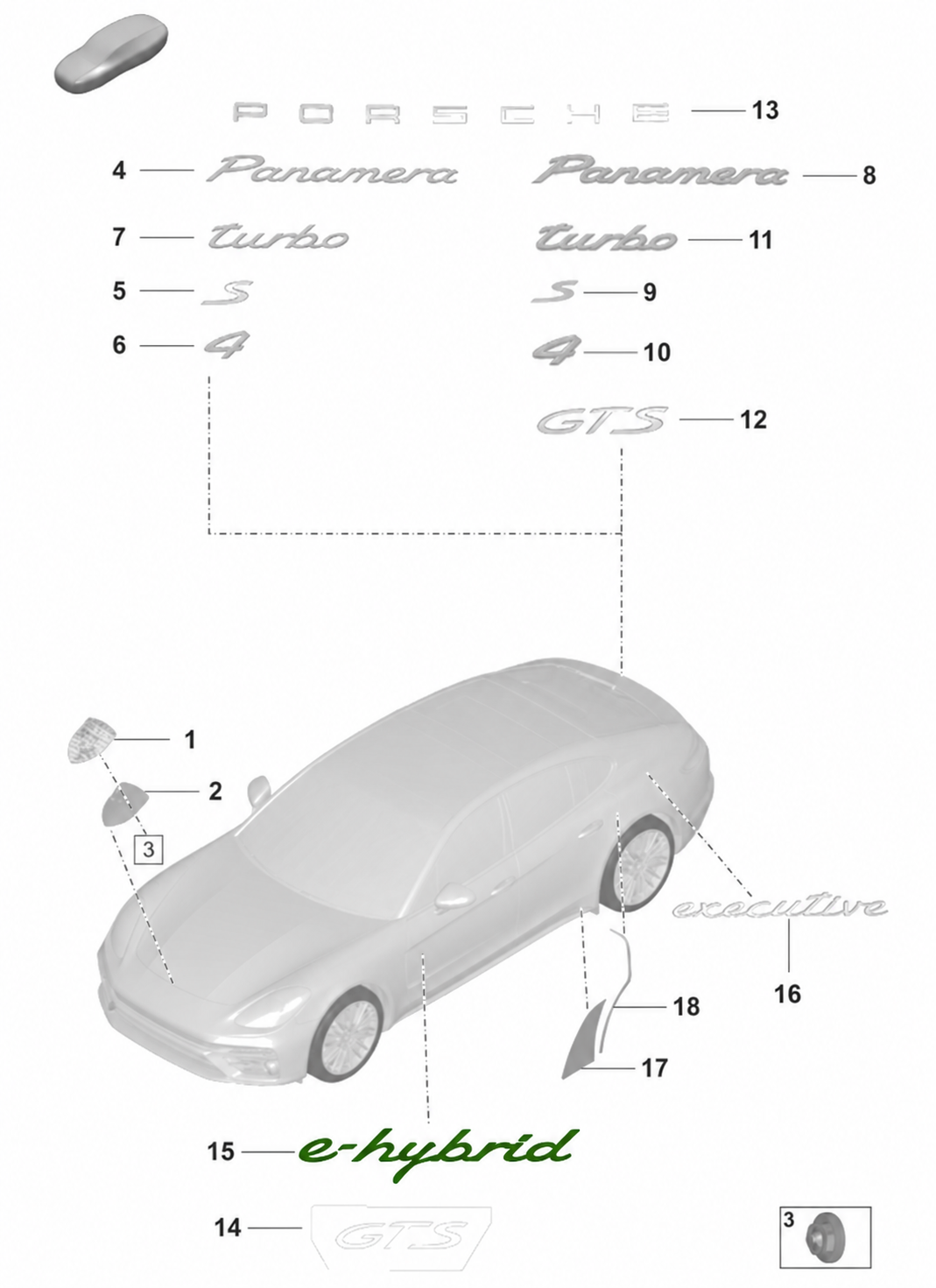

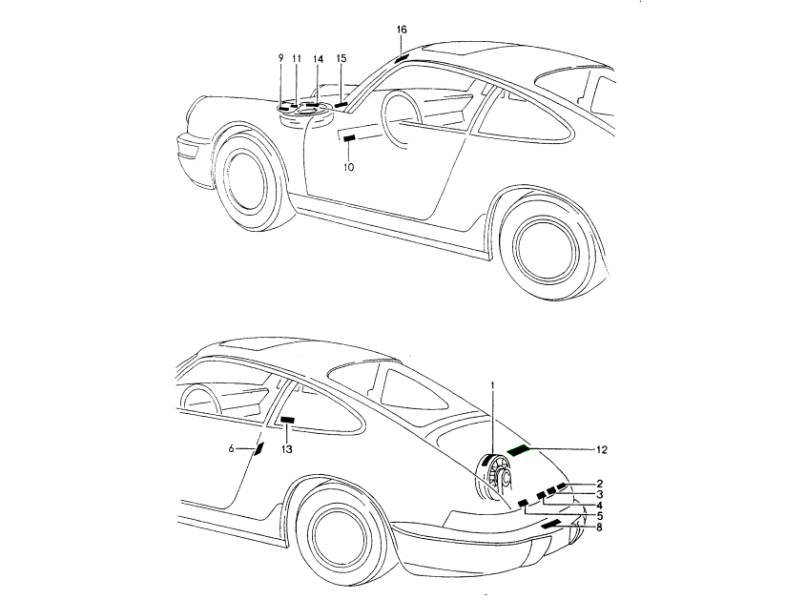
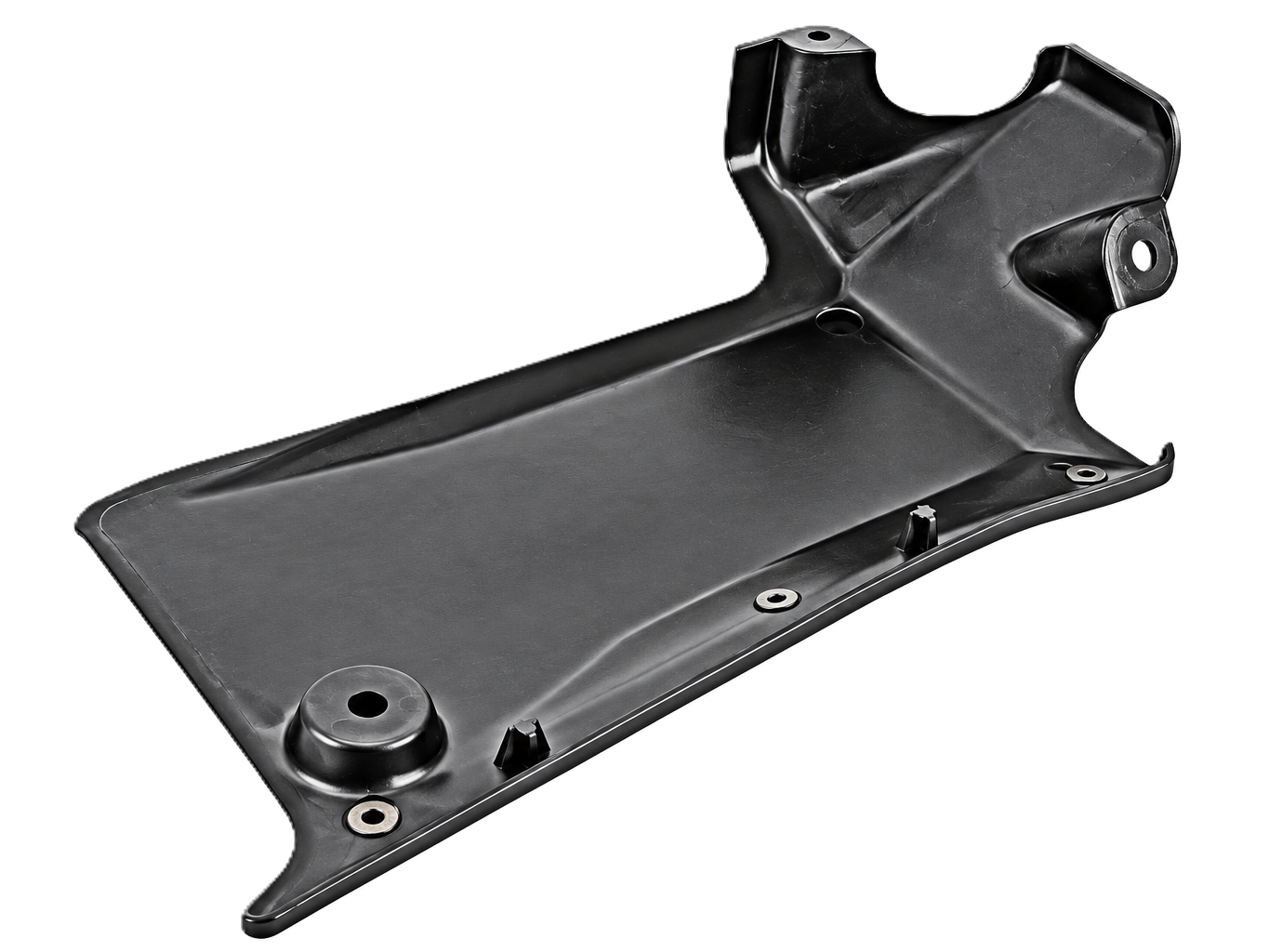
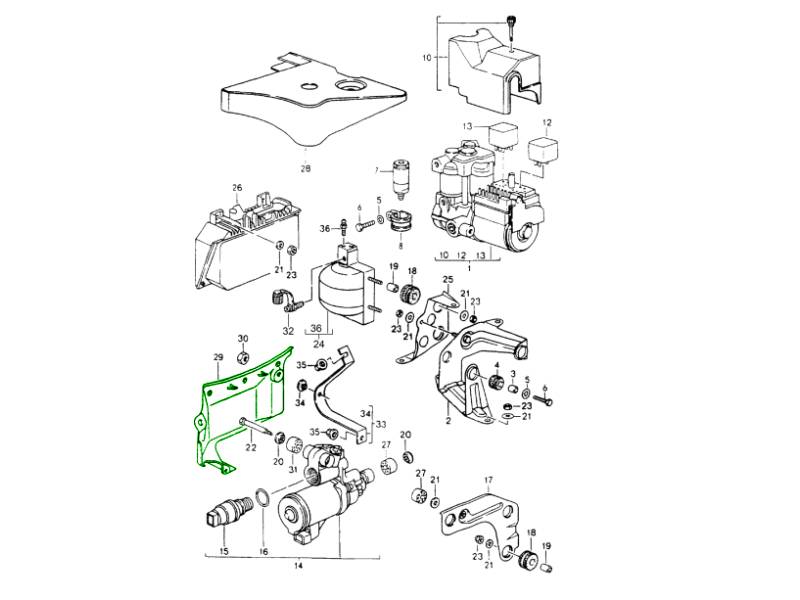
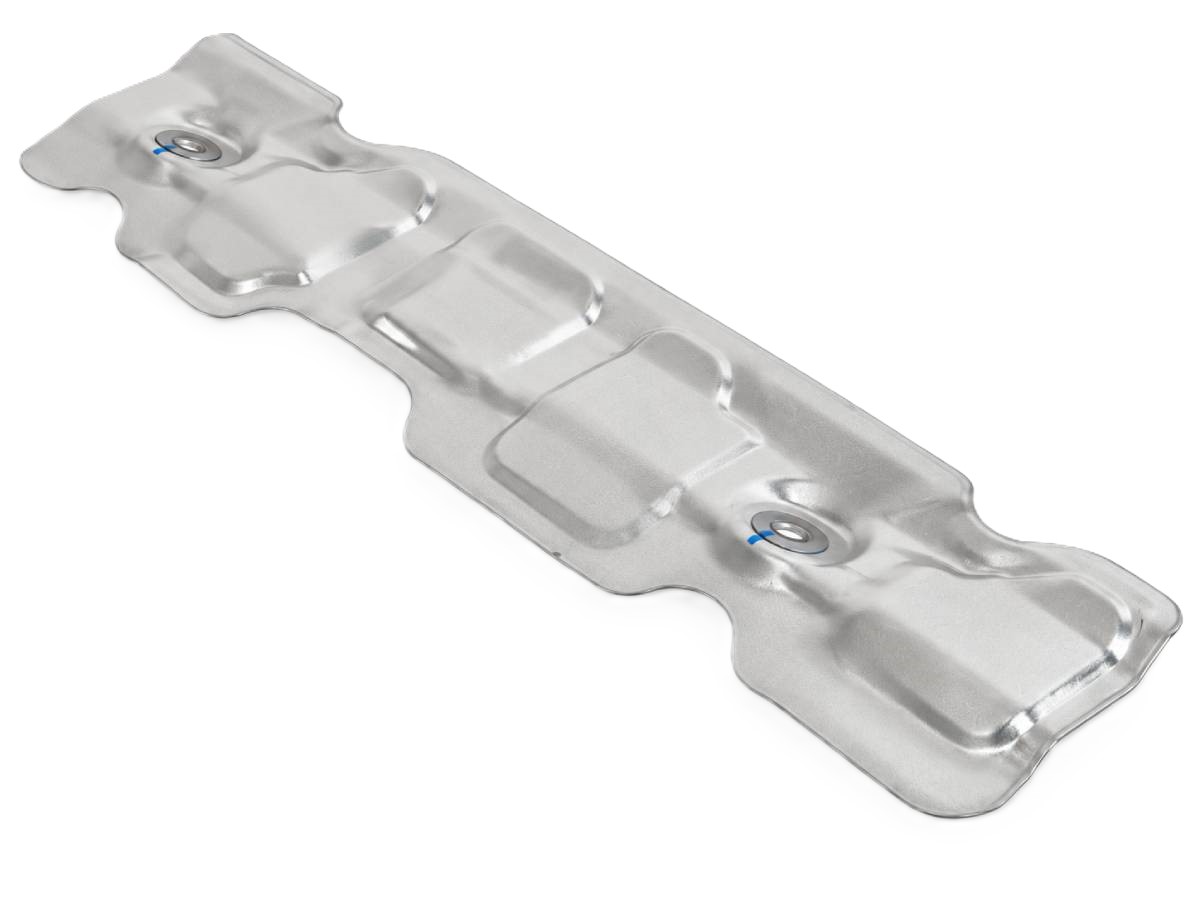
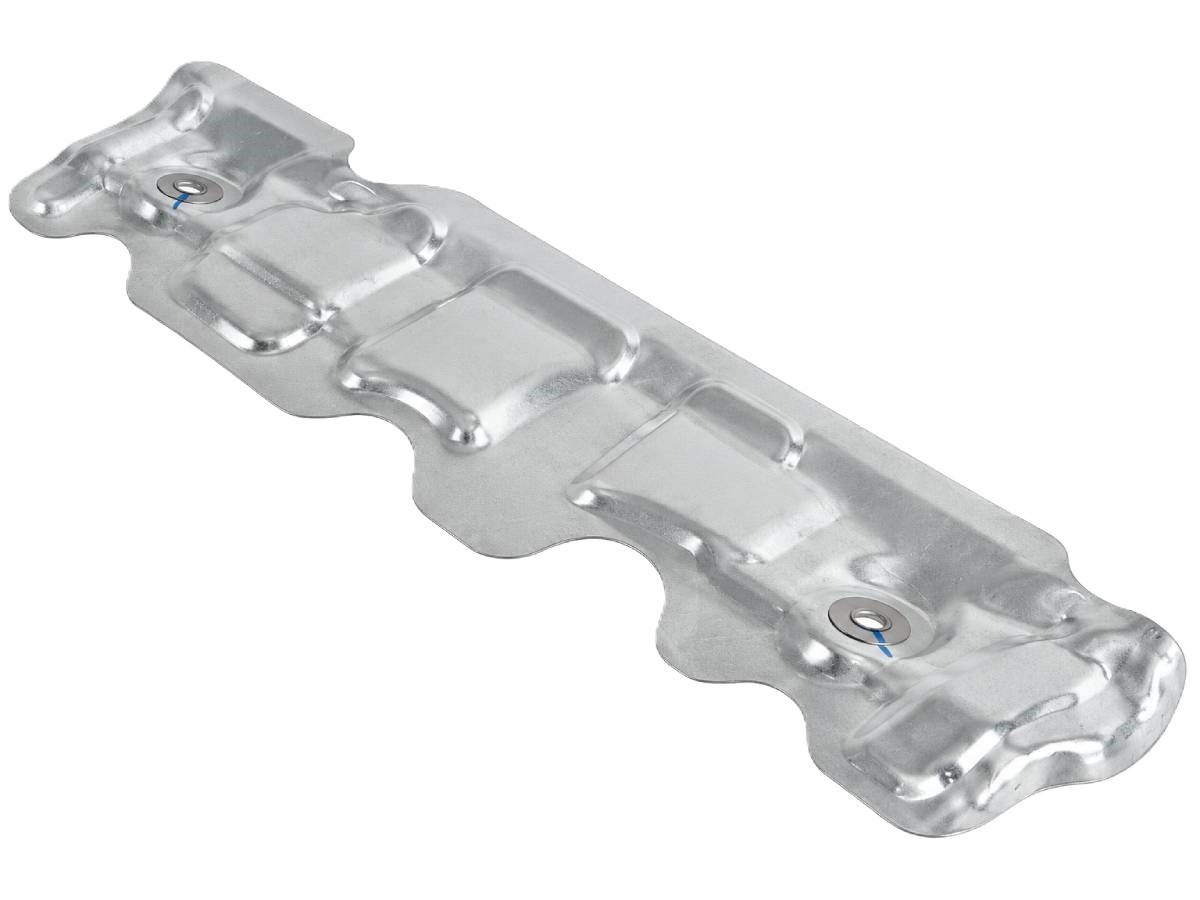
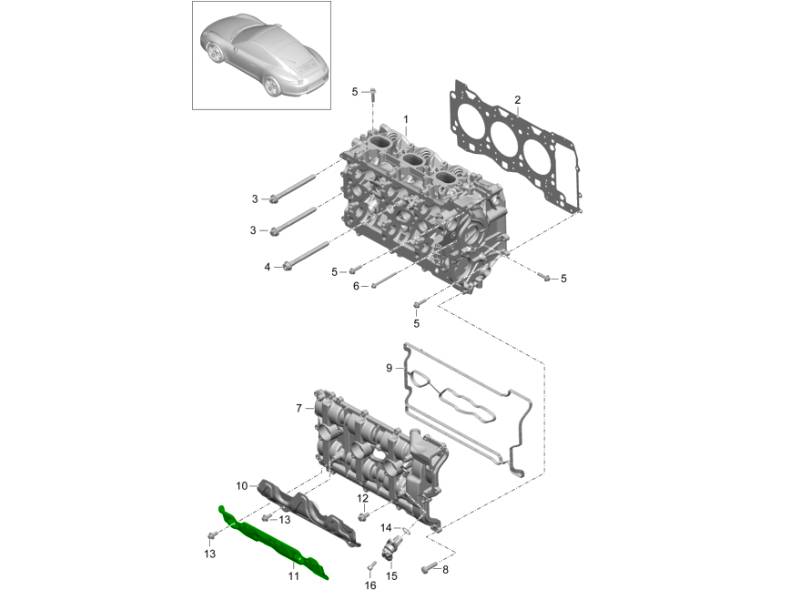
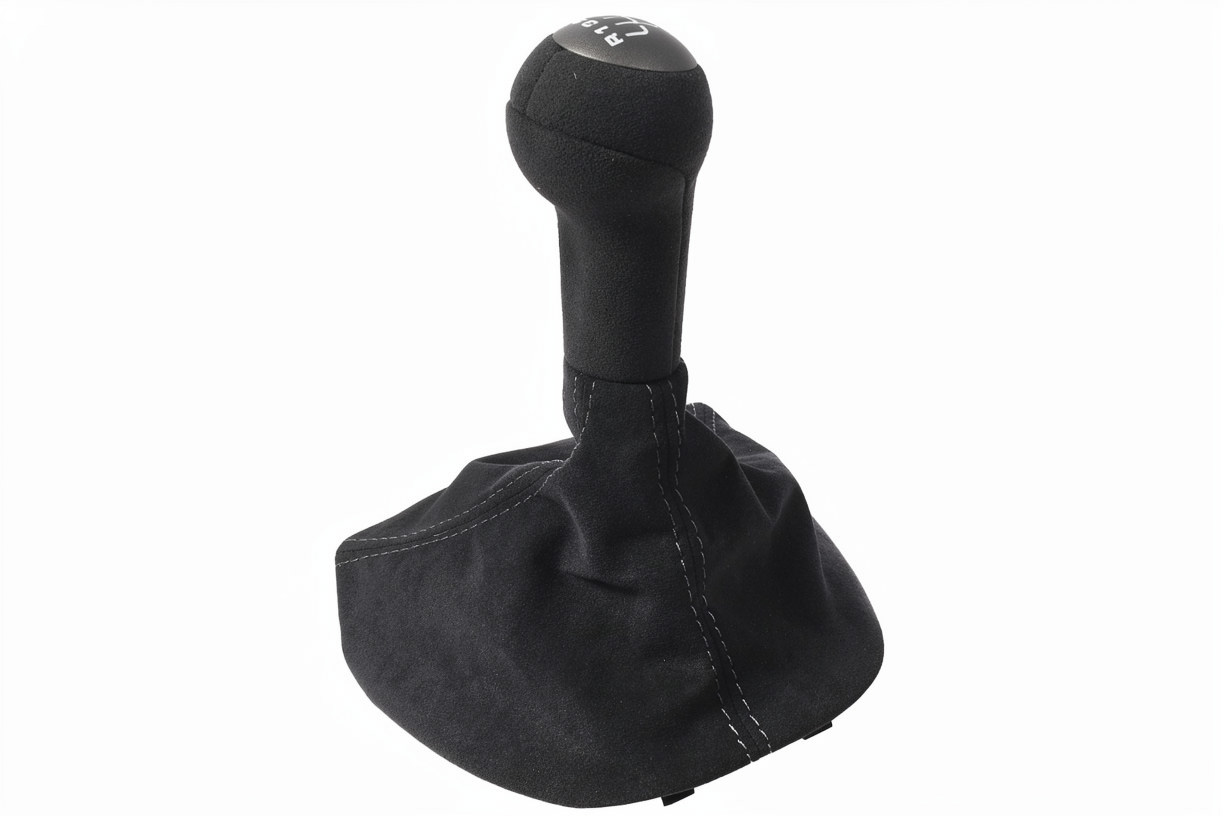
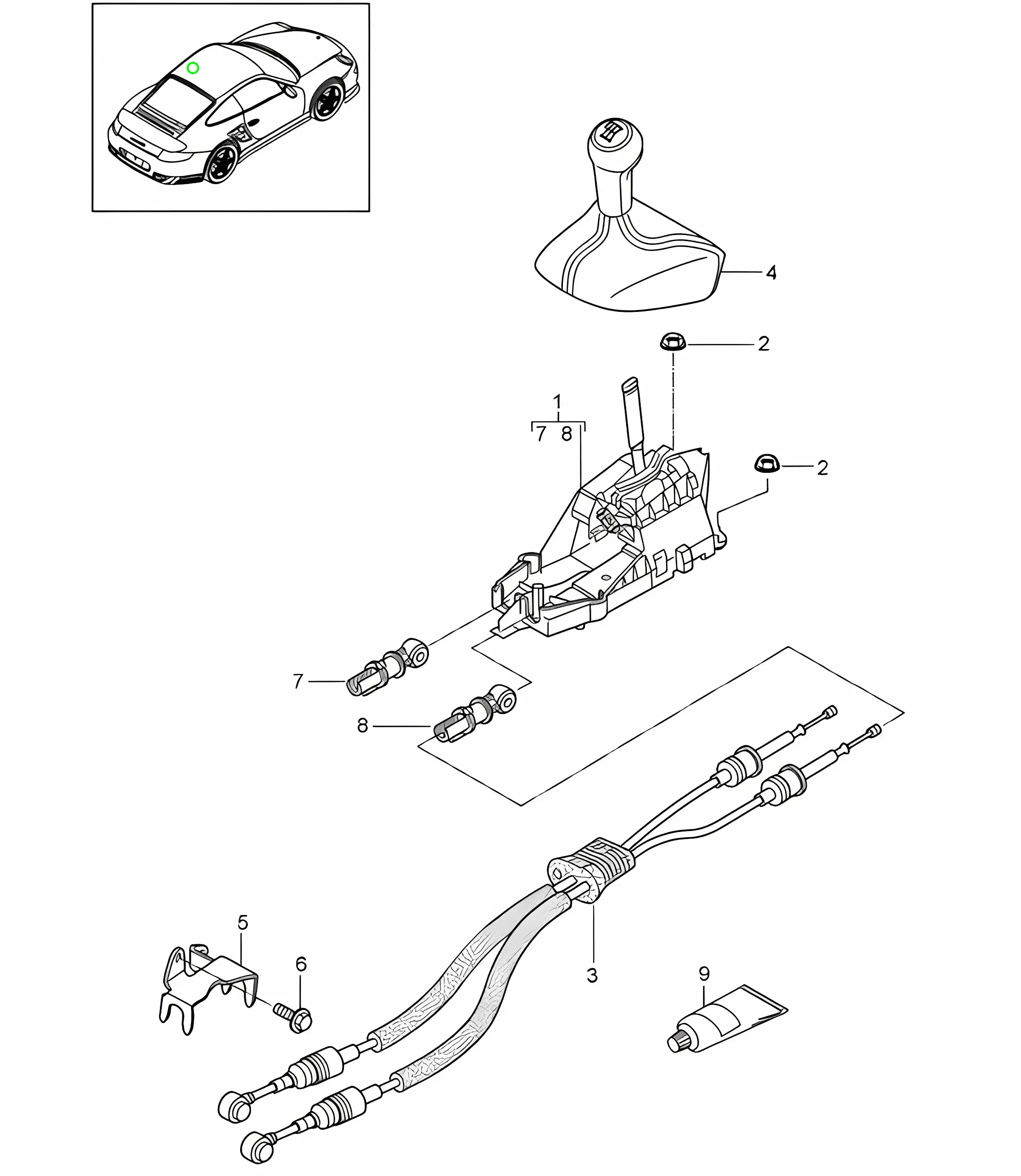
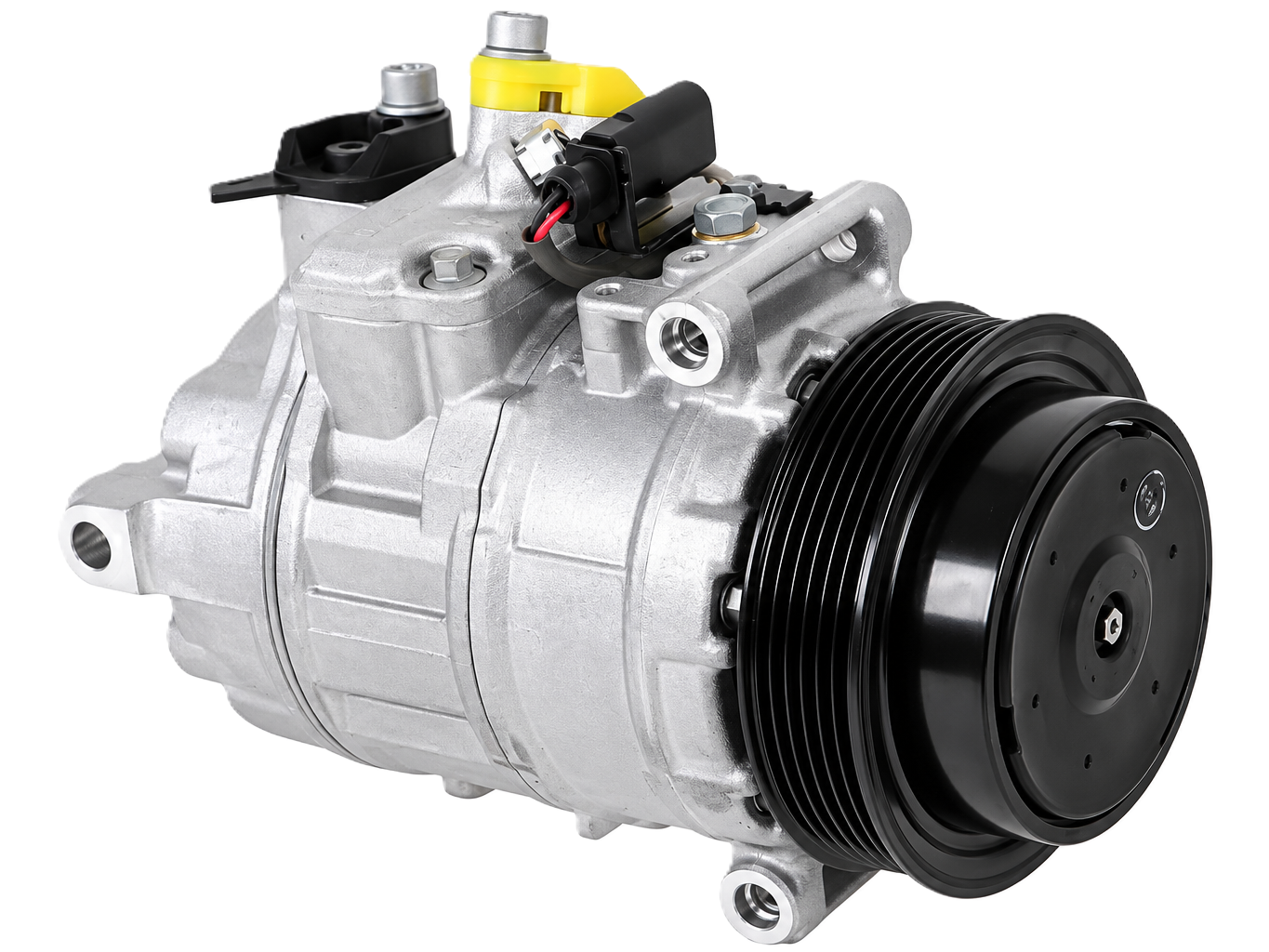
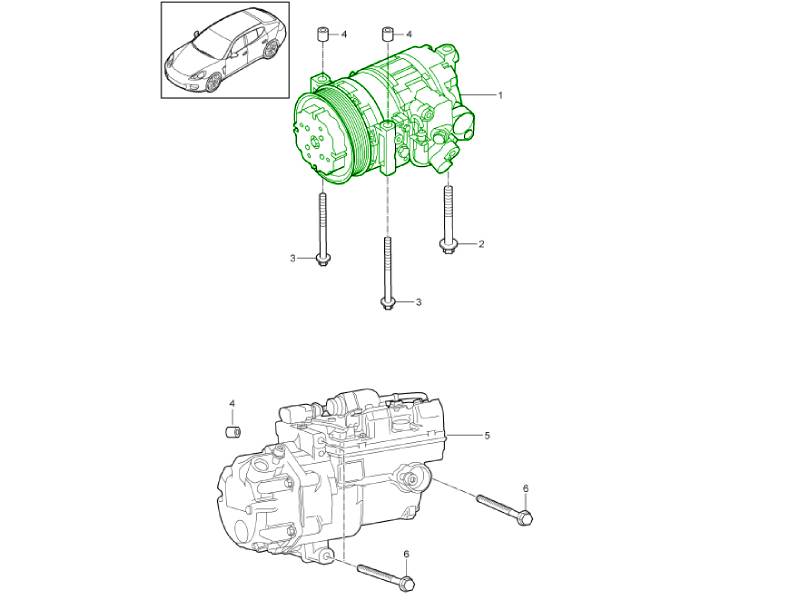
.jpg)
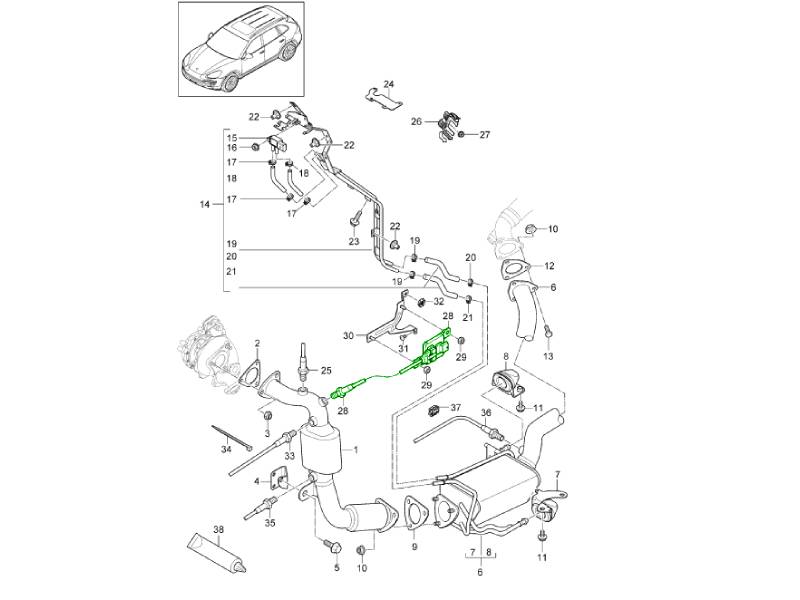
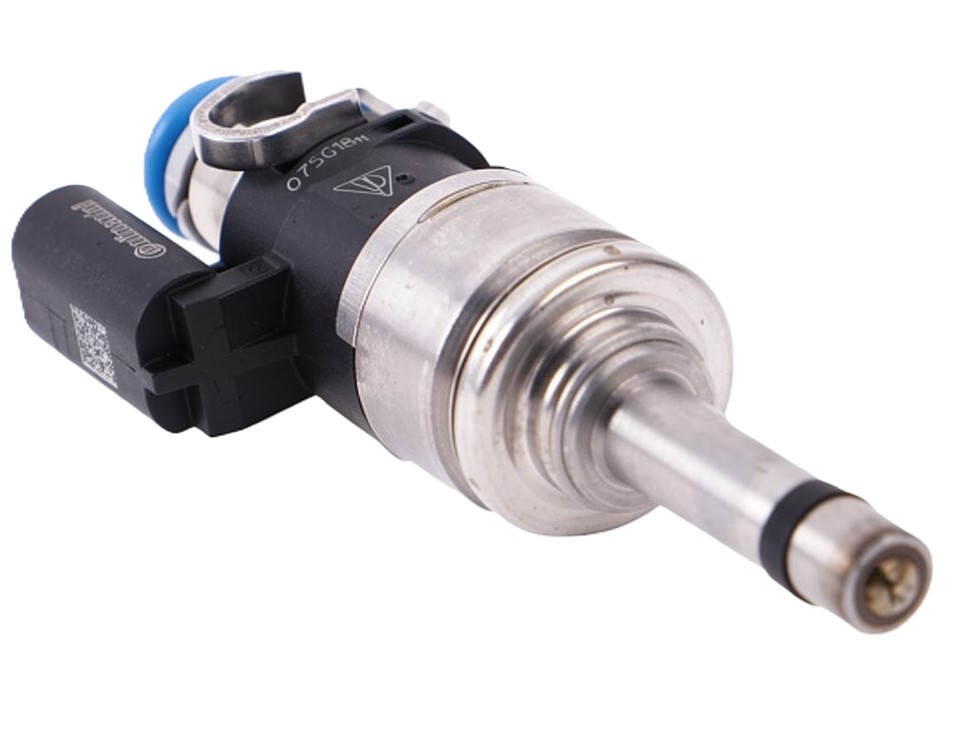
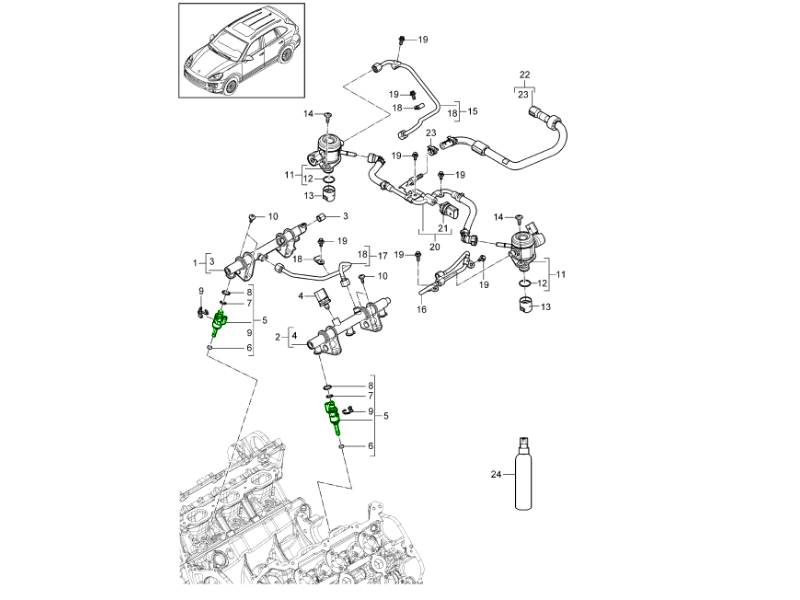
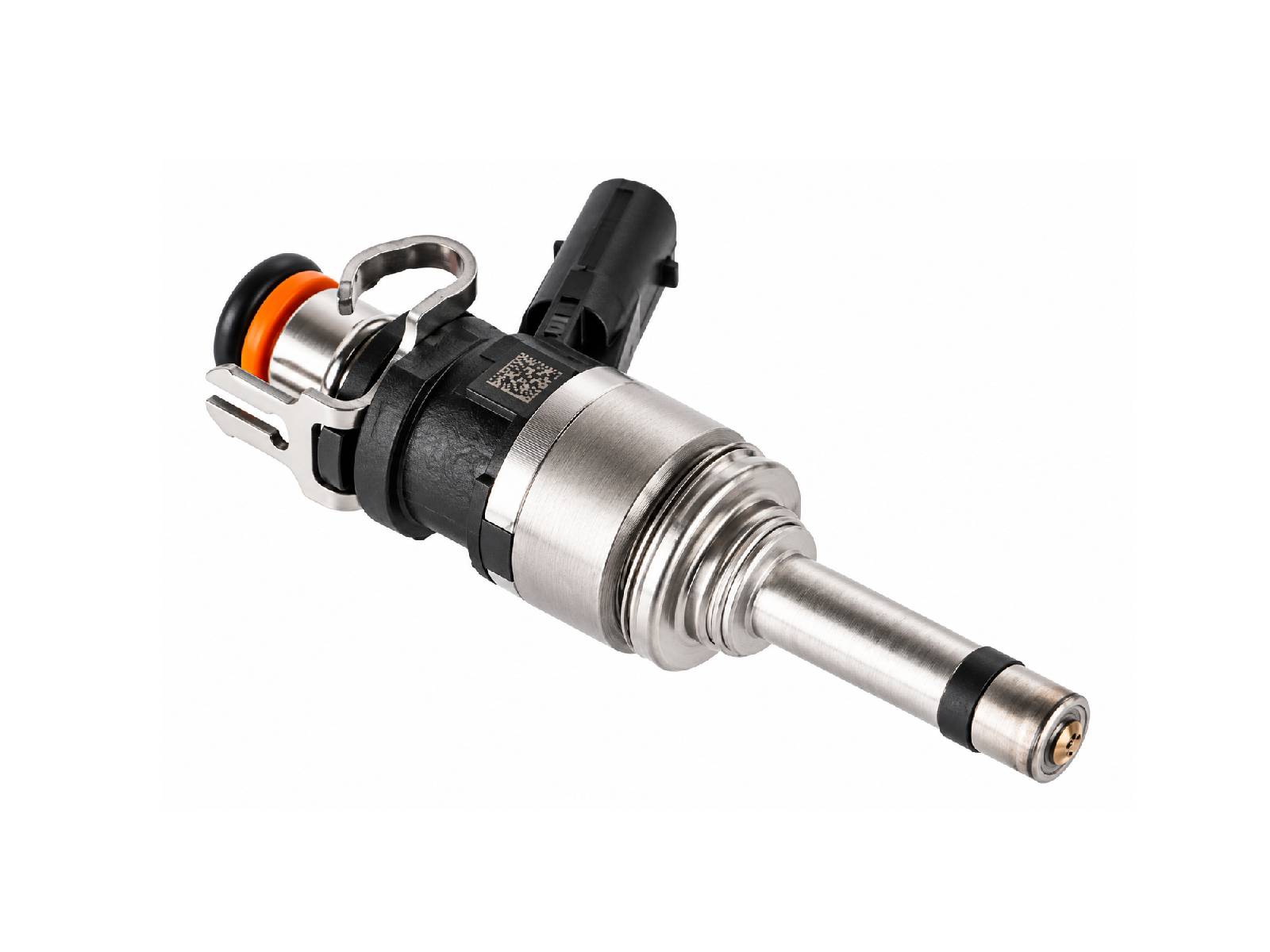
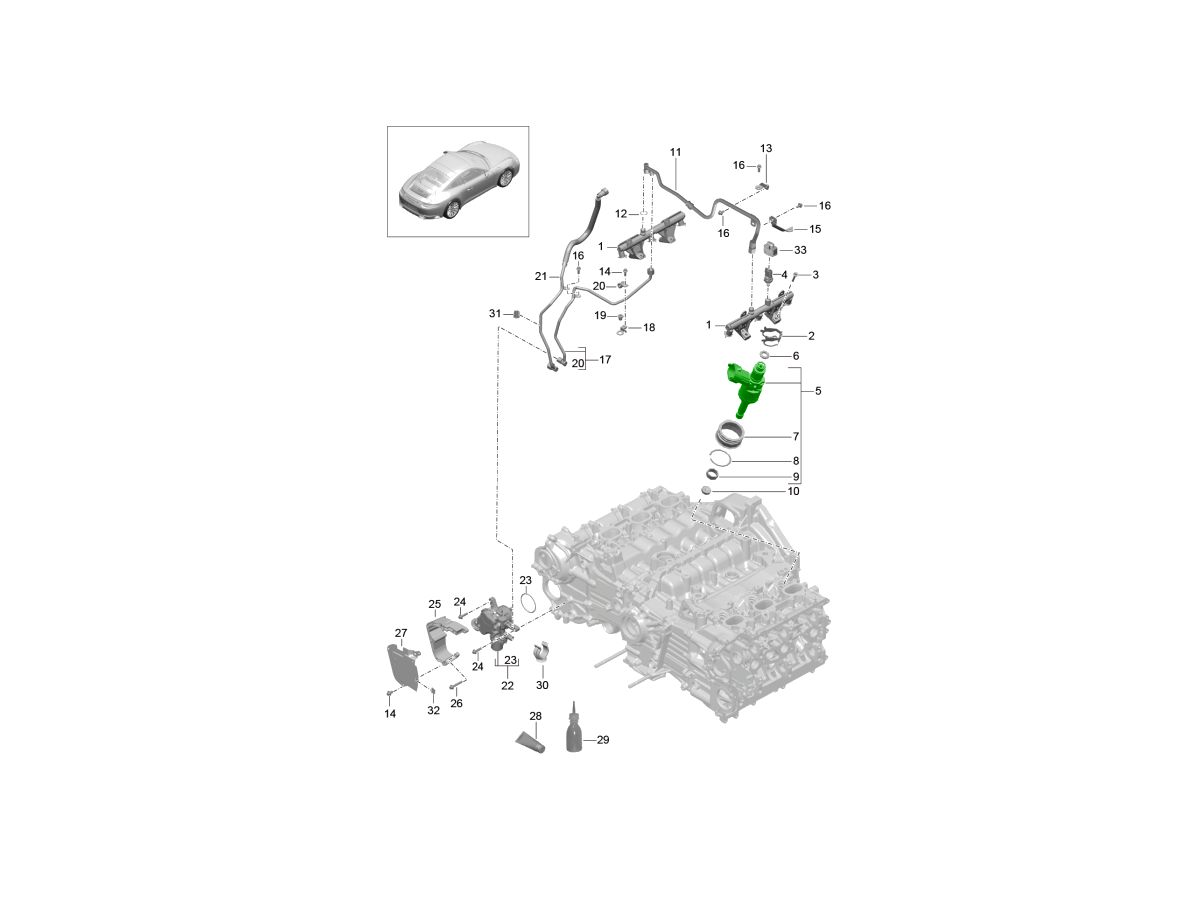
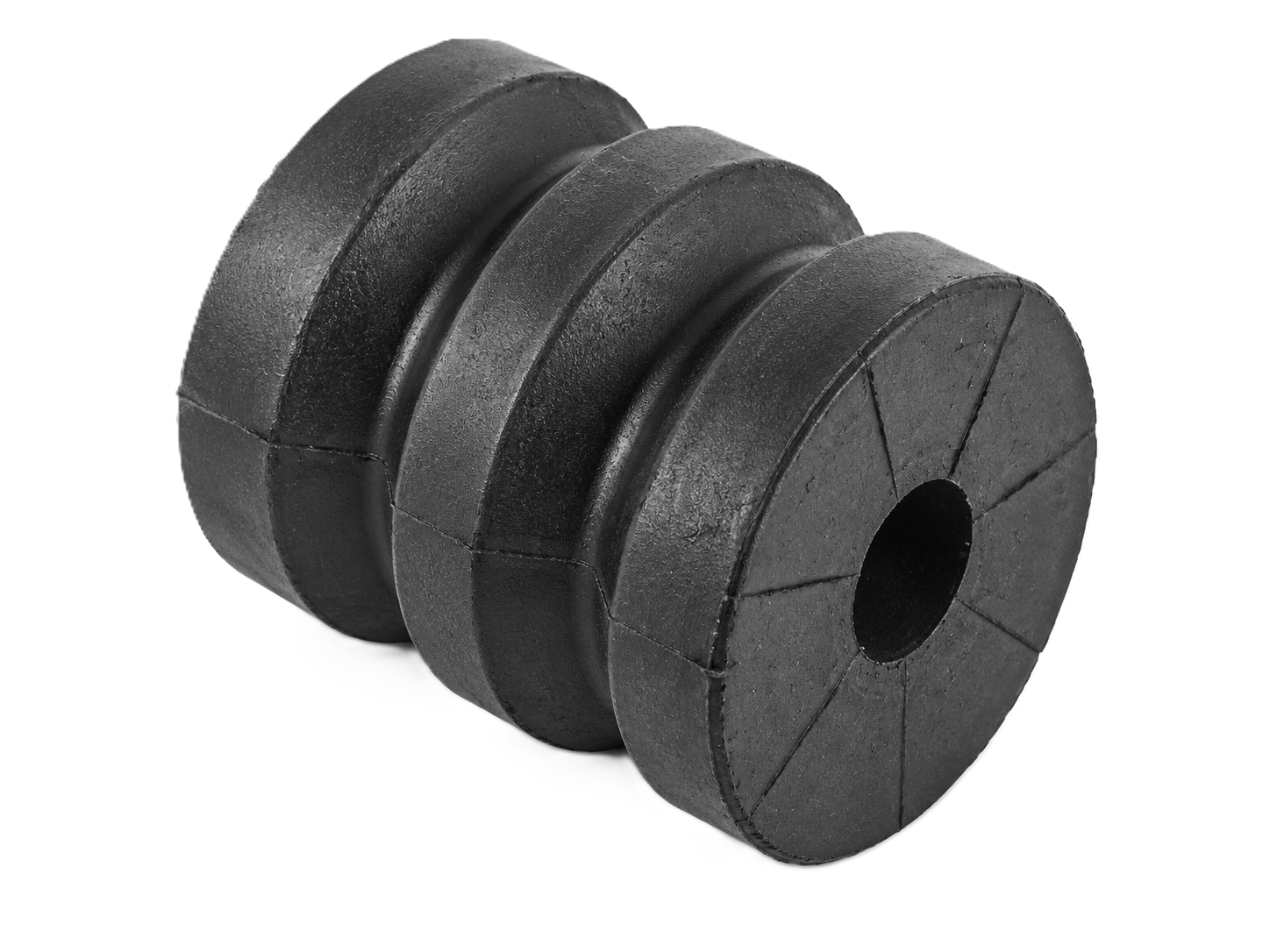
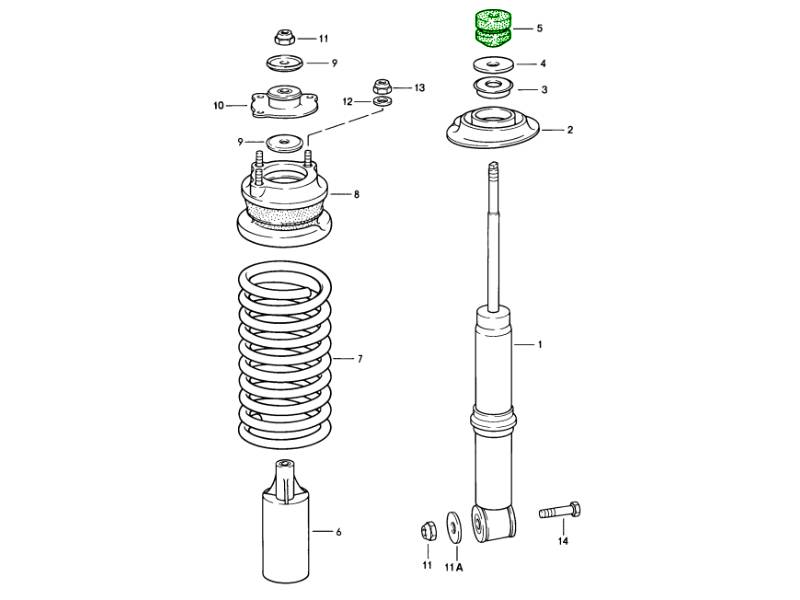
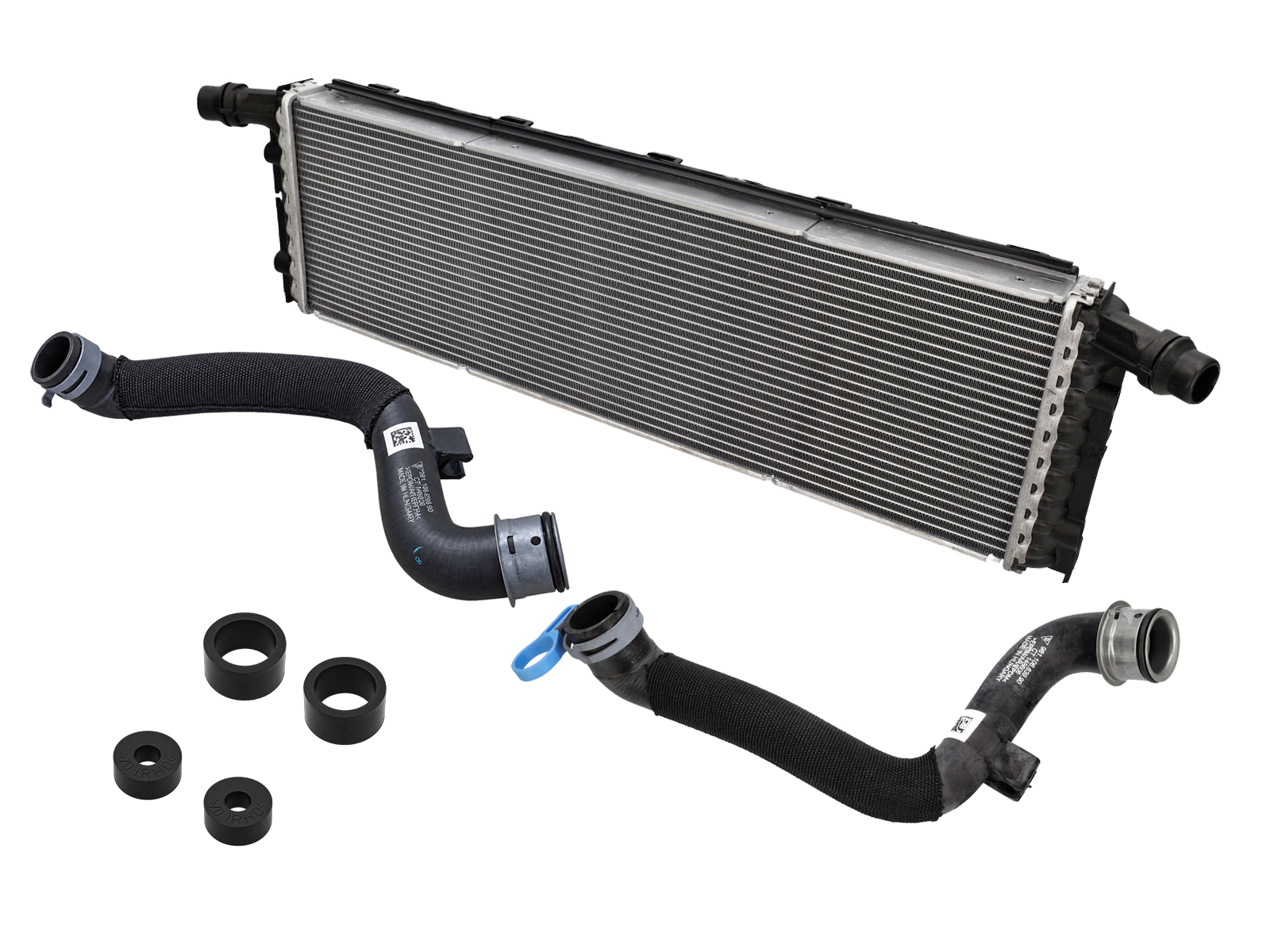
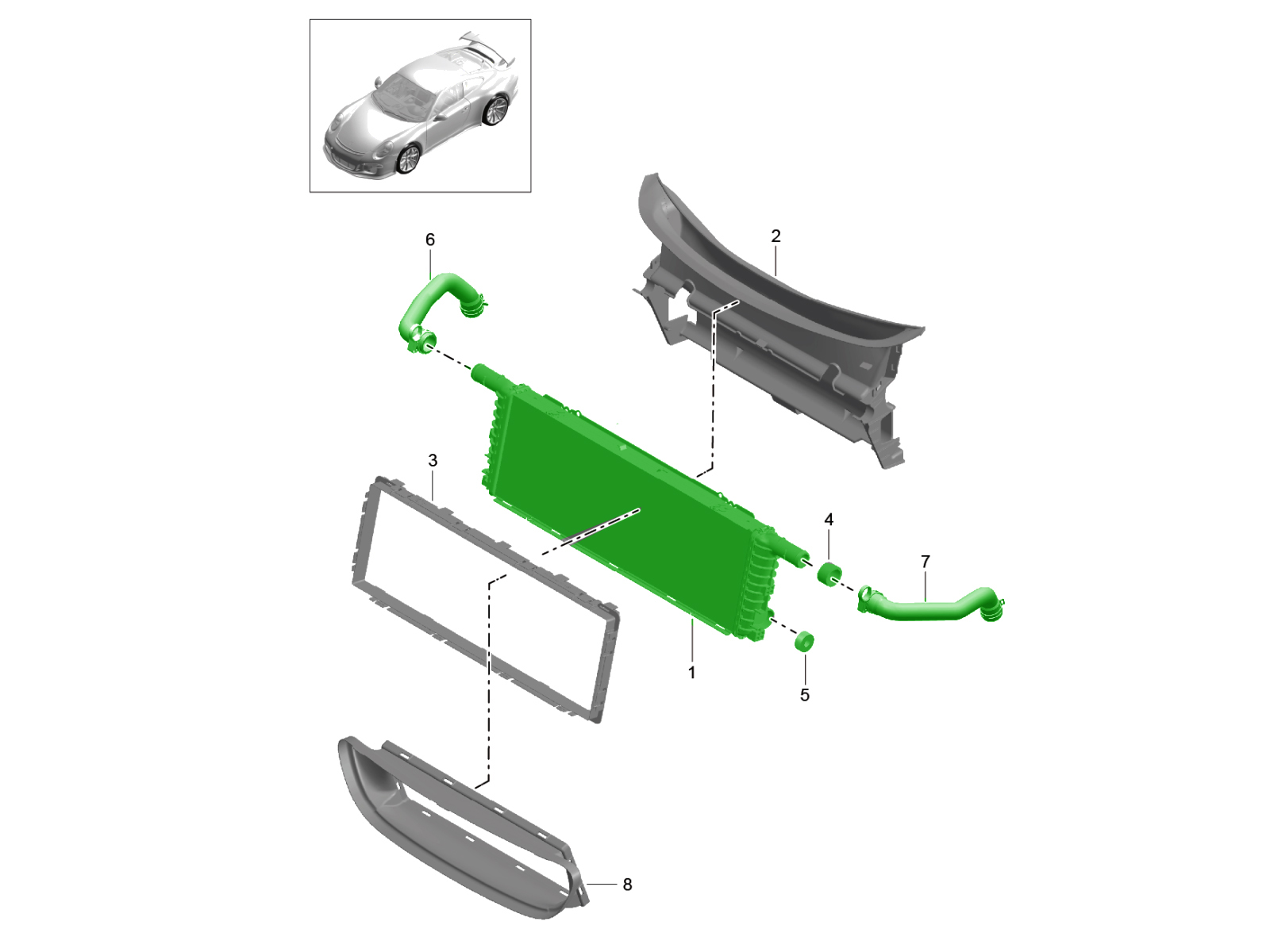
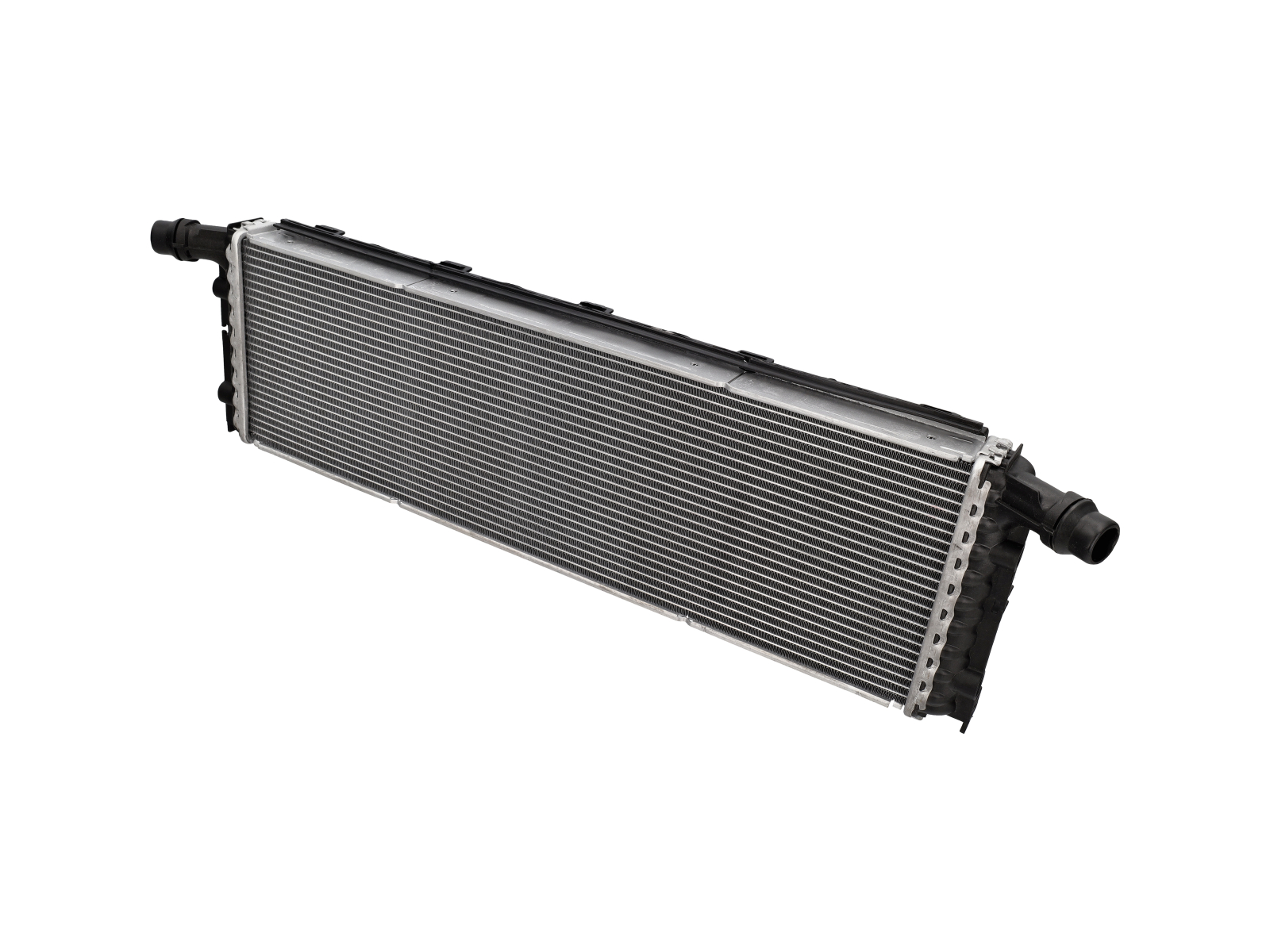


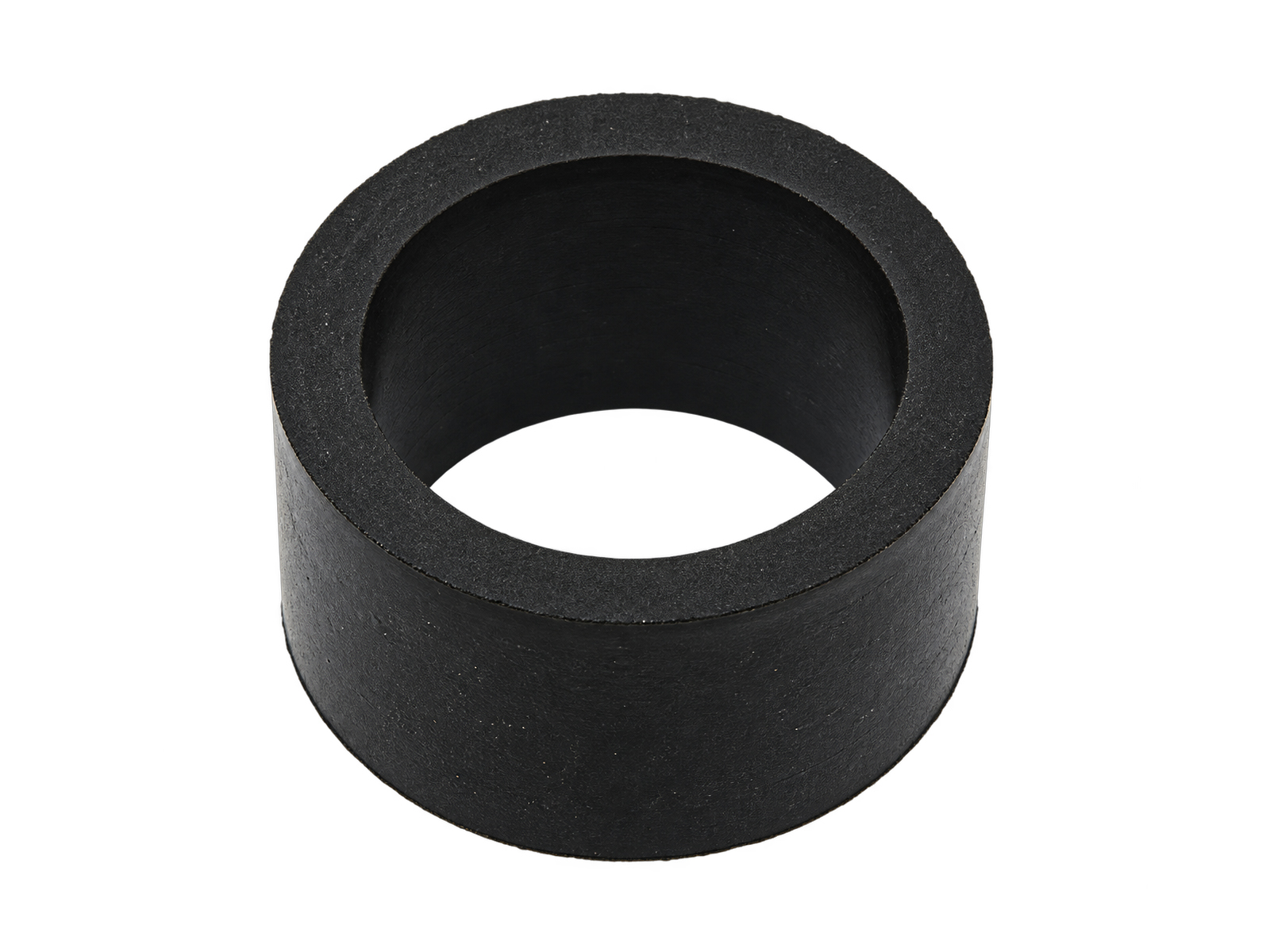
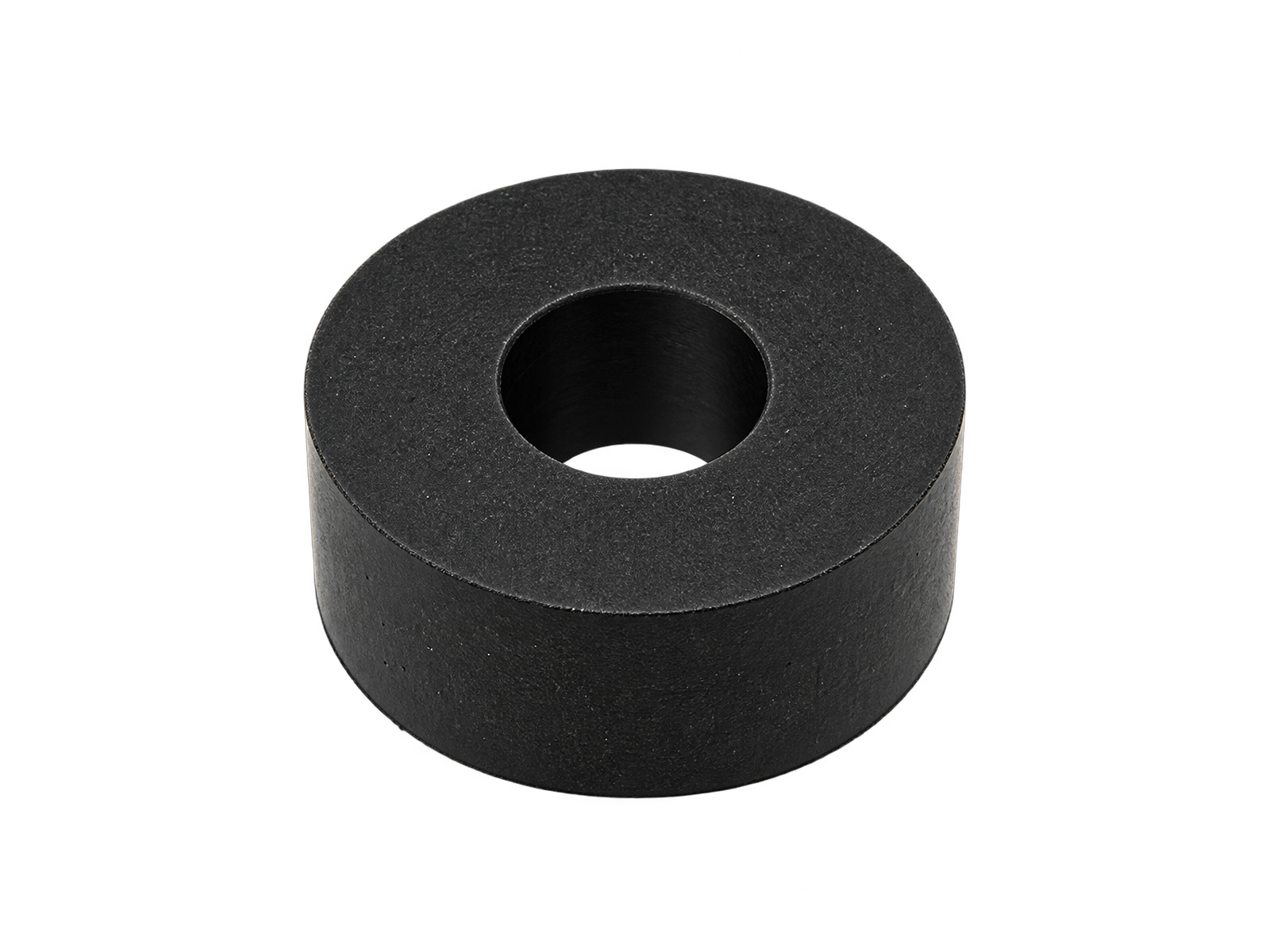
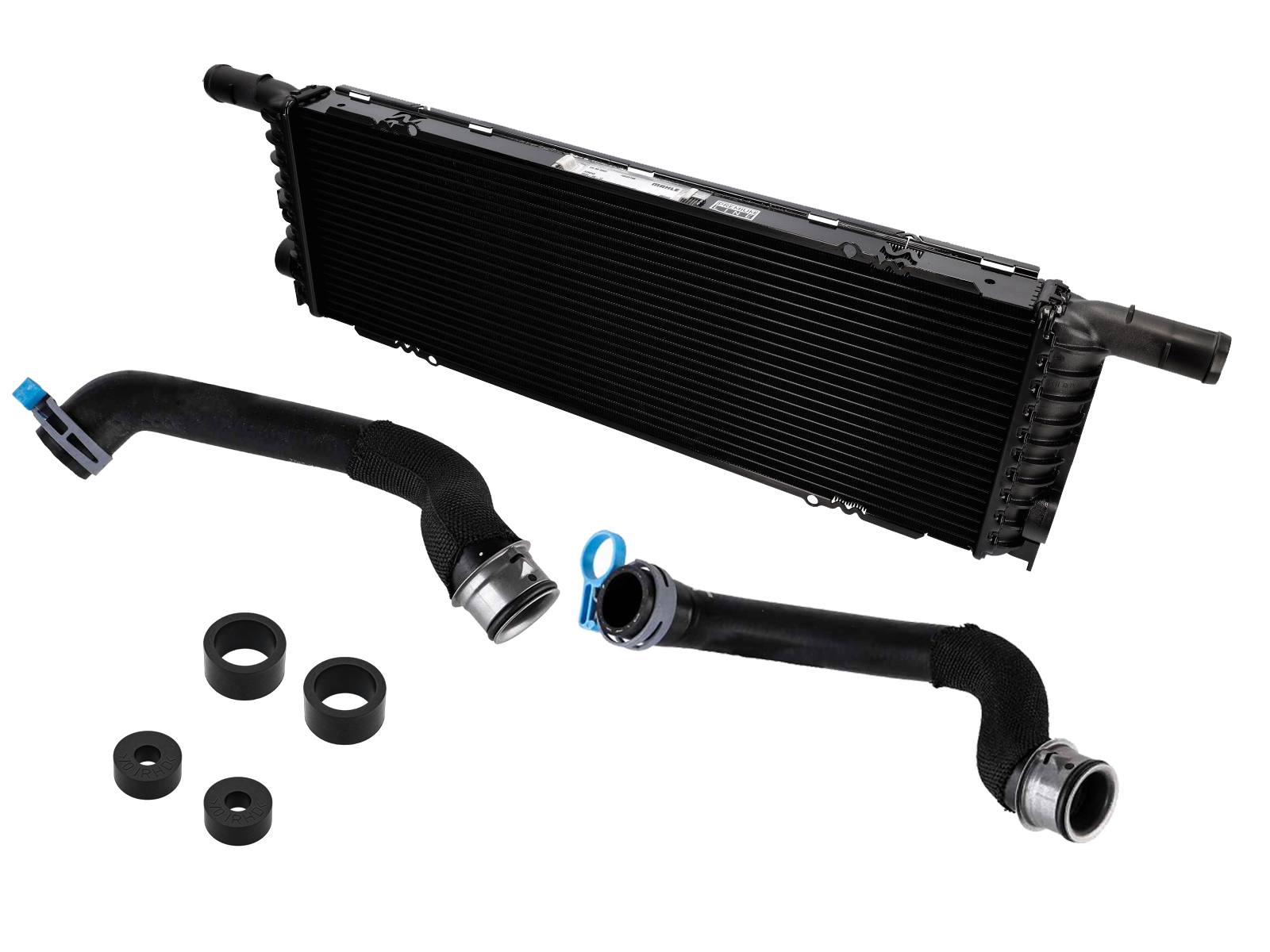

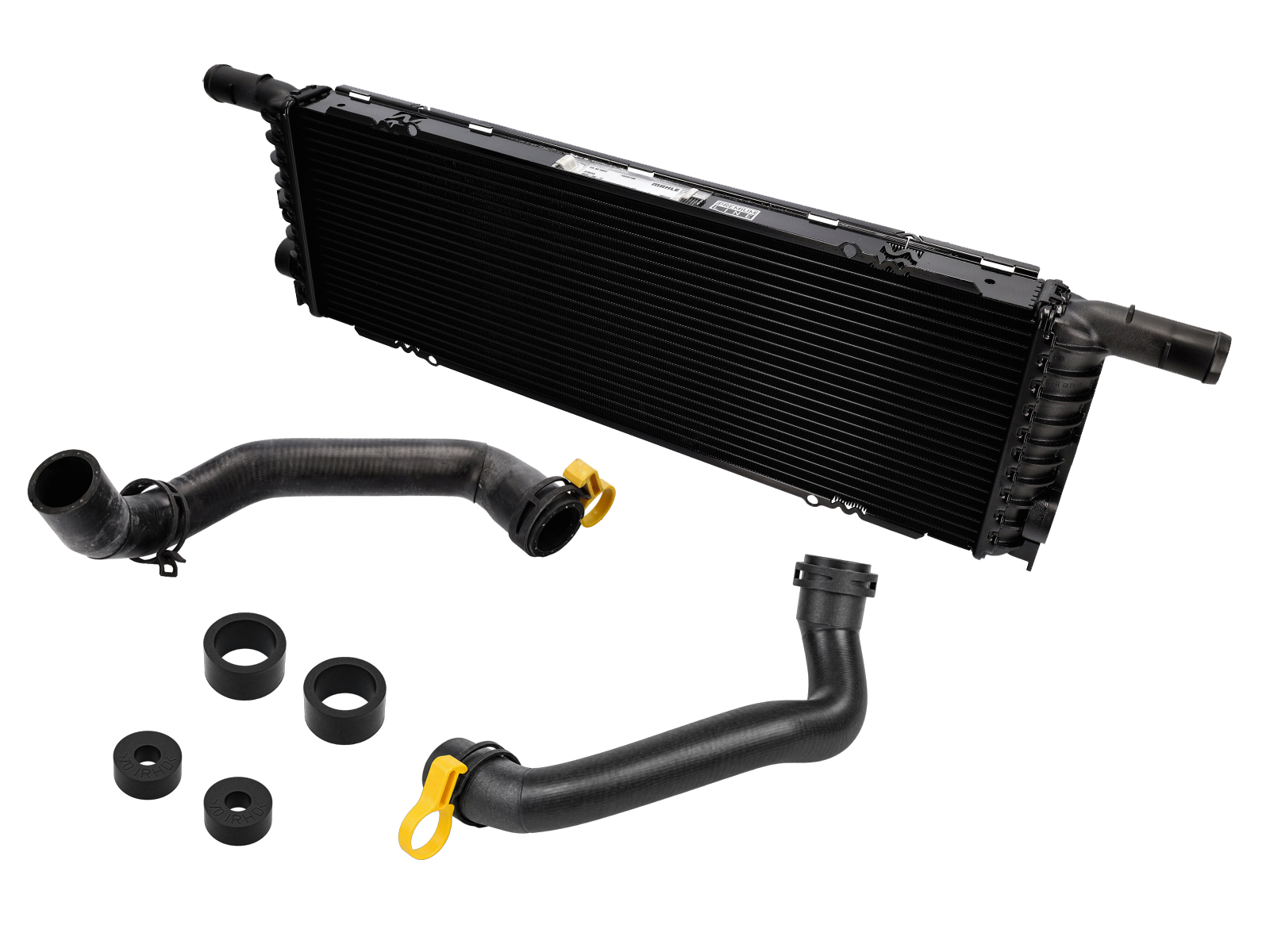

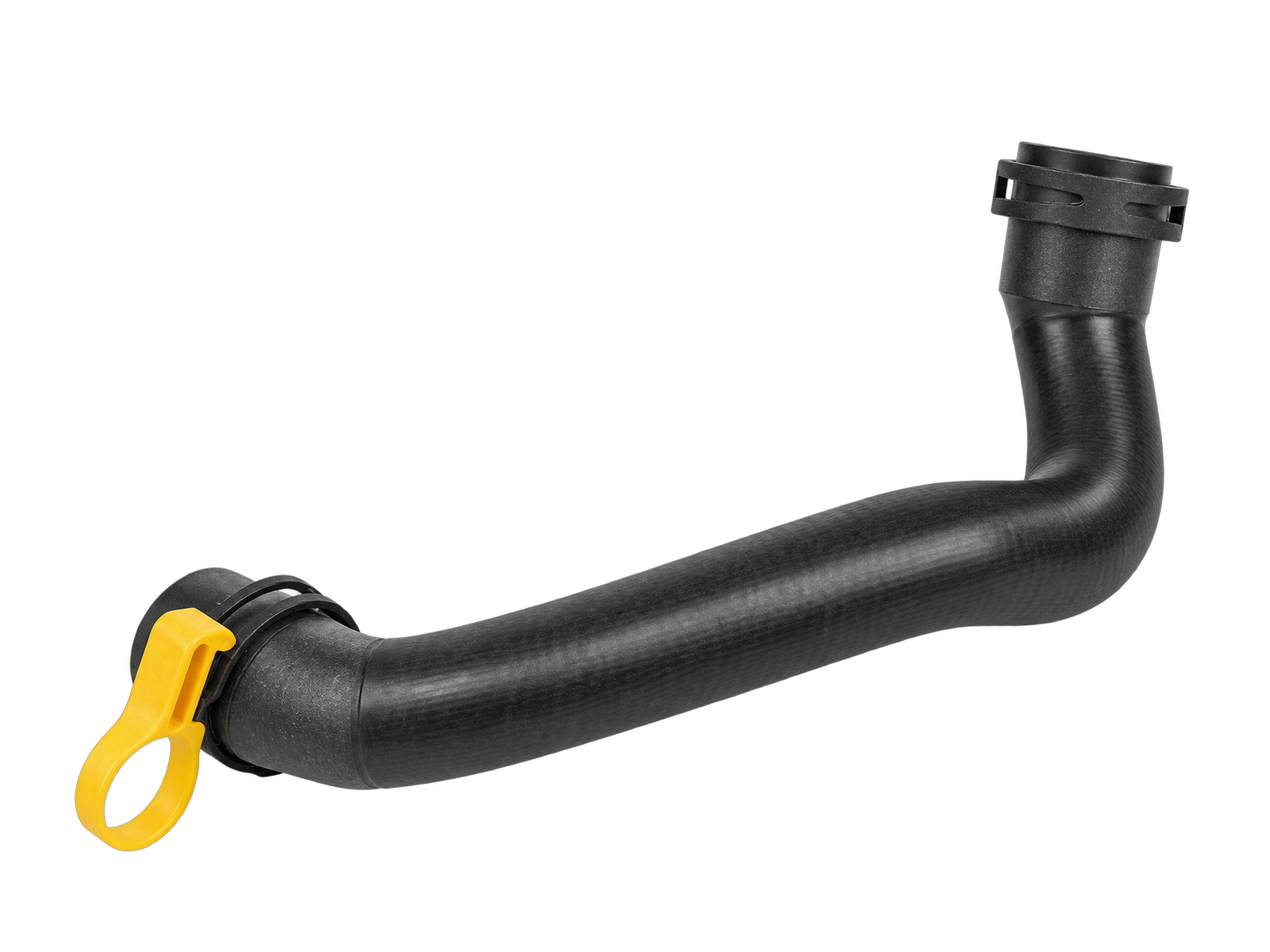
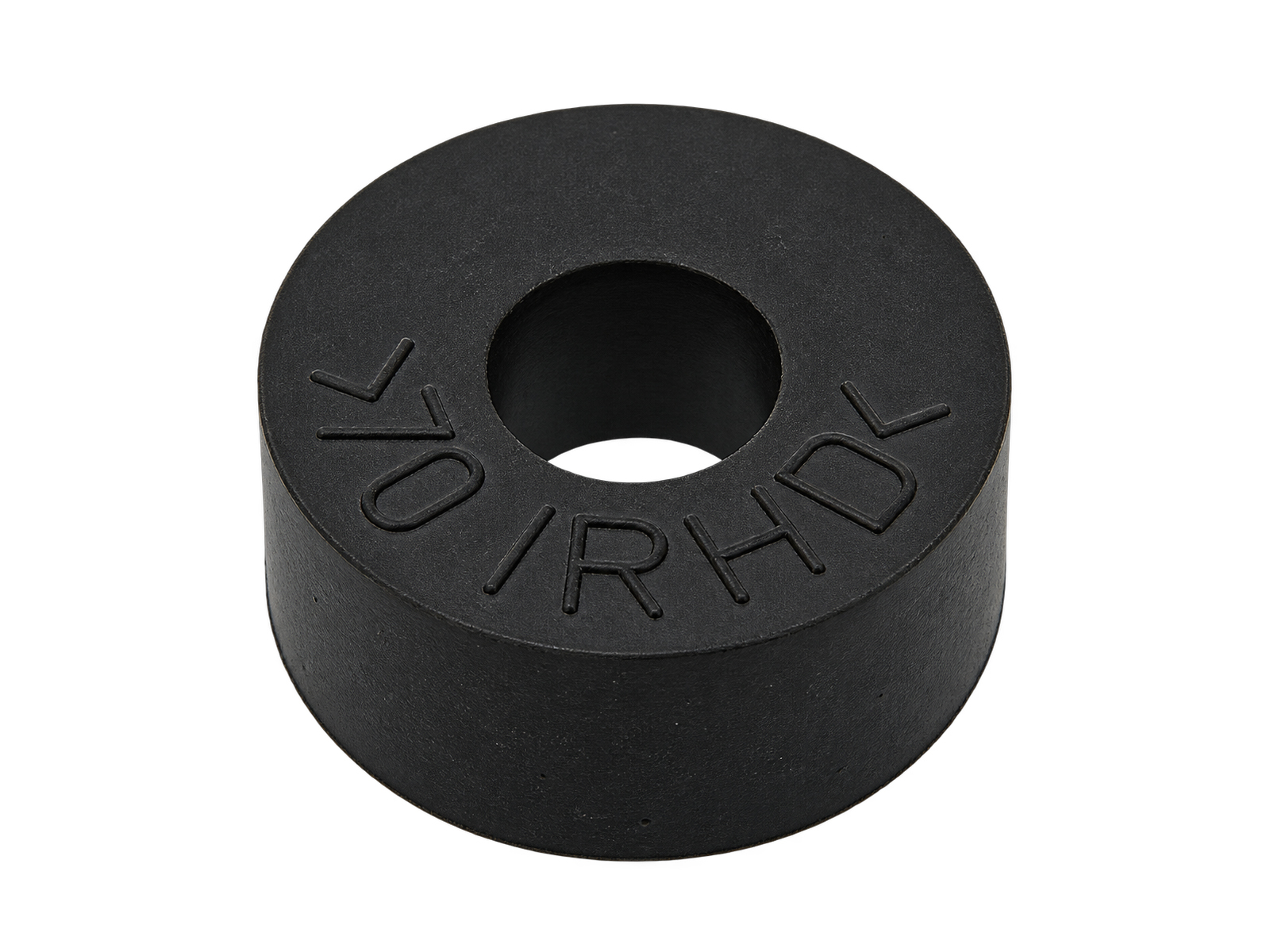
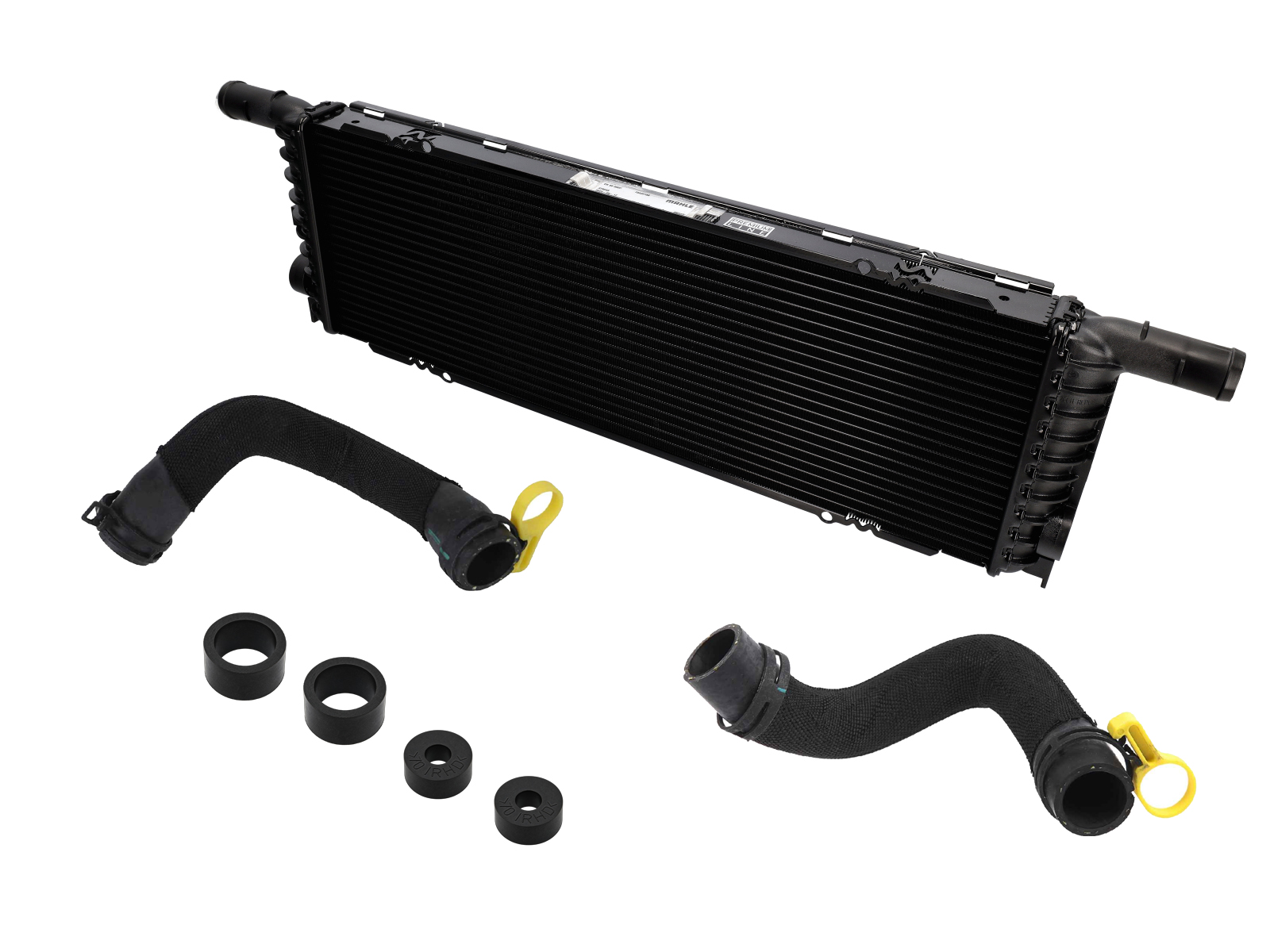
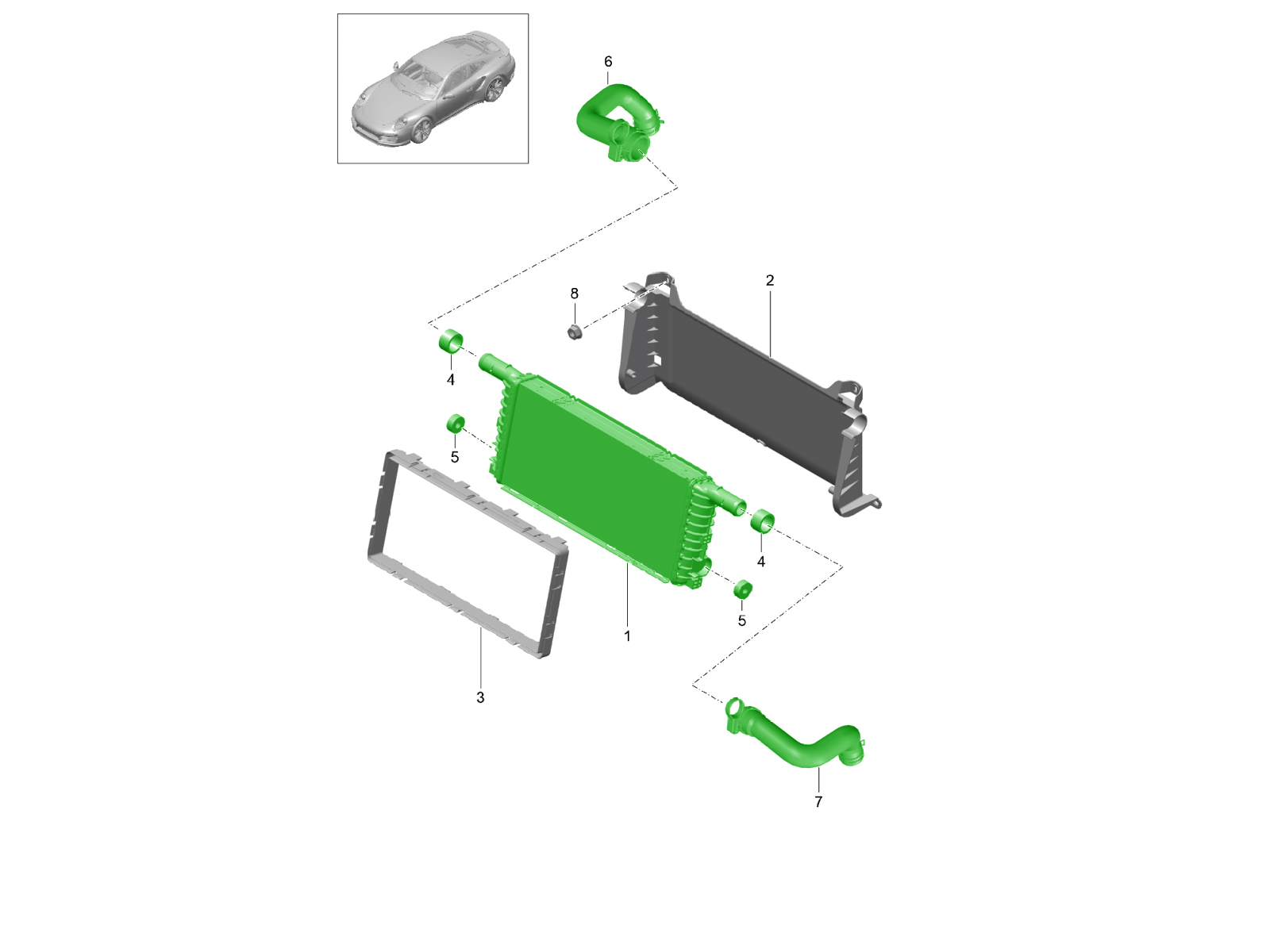
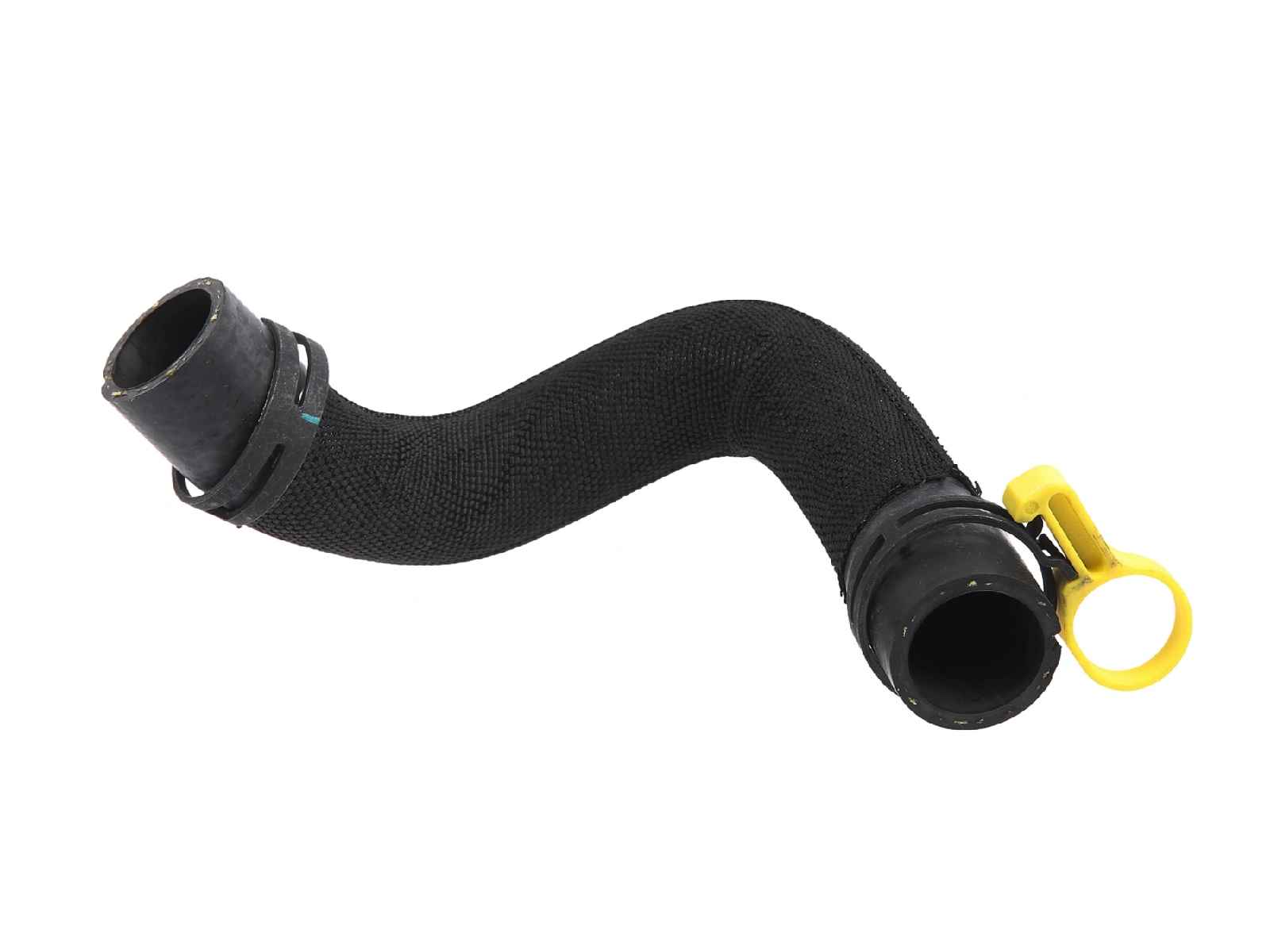
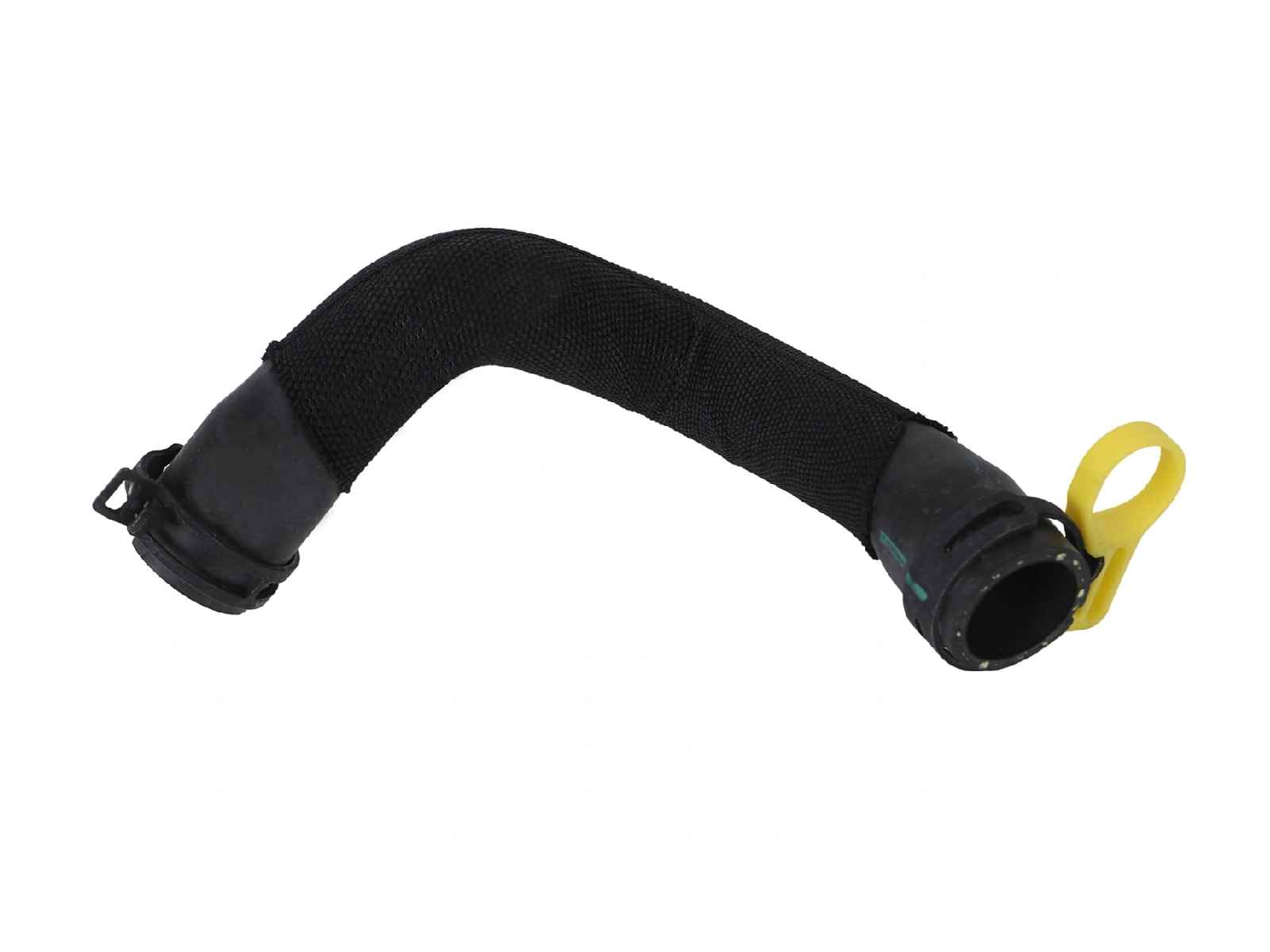
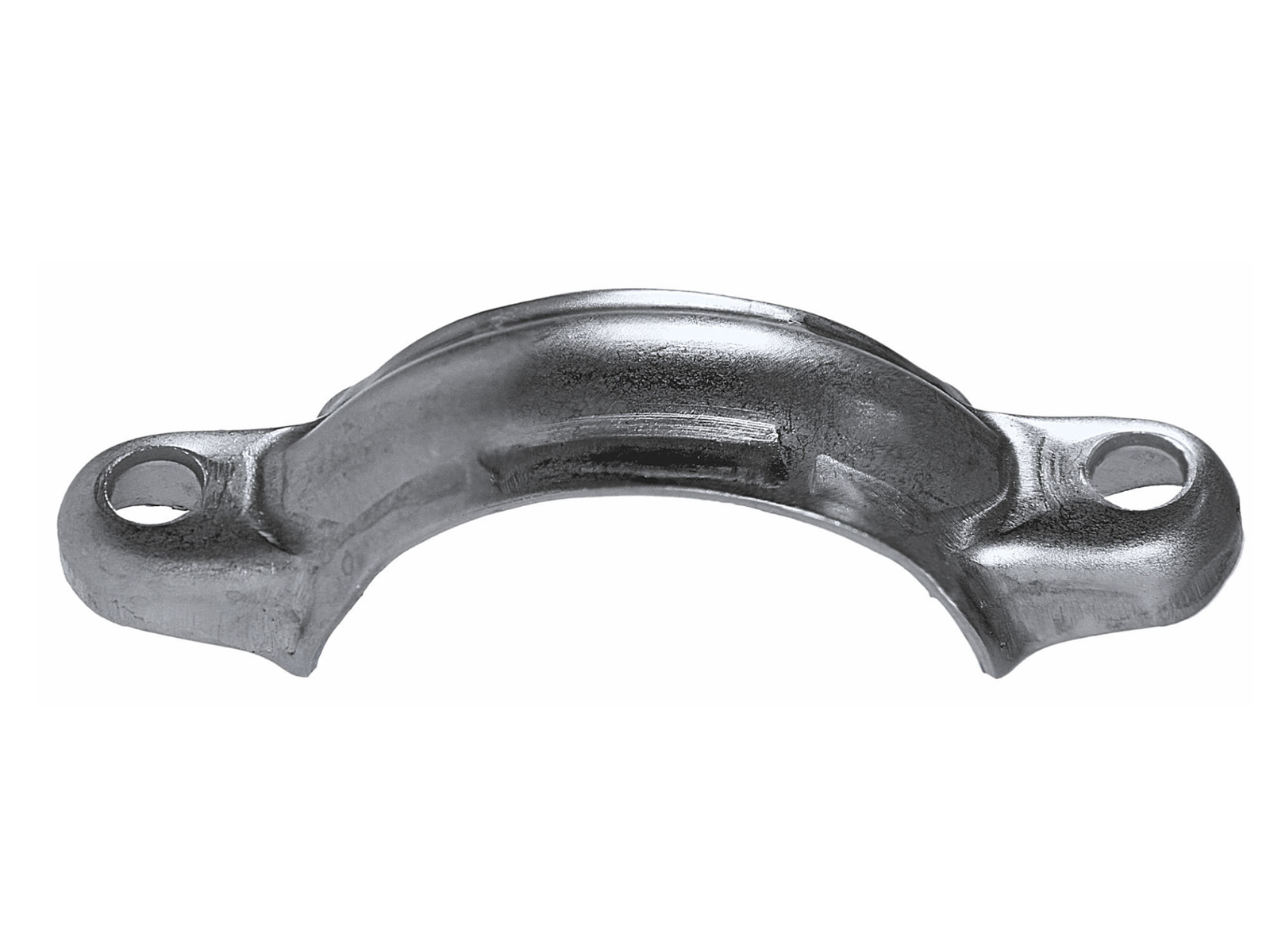
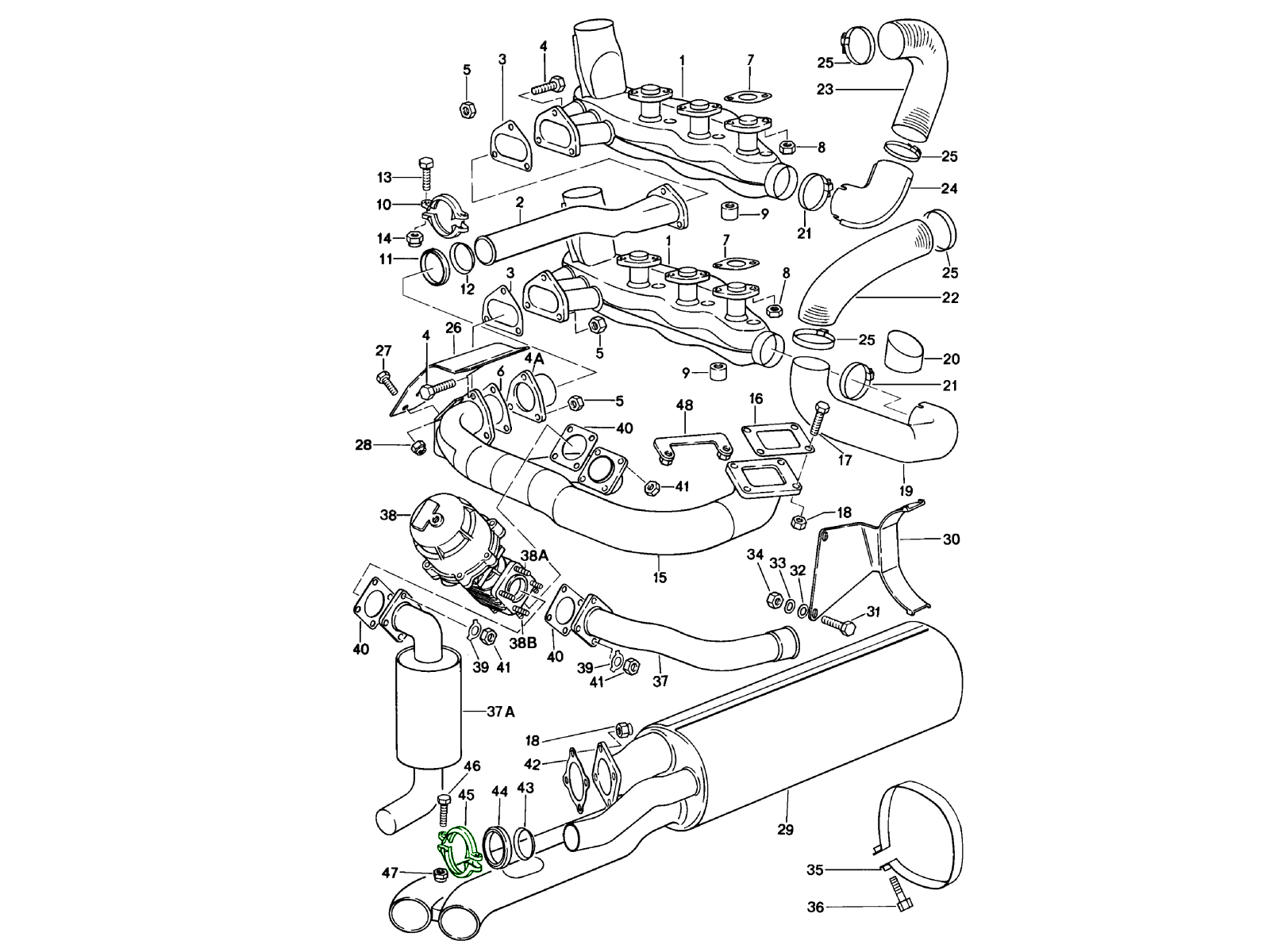
Porsche exhaust retaining clamp, half
This half-clamp is used to secure the connection between the wastegate exhaust pipe and muffler, helping maintain a stable and properly aligned exhaust joint.
This product is supplied as one half of the retaining clamp assembly. Two matching halves are typically required for a complete connection.
Fits:
Porsche 911 (930) Turbo 3.0L / 3.3L 1975 - 1982
Diagram ref no 14
Manufactured to Porsche's original specifications, it provides precise fitment and reliable fastening under the high temperatures and vibrations generated by the turbocharged exhaust system.
Functions
- Secure Connection: Holds the wastegate exhaust pipe firmly to the muffler.
- Exhaust Joint Support: Helps maintain a tight connection alongside the correct sealing gasket.
- Vibration Resistance: Reduces unwanted movement at the exhaust connection.
- Heat Resistance: Designed to withstand demanding exhaust operating temperatures.
- Original Fitment: Maintains factory-correct exhaust assembly and alignment.
Why Replace This Part?
Over time, exhaust retaining clamps can become corroded, weakened or damaged due to constant exposure to heat, moisture and vibration. A worn or loose clamp may compromise the exhaust connection, potentially causing gas leaks, rattling or excessive movement.
Replacing the damaged clamp with a genuine Porsche component helps restore secure exhaust fastening and maintain the original exhaust system configuration.
When to Replace This Part?
- Corrosion: Visible rust or deterioration affecting clamp strength.
- Loose Connection: Movement around the wastegate pipe-to-muffler joint.
- Exhaust Leaks: Escaping exhaust gases around the connection.
- Physical Damage: Cracked, bent or weakened clamp.
- Exhaust Repairs: During wastegate pipe or muffler replacement when the existing clamp is no longer serviceable.
Where Does It Fit on the Car?
Location: Rear exhaust system – wastegate pipe-to-muffler connection.
The retaining clamp is fitted at the joint connecting the wastegate exhaust discharge pipe to the muffler, within the rear-mounted exhaust assembly of the Porsche 911 Turbo (930).
It works together with the corresponding clamp half and sealing components to hold the exhaust connection securely in place.
Related reference numbers
Related, superseded, cross reference or alternative numbers for comparison.
93012313300
The product you are viewing cross references to these numbers
- Porsche 911 1975-1977 3.0L Turbo (930)
- Porsche 911 1978-1989 3.3L Turbo (930)
Shop Securely
12 Month Warranty
Worldwide Delivery


Monday-Friday: 8.30am - 5.30pm (GMT)
Saturday: Closed
Sunday: Closed